What Is Prescription Progesterone Cream Used For?
The reason for a progesterone cream depends on its exact formulation, and a prescription alone doesn’t show that it’s been shown to protect the uterine lining.
A clinician may prescribe progesterone as part of a menopause hormone plan, but “progesterone cream” doesn’t identify one standard product or prove what it’s meant to do. If you use estrogen and have a uterus, ask specifically whether this cream is intended to protect the uterine lining and what evidence supports that exact formulation. Evidence for oral progesterone capsules can’t automatically be applied to a cream. 2 4
First, find out what “progesterone cream” means
The word prescription tells you that a clinician prescribed the product. It doesn’t, by itself, tell you whether the specific cream is an FDA-approved product or a custom-compounded preparation. Compounded hormones are made for an individual prescription and are different from FDA-approved hormone products. Ask for the product name, its ingredients, and whether it is FDA-approved in that exact form. 3
This distinction matters because a progesterone capsule, a compounded cream, and a nonprescription cream aren’t interchangeable just because they contain or advertise progesterone. The evidence for one formulation doesn’t establish the dose, absorption, or effect of another.
If you also use estrogen, ask about uterine protection
For someone with a uterus using systemic estrogen, a key question is whether the prescribed progesterone is meant to reduce estrogen-related growth of the uterine lining. Progesterone acts on the endometrium, or uterine lining, and the FDA-approved oral progesterone product Prometrium is indicated to help prevent endometrial hyperplasia in certain postmenopausal women taking conjugated estrogen. That indication is for the capsule, not progesterone cream. 1 2
A small randomized crossover study tested one transdermal cream alongside conjugated estrogen. Twenty-six menopausal women completed both treatment periods, each lasting six months. The study found no hyperplasia in the biopsy samples, but its small size and short duration do not establish that creams generally provide reliable endometrial protection or that another cream will have the same effect. 4
So if the cream is part of an estrogen plan, ask: “Is this intended to protect my uterine lining, and what evidence supports this exact product and route?” Don’t assume that a cream offers the same protection as an oral product just because both contain progesterone.
If the goal is hot-flash relief
Menopause hormone therapy is individualized, and its benefits and risks vary with the type, dose, route, timing, and whether a progestogen is included. Treatment should be revisited periodically. 5 If the cream was recommended specifically for hot flashes, ask whether the expected benefit is based on evidence for this particular cream. An older North American Menopause Society position statement said there were few data supporting topical progesterone cream for hot flashes. 6
That doesn’t establish that every cream has the same effect, or that progesterone has no role in a hormone plan. It means the intended benefit should be clear rather than inferred from the ingredient name.
Get the details before you start
A useful conversation can stay focused on the product and the goal:
- What is the product’s exact name and formulation? Is it FDA-approved in this form or compounded?
- What is the specific reason you’re prescribing it: uterine-lining protection, another menopause-related goal, or something else?
- If I’m using estrogen and have a uterus, how will we assess whether this plan is providing the intended protection?
- If the goal is symptom relief, what change should I expect, and when will we review whether it’s helping?
- Is a nonprescription cream being discussed? If so, how is it different from the prescribed product, and is it intended to do the same job?
The most useful answer isn’t simply “progesterone is natural” or “it’s bioidentical.” It’s a clear explanation of the exact product, route, purpose, and follow-up plan.
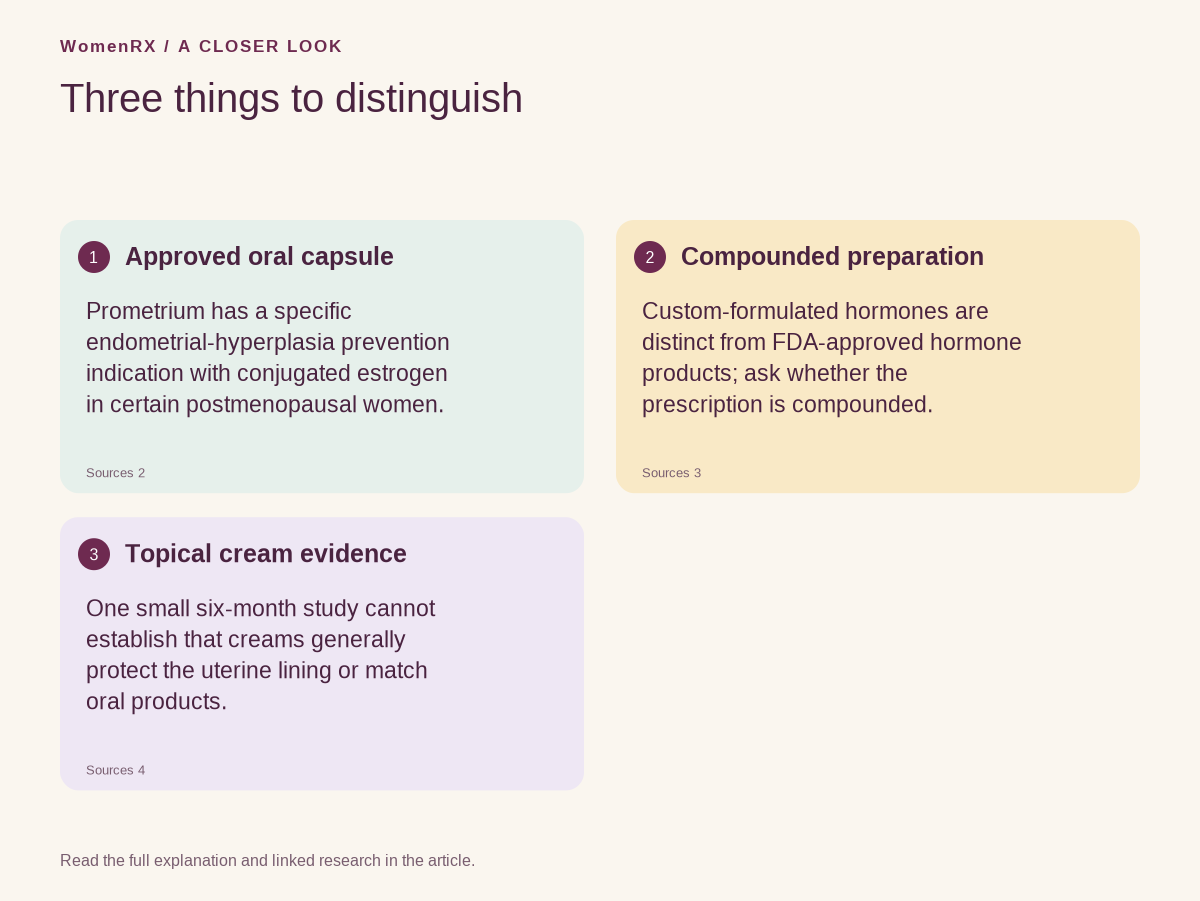
Three things to distinguish
Approved oral capsule: Prometrium has a specific endometrial-hyperplasia prevention indication with conjugated estrogen in certain postmenopausal women.2
Compounded preparation: Custom-formulated hormones are distinct from FDA-approved hormone products; ask whether the prescription is compounded.3
Topical cream evidence: One small six-month study cannot establish that creams generally protect the uterine lining or match oral products.4
Read the figure as text
The route and product identity determine which evidence applies. A finding about one formulation should not be treated as proof about another.- Approved oral capsule: Prometrium has a specific endometrial-hyperplasia prevention indication with conjugated estrogen in certain postmenopausal women.2
- Compounded preparation: Custom-formulated hormones are distinct from FDA-approved hormone products; ask whether the prescription is compounded.3
- Topical cream evidence: One small six-month study cannot establish that creams generally protect the uterine lining or match oral products.4
More questions, answered
Does a prescription progesterone cream protect the uterus when I use estrogen?
That depends on the exact product and evidence for that formulation. Oral Prometrium has a specific indication for preventing endometrial hyperplasia in certain women taking conjugated estrogen, but that capsule indication does not establish that a cream provides the same protection. Ask your prescriber about the exact cream and your plan. 2 4
Is compounded progesterone cream the same as an FDA-approved product?
No. Compounded hormones are custom-formulated preparations, distinct from FDA-approved hormone products. The product’s route and formulation matter, so ask whether your prescription is compounded and what evidence supports its intended use. 3
Sources you can check
- BIJUVA (ESTRADIOL AND PROGESTERONE) CAPSULE [MAYNE PHARMA] | US prescribing information and patient instructionsAccessed 2026-09-25Return to first citation
- PROMETRIUM (PROGESTERONE) CAPSULE [ACERTIS PHARMACEUTICALS, LLC] | US prescribing information and patient instructionsAccessed 2026-09-25Return to first citation
- The Clinical Utility of Compounded Bioidentical Hormone Therapy: A Review of Safety, Effectiveness, and UseNational Academies of Sciences, Engineering, and Medicine; Health and Medicine Division; Board on Health Sciences Policy; Committee on the Clinical Utility of Treating Patients wit... · 2020Return to first citation
- Transdermal progesterone cream as an alternative progestin in hormone therapy.Leonetti HB, Landes J, Steinberg D, Anasti JN. · Alternative therapies in health and medicine · 2005Return to first citation
- The 2022 hormone therapy position statement of The North American Menopause Society.“The 2022 Hormone Therapy Position Statement of The North American Menopause Society” Advisory Panel. · Menopause (New York, N.Y.) · 2022Return to first citation
- Treatment of menopause-associated vasomotor symptoms: position statement of The North American Menopause Society.North American Menopause Society. · Menopause (New York, N.Y.) · 2004Return to first citation