Progesterone: What It Does and When It Changes
Progesterone rises after ovulation, changes the uterine lining, and follows a different course if pregnancy begins.
Progesterone is a hormone produced by the ovaries, adrenal glands, and, during pregnancy, the placenta. In an ovulatory cycle, it rises after ovulation and changes the uterine lining in preparation for possible implantation. If pregnancy doesn’t occur, progesterone falls and the lining sheds. Prescription progesterone contains progesterone as its named ingredient; a medicine called a progestin may contain a different ingredient. 1 2 3
The change after ovulation
Progesterone’s most familiar pattern follows ovulation. Earlier in a menstrual cycle, progesterone is low while estrogen helps the uterine lining grow. After an egg is released, the emptied ovarian follicle becomes the corpus luteum and produces progesterone. The lining then shifts from growing to a secretory state: its cells and glands change in preparation for possible implantation. 3 4
Think of estrogen and progesterone as taking different parts in this sequence. Estrogen supports the lining’s growth; progesterone changes how that lining functions after ovulation. Progesterone acts by binding to receptors in cells, including cells in the reproductive tract. Receptors are also found in the breast and parts of the brain, so the hormone’s activity isn’t confined to the uterus. Some effects outside the reproductive system are still less fully understood. 1 3
What happens next depends on pregnancy
If pregnancy doesn’t occur, progesterone falls near the end of the cycle and the prepared uterine lining sheds as a period. If implantation occurs, a pregnancy hormone called hCG prompts the corpus luteum to keep producing progesterone. The placenta also produces progesterone during pregnancy. Progesterone helps support the uterine environment for implantation and early placental development, but it’s one part of a larger process, not a guarantee that pregnancy will occur. 3
This rise-and-fall pattern describes a cycle in which ovulation happens. It isn’t a fixed template for every cycle or every reproductive stage. The adrenal glands also produce progesterone, but the prominent post-ovulation rise described here comes from the corpus luteum. 1 3
The hormone and the medicine names
“Progesterone” names the hormone your body makes. It can also name the ingredient in a prescription product, such as progesterone capsules. Progestin is a term used for a category of hormone medicines; it doesn’t tell you that a product contains the progesterone molecule. For example, prescribing information describes medroxyprogesterone acetate as the progestin used with estrogen in one menopause hormone-therapy trial. That is a different named ingredient from progesterone capsules. 1 2
The distinction is useful when you read about hormone treatment. An explanation of what your own progesterone does during a cycle doesn’t establish that every prescribed progestin has the same effects as progesterone, or that different products can be used interchangeably. Look for the specific ingredient name when comparing them.
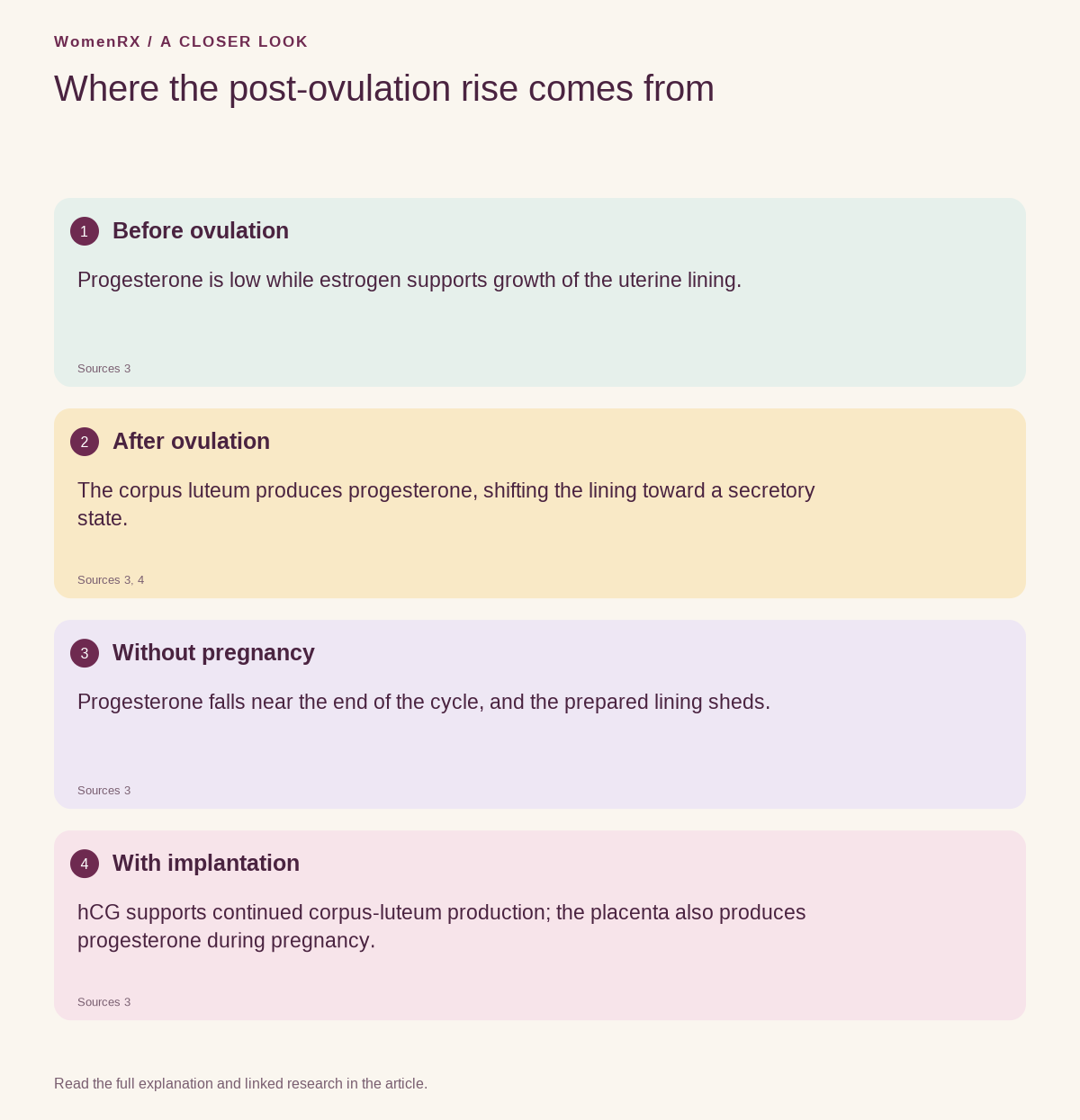
Where the post-ovulation rise comes from
Before ovulation: Progesterone is low while estrogen supports growth of the uterine lining.3
After ovulation: The corpus luteum produces progesterone, shifting the lining toward a secretory state.34
Without pregnancy: Progesterone falls near the end of the cycle, and the prepared lining sheds.3
With implantation: hCG supports continued corpus-luteum production; the placenta also produces progesterone during pregnancy.3
Read the figure as text
The ovarian source of progesterone changes after ovulation, with different outcomes depending on whether pregnancy begins.- Before ovulation: Progesterone is low while estrogen supports growth of the uterine lining.3
- After ovulation: The corpus luteum produces progesterone, shifting the lining toward a secretory state.34
- Without pregnancy: Progesterone falls near the end of the cycle, and the prepared lining sheds.3
- With implantation: hCG supports continued corpus-luteum production; the placenta also produces progesterone during pregnancy.3
Sources you can check
- BIJUVA (ESTRADIOL AND PROGESTERONE) CAPSULE [MAYNE PHARMA] | US prescribing information and patient instructionsAccessed 2026-09-25Return to first citation
- PROMETRIUM (PROGESTERONE) CAPSULE [ACERTIS PHARMACEUTICALS, LLC] | US prescribing information and patient instructionsAccessed 2026-09-25Return to first citation
- Progesterone signaling in cardio-renal physiology and pathophysiology.Nguyen J, Kriegel AJ. · Frontiers in endocrinology · 2026Return to first citation
- An Overview of the Impact of the Menstrual Cycle on Nutrient Metabolism: An Integrative Perspective.García-Montero C, de Castro-Martínez P, Liviu Boaru D, Ortega MA, Fraile-Martínez Ó. · Nutrients · 2026Return to first citation