When Progesterone Symptoms Might Be Intolerance or Allergy
What happens, and when it happens, helps separate a medicine side effect from a possible hypersensitivity reaction.
Yes. Symptoms that recur after progesterone or a progestin could be an unwanted drug effect, a reaction to a product ingredient, or progestogen hypersensitivity. Headache or nausea alone doesn’t establish an allergy. Recurrent hives or a rash warrant assessment. If your lips, tongue, or throat suddenly swell or you struggle to breathe, seek emergency care immediately. 1257
Start with the symptom, not the label
If you feel unwell each time you take progesterone, that pattern is worth taking seriously. But “intolerance” and “allergy” answer different questions. Intolerance is a useful everyday description when a treatment causes symptoms you can’t comfortably live with. It doesn’t say what caused them. Progestogen hypersensitivity refers to reactions linked to the body’s own progesterone or to a progesterone or progestin treatment. Reported presentations include dermatitis, hives, asthma, and anaphylaxis, although the published clinical evidence largely consists of case reports and small case series. 35
The first distinction is what the symptom looks like. For example, headache, dizziness, nausea, bloating, mood symptoms, and breast tenderness are reported adverse effects with oral progesterone treatment; they are not, on their own, proof of an immune reaction. In a trial described in the Prometrium prescribing information, postmenopausal women received cyclic Prometrium plus an estrogen or placebo. That comparison helps show which symptoms were reported during treatment, but it cannot tell whether an individual symptom came from progesterone, estrogen, or another cause. 2
A repeated outbreak of hives or dermatitis after exposure raises a different question. So do breathing symptoms or swelling. If your lips, tongue, or throat suddenly swell or you struggle to breathe, seek emergency care immediately rather than waiting for an appointment. 57 Other reactions still need evaluation rather than a self-diagnosis: progestogen hypersensitivity has varied presentations, and the timing and other possible triggers matter. Bijuva’s product information identifies angioedema as a reason not to use that particular product if it has caused the reaction. 15
Timing can point to two different exposures
There are two histories a clinician may explore. One starts with a product: symptoms appear in relation to starting or taking a particular progesterone or progestin medicine. Write down the exact product and what else you were taking at the time. If it’s a combined estrogen-and-progesterone treatment, a symptom after a dose doesn’t identify which ingredient caused it. Product ingredients matter too: Prometrium capsules contain peanut oil and are contraindicated for people with a peanut allergy. That warning is specific to Prometrium, not a reason to assume every progesterone product has the same ingredients. 125
The other history starts with a menstrual pattern. In people who ovulate, progesterone rises in the luteal phase, after ovulation and before a period. Progestogen hypersensitivity has been described with symptoms linked to that phase even without a prescribed progestogen. A recurring premenstrual rash, for example, is therefore relevant to mention, along with any hormone treatments. It isn’t diagnostic by itself. 346
These patterns shouldn’t be collapsed into one. If you’re postmenopausal and symptoms recur during the progesterone days of a cyclic hormone-therapy regimen, that is a pattern linked to the treatment schedule, not evidence of a monthly surge in your own progesterone. Symptoms throughout the month are less characteristic of a luteal-phase pattern, but they can still be relevant if you’re taking a medicine throughout the month. 234
What assessment can clarify
A useful account is more specific than “progesterone makes me sick.” Describe the symptom, when it began, how long it lasted, whether it happened again, and whether it involved a rash, hives, swelling, or breathing. Include the product name, whether it was taken alone or with estrogen, any known ingredient allergies, and, if you still have periods, where you were in your cycle. Photos can help show a visible rash that has faded by the time you’re seen. This history helps a clinician decide whether the concern is a tolerability problem, a possible reaction to a product ingredient, or suspected progestogen hypersensitivity. 1235
There isn’t a single standardized skin or laboratory test that settles progestogen hypersensitivity. A review of diagnostic methods describes differing skin-test techniques. A specialist may consider testing as part of an assessment, but a test result cannot replace the clinical history. 34
What happens next depends on that distinction. If hormone therapy causes recurring side effects, the prescriber can reassess the treatment rather than automatically calling it an allergy. Options may include changing the dose, the type of hormone therapy, or how it’s taken. Those are changes to discuss in the context of your whole regimen, not a reason to stop a prescribed component on your own. 8 If a product ingredient is the concern, the exact product matters: someone with a peanut allergy should not use peanut-oil-containing Prometrium, and the prescriber can assess a different product. 2 If the history suggests progestogen hypersensitivity, allergy evaluation can help guide decisions about further exposure. Its varied presentations and limited clinical evidence don’t support choosing a treatment from symptoms or cycle timing alone. 345
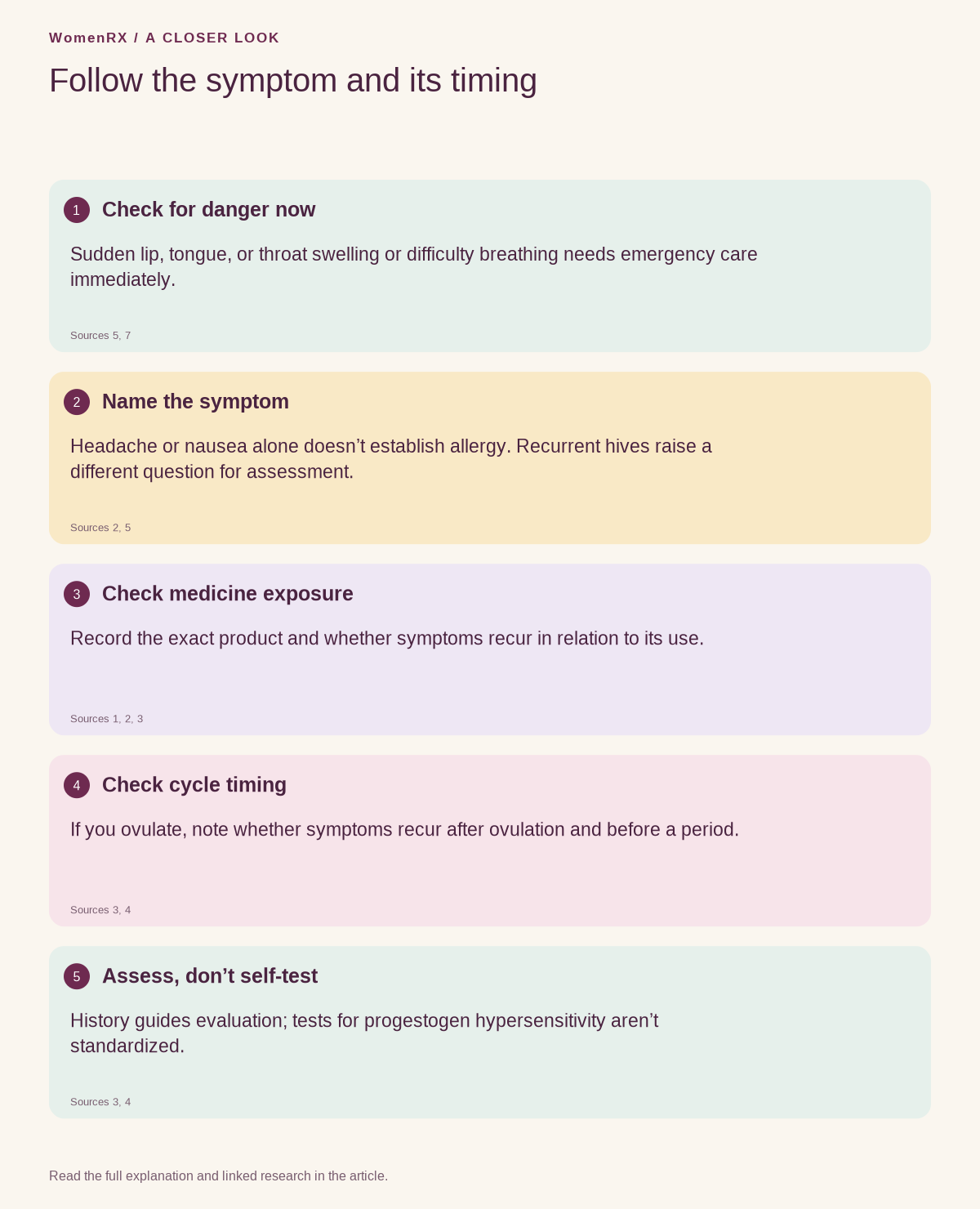
Follow the symptom and its timing
Check for danger now: Sudden lip, tongue, or throat swelling or difficulty breathing needs emergency care immediately.57
Name the symptom: Headache or nausea alone doesn’t establish allergy. Recurrent hives raise a different question for assessment.25
Check medicine exposure: Record the exact product and whether symptoms recur in relation to its use.123
Check cycle timing: If you ovulate, note whether symptoms recur after ovulation and before a period.34
Assess, don’t self-test: History guides evaluation; tests for progestogen hypersensitivity aren’t standardized.34
Read the figure as text
First separate symptoms needing emergency care from those that can be assessed through their pattern; neither timing nor symptom type diagnoses the cause.- Check for danger now: Sudden lip, tongue, or throat swelling or difficulty breathing needs emergency care immediately.57
- Name the symptom: Headache or nausea alone doesn’t establish allergy. Recurrent hives raise a different question for assessment.25
- Check medicine exposure: Record the exact product and whether symptoms recur in relation to its use.123
- Check cycle timing: If you ovulate, note whether symptoms recur after ovulation and before a period.34
- Assess, don’t self-test: History guides evaluation; tests for progestogen hypersensitivity aren’t standardized.34
More questions, answered
Can I react to my own progesterone if I’m not taking hormone therapy?
Yes. Progestogen hypersensitivity has been described with symptoms associated with the progesterone rise after ovulation, as well as after exposure to progesterone or progestins in medicines. A recurring cycle pattern is a clue for assessment, not a diagnosis. 356
Does a positive progesterone skin test confirm an allergy?
Not on its own. Diagnostic skin-testing methods for progestogen hypersensitivity aren’t standardized. Results need to be considered alongside symptoms and exposure history. 34
Sources you can check
- BIJUVA (ESTRADIOL AND PROGESTERONE) CAPSULE [MAYNE PHARMA] | US prescribing information and patient instructionsAccessed 2026-09-25Return to first citation
- PROMETRIUM (PROGESTERONE) CAPSULE [ACERTIS PHARMACEUTICALS, LLC] | US prescribing information and patient instructionsAccessed 2026-09-25Return to first citation
- Progestogen Hypersensitivity: An Evidence-Based Approach to Diagnosis and Management in Clinical Practice.Foer D, Buchheit KM. · Immunology and allergy clinics of North America · 2017Return to first citation
- Diagnostic tests for progestogen hypersensitivity.Alonso Bello CD, González Guzmán OP, Moncayo Coello CV, Rojo Gutiérrez MI, Castrejón Vázquez MI. · Frontiers in allergy · 2024Return to first citation
- Presentation and natural history of progestogen hypersensitivity.Foer D, Buchheit KM. · Annals of allergy, asthma & immunology : official publication of the American College of Allergy, Asthma, & Immunology · 2019Return to first citation
- Progestogen Hypersensitivity: Heterogeneous Manifestations with a Common Trigger.Buchheit KM, Bernstein JA. · The journal of allergy and clinical immunology. In practice · 2017Return to first citation
- Anaphylaxis - NHSAccessed 2026-09-25Return to first citation
- Side effects of hormone replacement therapy (HRT) - NHSAccessed 2026-09-26Return to first citation