How Do Progesterone Creams Differ, and What Does the Evidence Say?
To compare progesterone creams, check the ingredient, how the product is made, where it’s applied, and what it has actually been studied to do.
“Progesterone cream” isn’t one standard formulation. A compounded skin cream, a manufactured skin cream, and a vaginal preparation may have different ingredients and absorption, so findings for one can’t be assumed to apply to another. A review of three trials in postmenopausal women did not find overall support for progesterone creams to relieve hot flashes and night sweats. 234
Start with what’s in it and where it goes
The word cream describes a texture, not a route of treatment. Check the named active ingredient and whether the directions say to apply the product to skin or use it vaginally. Then check whether it’s a manufactured product or a preparation compounded for an individual or a study. Those details matter more than a shared name: research on a vaginal progesterone preparation cannot tell you how a cream rubbed onto skin will behave. 34
A label’s stated concentration is another piece of the description, not a measure of how much progesterone reaches your bloodstream or uterine lining. A review of skin-applied progesterone cream describes its pharmacokinetics as complex and the research findings as inconsistent. To judge an absorption claim, look for research on the specific formulation and application route, not just the amount printed on the container. 3
What the menopause-symptom trials found
A review identified three placebo-controlled randomized trials of bioidentical progesterone cream in postmenopausal women with hot flashes or night sweats. One trial used a cream compounded specifically for that study and found more symptom relief than placebo. Two trials using manufactured creams found no advantage over placebo. Taken together, the reviewers concluded that the trials did not support progesterone cream as a treatment for these symptoms. 2
That’s a distinction worth keeping intact. The positive trial doesn’t show that compounded creams are generally better: the trials did not directly compare a compounded cream with a manufactured one. Nor does it show that a different compounded recipe will work the same way. These were trials in postmenopausal women, so they also don’t establish how well a cream treats symptoms during perimenopause. 2
Don’t borrow results from another route
You may also encounter progesterone products that aren’t skin creams. US product information for oral micronized progesterone capsules describes absorption after the capsules are swallowed; those measurements cannot be used to calculate absorption from a cream. 1 In a study of a particular vaginal cream suppository, its formulation showed a higher rate and extent of absorption than the hard-fat vaginal suppository used for comparison. That result applies to the preparations studied, not to skin-applied creams or to relief of menopause symptoms. 4
If you use estrogen and have a uterus, there’s a separate question from symptom relief: what is intended to protect the uterine lining? The cream trials reviewed for hot flashes and night sweats do not establish that a progesterone cream serves that purpose. Before treating a cream as a substitute for the progesterone in your estrogen regimen, ask the prescriber managing that regimen whether the specific product and route have evidence for uterine-lining protection. 23
A practical way to compare two products is to write down four things for each: its active ingredient, how it’s prepared, where it’s applied, and what outcome you want from it. A study measuring absorption answers a different question from a trial measuring hot flashes. Neither result, by itself, answers whether the product protects the uterine lining. 234
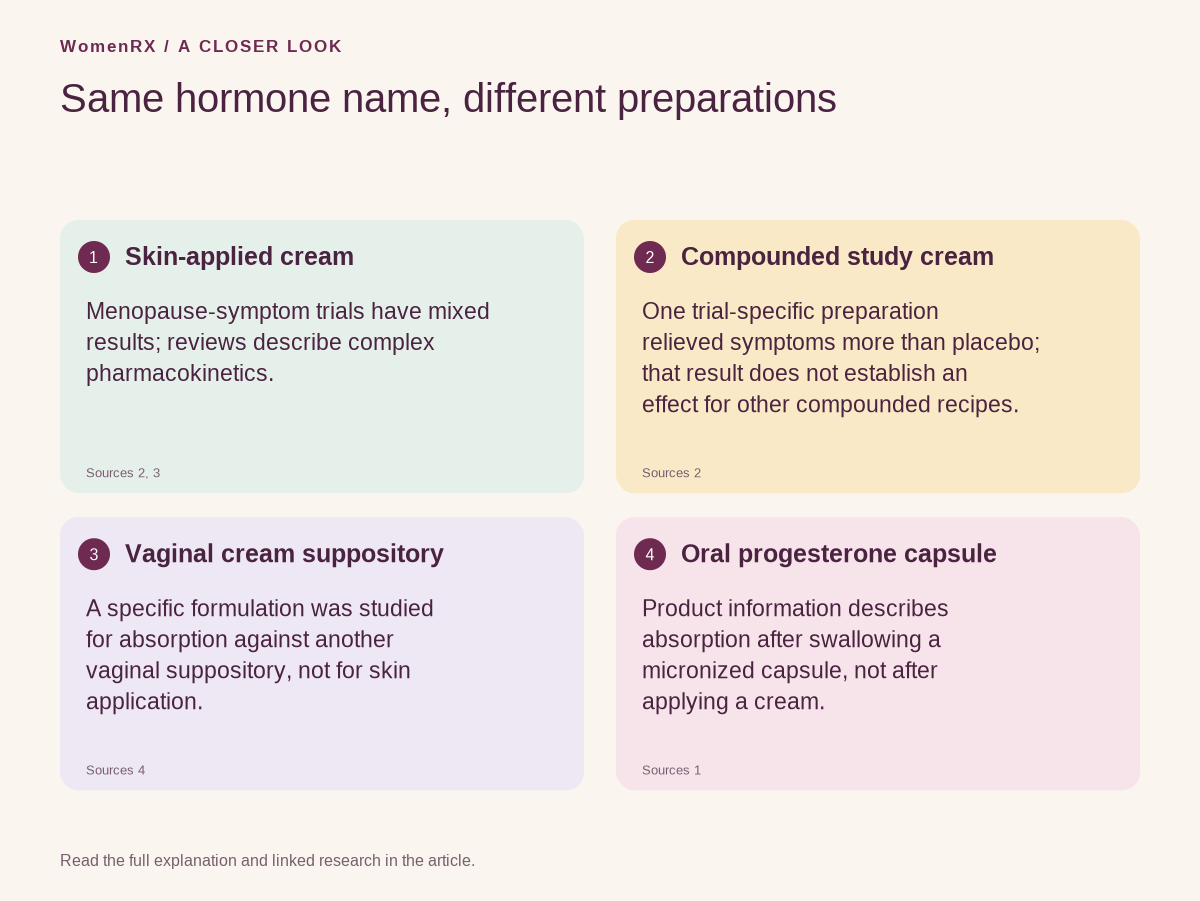
Same hormone name, different preparations
Skin-applied cream: Menopause-symptom trials have mixed results; reviews describe complex pharmacokinetics.23
Compounded study cream: One trial-specific preparation relieved symptoms more than placebo; that result does not establish an effect for other compounded recipes.2
Vaginal cream suppository: A specific formulation was studied for absorption against another vaginal suppository, not for skin application.4
Oral progesterone capsule: Product information describes absorption after swallowing a micronized capsule, not after applying a cream.1
Read the figure as text
Compare where each product goes and what its research can answer. These categories are not interchangeable.- Skin-applied cream: Menopause-symptom trials have mixed results; reviews describe complex pharmacokinetics.23
- Compounded study cream: One trial-specific preparation relieved symptoms more than placebo; that result does not establish an effect for other compounded recipes.2
- Vaginal cream suppository: A specific formulation was studied for absorption against another vaginal suppository, not for skin application.4
- Oral progesterone capsule: Product information describes absorption after swallowing a micronized capsule, not after applying a cream.1
More questions, answered
Does a higher percentage on the label mean better absorption?
Not by itself. The percentage identifies a product’s stated concentration, while absorption must be evaluated for its formulation and route. Reviews describe the pharmacokinetics of skin-applied progesterone cream as complex and the findings as inconsistent. 3
Sources you can check
- PROMETRIUM (PROGESTERONE) CAPSULE [ACERTIS PHARMACEUTICALS, LLC] | US prescribing information and patient instructionsAccessed 2026-09-25Return to first citation
- Bioidentical progesterone cream for menopause-related vasomotor symptoms: is it effective?Whelan AM, Jurgens TM, Trinacty M. · The Annals of pharmacotherapy · 2013Return to first citation
- Transdermal natural progesterone cream for postmenopausal women: inconsistent data and complex pharmacokinetics.Elshafie MA, Ewies AA. · Journal of obstetrics and gynaecology : the journal of the Institute of Obstetrics and Gynaecology · 2007Return to first citation
- Rapidly disintegrating vagina retentive cream suppositories of progesterone: development, patient satisfaction and in vitro/in vivo studies.Bendas ER, Basalious EB. · Pharmaceutical development and technology · 2016Return to first citation