Should Postmenopausal People Use Progesterone Cream?
Progesterone is usually considered after menopause because of the uterus and the type of estrogen therapy being used, not simply because menopause has occurred.
Not everyone needs progesterone after menopause. The key question is whether you have a uterus and use systemic estrogen: estrogen can stimulate the uterine lining, so a progestogen is generally included for protection. A skin-applied progesterone cream shouldn’t be assumed to provide that protection; evidence for other progesterone forms doesn’t establish that a cream is adequate. 2
Start with two questions: uterus and estrogen
Progesterone isn’t a routine requirement just because you’re postmenopausal. The clearest reason to consider it is having a uterus while using systemic estrogen, such as estrogen prescribed for symptoms like hot flashes. Estrogen can stimulate the lining of the uterus. Adding a progestogen helps counter that effect and reduce the risk of endometrial overgrowth. 2
If you’ve had a hysterectomy, protecting the uterine lining isn’t the reason to use progesterone. The question then becomes whether there’s another specific reason to take it. If you still have your uterus, ask whether your estrogen is systemic or intended for local vaginal symptoms. Those are different treatment situations; don’t assume the answer about progesterone is the same for every estrogen product.
Why a cream isn’t automatically equivalent
“Progesterone” describes a hormone, not proof that every product or route works the same way. A review of studies in people using estrogen examined endometrial protection with options including an intrauterine levonorgestrel device and oral or vaginal progesterone. It found evidence supporting those approaches, but that does not establish that a progesterone cream applied to the skin provides reliable protection for your uterine lining. 2
That distinction matters because feeling well, or having a hormone level measured, can’t by itself confirm that the uterine lining is protected. A 2025 review notes that hormone measurements generally don’t guide care for people taking hormone therapy; symptoms and shared decision-making are more useful guides. 3
If a cream is being suggested, ask about the exact product and whether that formulation has evidence for protecting the uterine lining with your specific estrogen regimen. Don’t assume that a cream is interchangeable with a prescribed oral, vaginal, or intrauterine option simply because each involves a progestogen.
Choose the regimen around the reason for treatment
Progesterone decisions are part of a broader hormone-therapy discussion, not a one-size-fits-all menopause rule. The North American Menopause Society says hormone-therapy risks vary by factors including type, dose, duration, route, timing, and whether a progestogen is used. It recommends individualizing treatment and periodically reviewing its benefits and risks. 1
A useful conversation is specific: “I still have my uterus, and I use this estrogen product. What is protecting my uterine lining, and how do we know this progesterone form is appropriate?” If you don’t have a uterus, ask what separate treatment goal progesterone is meant to address. Those questions help keep the decision focused on your situation rather than on a blanket claim that everyone after menopause needs progesterone, or that any cream will do.
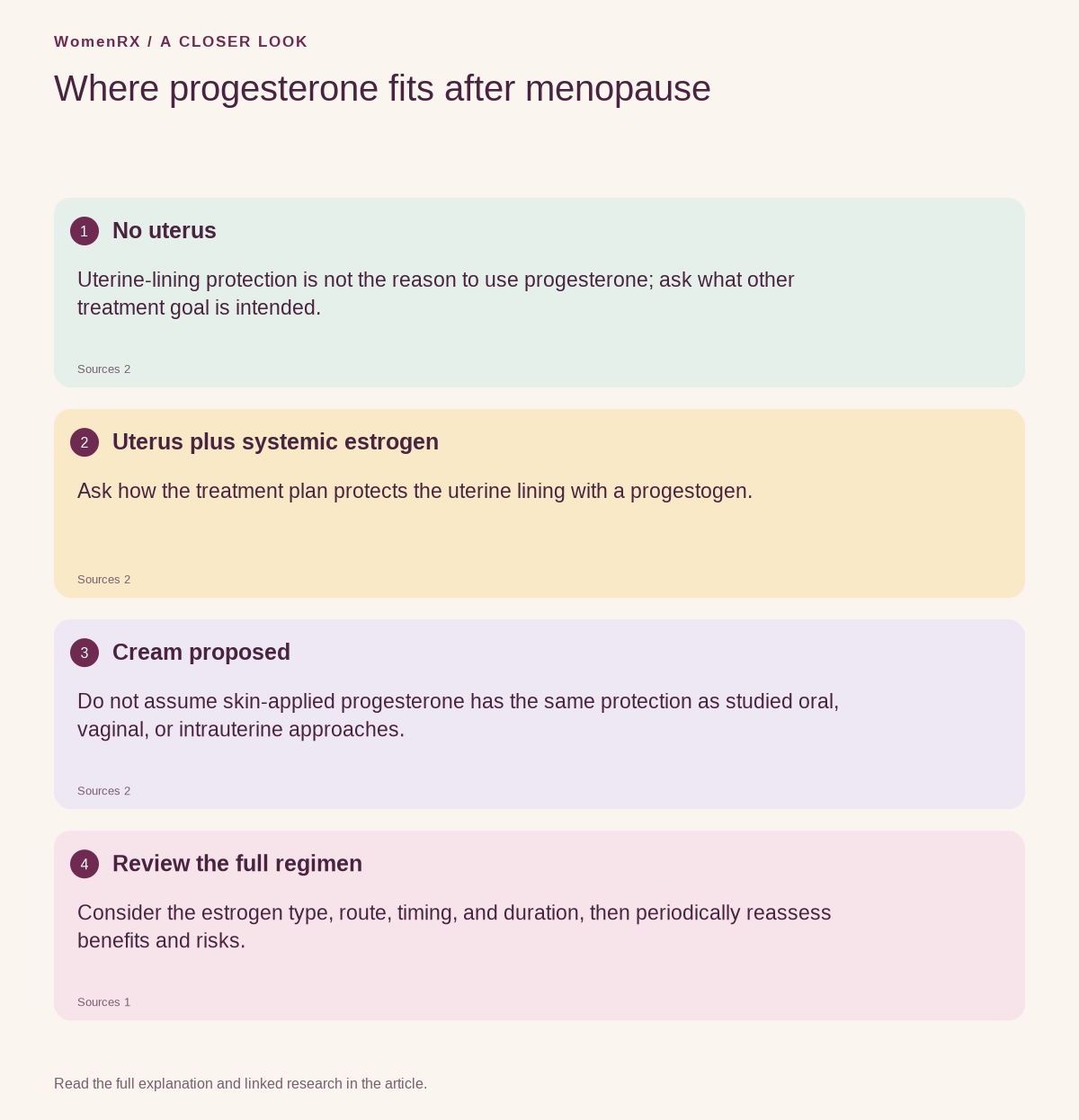
Where progesterone fits after menopause
No uterus: Uterine-lining protection is not the reason to use progesterone; ask what other treatment goal is intended.2
Uterus plus systemic estrogen: Ask how the treatment plan protects the uterine lining with a progestogen.2
Cream proposed: Do not assume skin-applied progesterone has the same protection as studied oral, vaginal, or intrauterine approaches.2
Review the full regimen: Consider the estrogen type, route, timing, and duration, then periodically reassess benefits and risks.1
Read the figure as text
The reason for considering progesterone depends first on uterus status and then on the estrogen treatment and product being considered.- No uterus: Uterine-lining protection is not the reason to use progesterone; ask what other treatment goal is intended.2
- Uterus plus systemic estrogen: Ask how the treatment plan protects the uterine lining with a progestogen.2
- Cream proposed: Do not assume skin-applied progesterone has the same protection as studied oral, vaginal, or intrauterine approaches.2
- Review the full regimen: Consider the estrogen type, route, timing, and duration, then periodically reassess benefits and risks.1
More questions, answered
Does having a uterus change the progesterone question?
Yes. If you have a uterus and use systemic estrogen, protection of the uterine lining is a central reason to include a progestogen. Without a uterus, that particular purpose does not apply. 2
Can a progesterone cream be assumed to protect the uterine lining?
No. Evidence about other progesterone forms does not establish that a skin-applied cream provides adequate endometrial protection. Ask about evidence for the exact product and your estrogen regimen. 2
Sources you can check
- The 2022 hormone therapy position statement of The North American Menopause Society.“The 2022 Hormone Therapy Position Statement of The North American Menopause Society” Advisory Panel. · Menopause (New York, N.Y.) · 2022Return to first citation
- Benefits of Levonorgestrel Intrauterine Device Use vs. Oral or Transdermal Progesterone for Postmenopausal Women Using Estrogen Containing Hormone Therapy.Clark K, Westberg SM. · Innovations in pharmacy · 2019Return to first citation
- A Comprehensive Review of Estradiol, Progesterone, Luteinizing Hormone, and Follicle-Stimulating Hormone in the Context of Laboratory Medicine to Support Women's Health.Greene DN, Ahmed SB, Daccarett S, Kling JM, Lorey TS, Rytz CL, Smock KJ, Winston-McPherson G. · Clinical chemistry · 2025Return to first citation