Do Estrogen Face Creams Have Evidence for Skin Changes?
A few small studies suggest possible changes in postmenopausal facial skin, but they don’t establish long-term benefit or safety for the many products sold as estrogen creams.
There is some direct research in postmenopausal women: one small trial measured increased facial collagen after topical estradiol, and a pilot study reported improvements in several skin appearance measures with a different estrogen-like ingredient. These findings are preliminary, and they don’t establish that facial estrogen creams are interchangeable, safe long term, or appropriate for you. Ask what exact ingredient and formulation were studied and what is known about absorption. 3 4

What the facial studies actually found
There is a reason estrogen is studied in skin: postmenopausal skin changes can include dryness, thinning, and loss of elasticity, and estrogen signaling is involved in skin biology. But a biological explanation isn’t the same as proof that a particular cream will produce a noticeable or lasting cosmetic benefit. 5 6
One randomized, double-blind trial enrolled 30 postmenopausal women, ages 45 to 55, who weren’t using systemic hormone therapy. Participants used either topical estrogen or genistein, a soy-derived compound, for 24 weeks. Researchers measured collagen in facial skin biopsies and reported increases in type I and type III collagen in both groups; the estrogen group had a greater increase than the genistein group. This is evidence of a change in a tissue measure, not proof of a particular improvement in wrinkles, firmness, or how someone feels about her appearance. 3
A separate double-blind pilot study tested methyl estradiolpropanoate, or MEP, in estrogen-deficient women. It reported improvements from baseline in dryness, laxity, atrophy, and dullness after 14 weeks compared with the vehicle. MEP is not the same ingredient as estradiol. The study’s abstract describes it as an estrogen-like compound that is metabolized in skin, but one pilot study can’t establish long-term safety or show that other facial products behave the same way. 4
Why “estrogen cream” isn’t one treatment
The evidence concerns specific ingredients and formulations, used in particular study settings. It doesn’t tell you that a facial product containing one form of estrogen has the same absorption, effects, or risks as another product. Nor does it make facial application equivalent to prescribed vaginal estrogen or systemic hormone therapy.
Those routes serve different purposes. Menopause guidance discusses systemic hormone therapy for symptoms such as hot flashes and vaginal estrogen for certain genitourinary symptoms; it does not establish facial estrogen as a recommended treatment for cosmetic skin changes. The benefits and risks of hormone therapy can vary with factors such as type, dose, route, timing, and whether a progestogen is used. 1 2
That distinction matters if you already use hormone therapy, have been offered a prescription cream, or are considering a product marketed as cosmetic. A product’s label or “hormone-like” language doesn’t answer how much is absorbed through facial skin or whether the research applies to that exact formulation.
Questions to take to your appointment
Before using an estrogen-containing or estrogen-like product on your face, bring the package or ingredient list and ask:
- What is the active ingredient, and is it the same one used in the facial study?
- Was this exact formulation studied on facial skin, or is the evidence from a different ingredient or route?
- What outcomes were measured: skin appearance, a biopsy finding, or both?
- What is known about absorption and longer-term safety with facial use?
- How does this fit with my personal health history and any hormone treatment I already use?
A dermatologist can help compare the product’s claims with the skin evidence; a menopause clinician can put hormone-related questions in the context of your overall treatment. If your main concern is dryness, texture, or wrinkles, it’s also reasonable to ask about options with evidence for that specific concern that don’t involve applying estrogen.
The practical takeaway
Topical estrogen has been studied on postmenopausal facial skin, so the evidence isn’t zero. But it is limited: one small trial focused on biopsy-measured collagen, and a pilot study tested a distinct estrogen-like ingredient over a relatively short period. Neither establishes the long-term safety or benefit of facial estrogen creams as a broad product category. 3 4
What facial estrogen studies measured
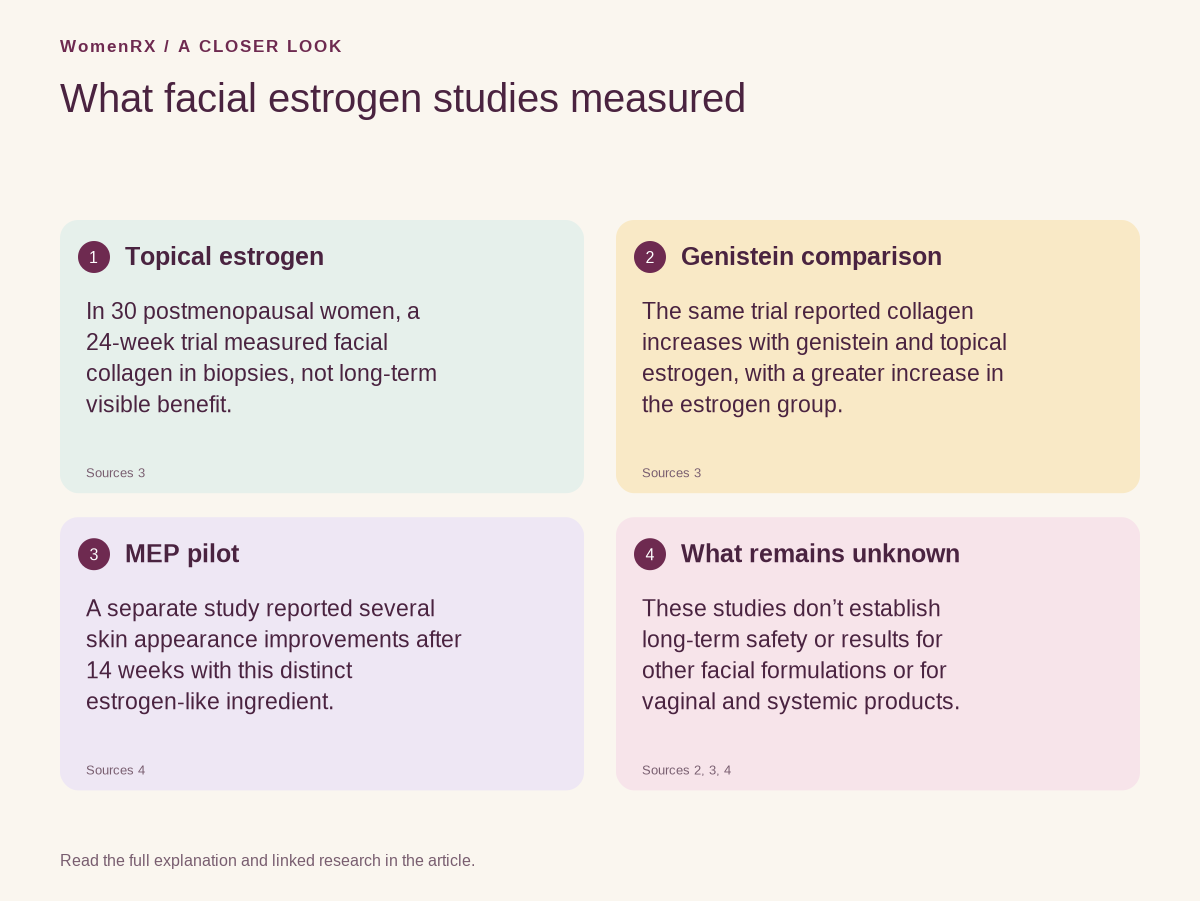
Topical estrogen: In 30 postmenopausal women, a 24-week trial measured facial collagen in biopsies, not long-term visible benefit.3
Genistein comparison: The same trial reported collagen increases with genistein and topical estrogen, with a greater increase in the estrogen group.3
MEP pilot: A separate study reported several skin appearance improvements after 14 weeks with this distinct estrogen-like ingredient.4
What remains unknown: These studies don’t establish long-term safety or results for other facial formulations or for vaginal and systemic products.234
Read the figure as text
The direct facial studies tested different ingredients and outcomes. Their findings shouldn’t be treated as evidence for every product marketed as an estrogen cream.- Topical estrogen: In 30 postmenopausal women, a 24-week trial measured facial collagen in biopsies, not long-term visible benefit.3
- Genistein comparison: The same trial reported collagen increases with genistein and topical estrogen, with a greater increase in the estrogen group.3
- MEP pilot: A separate study reported several skin appearance improvements after 14 weeks with this distinct estrogen-like ingredient.4
- What remains unknown: These studies don’t establish long-term safety or results for other facial formulations or for vaginal and systemic products.234
More questions, answered
Does research on vaginal estrogen tell us whether facial estrogen is safe?
No. Vaginal and facial application are different routes, and evidence for one doesn’t establish effects or safety for the other. Menopause guidance addresses vaginal estrogen for genitourinary symptoms, not facial skin treatment. 2
Did the facial studies show fewer wrinkles?
The collagen trial measured collagen in skin biopsies. The MEP pilot reported changes in dryness, laxity, atrophy, and dullness. Those findings are not the same as establishing lasting wrinkle reduction across facial estrogen products. 3 4
Sources you can check
- Recommendations | Menopause: identification and management | Guidance | NICEAccessed 2026-09-25Return to first citation
- The 2022 hormone therapy position statement of The North American Menopause Society.“The 2022 Hormone Therapy Position Statement of The North American Menopause Society” Advisory Panel. · Menopause (New York, N.Y.) · 2022Return to first citation
- Collagen concentration on the facial skin of postmenopausal women after topical treatment with estradiol and genistein: a randomized double-blind controlled trial.Silva LA, Ferraz Carbonel AA, de Moraes ARB, Simões RS, Sasso GRDS, Goes L, Nunes W, Simões MJ, Patriarca MT. · Gynecological endocrinology : the official journal of the International Society of Gynecological Endocrinology · 2017Return to first citation
- A Double-Blind Randomized Pilot Study Evaluating the Safety and Efficacy of Topical MEP in the Facial Appearance Improvement of Estrogen Deficient FemalesDraelos ZD. · Journal of drugs in dermatology : JDD · 2018Return to first citation
- Targeting estrogen signaling and biosynthesis for aged skin repair.Zomer HD, Cooke PS. · Frontiers in physiology · 2023Return to first citation
- Estrogen-deficient skin: The role of topical therapy.Rzepecki AK, Murase JE, Juran R, Fabi SG, McLellan BN. · International journal of women's dermatology · 2019Return to first citation