Estradiol Face Cream: What Skin Evidence and Safety Show
Estradiol can help with certain menopause symptoms, but that doesn’t show that a facial cream improves skin or stays only where you apply it.
Estradiol is an established treatment for certain menopause symptoms, but that doesn’t establish a benefit for facial dryness, wrinkles, or firmness. A short study found blood hormone changes with one transdermal gel, not a facial cream. Since estrogen can be absorbed through skin, facial use can’t be assumed to stay local; the absorption and risks of a particular facial product aren’t established by these findings. 2 3 1
Menopause treatment evidence isn’t facial skin evidence
Estradiol hormone therapy is used for certain menopause concerns, including hot flashes and genitourinary symptoms. Those established uses don’t show that applying estradiol to the face improves dryness, fine lines, texture, or firmness. And a skin change during or after menopause doesn’t, by itself, show that estrogen loss is the cause. 2
It helps to separate three questions: Does the specific product improve the facial concern you have? How much estradiol enters the bloodstream when it’s used on the face? And what might that exposure mean for your personal risks? Evidence about menopause treatment generally can’t answer all three.
“Topical” doesn’t necessarily mean local
Estradiol can be absorbed through skin. In a 14-day study of ten postmenopausal women, one transdermal estradiol gel produced measurable blood estradiol levels and changes in hormone markers. That shows that this skin-applied gel can have effects beyond the application site. It does not tell us how much estradiol a facial cream would deliver, whether it would improve facial skin, or whether another formulation would behave similarly. 3
Formulation and application site matter. The US prescribing information for Estrace vaginal cream describes estrogen absorption through skin and mucous membranes, but it concerns a specific vaginal product. It doesn’t establish absorption from a cream applied to the face. A transdermal gel and a facial cream are both applied to skin, but differences in formulation, application site, amount used, and intended purpose mean results for one product can’t establish benefit or absorption for the other. 1 3
Why product-specific evidence matters for risk
For hormone therapy, risks vary with the product, dose, duration, route, timing, and whether a progestogen is used. The North American Menopause Society describes a less favorable benefit-risk balance for starting hormone therapy after age 60 or more than ten years after menopause, partly because absolute risks of coronary heart disease, stroke, blood clots, and dementia are greater in those groups. Those statements concern hormone therapy overall. They don’t calculate the risks of applying estradiol to the face. 2
For a facial product, the important unanswered question is whether it causes meaningful systemic exposure, and how much. Without evidence for the exact formulation and way it’s used, it isn’t possible to say that facial application is risk-free or to directly apply risk estimates from another estrogen product. That uncertainty matters more when use is regular or long-term.
Ask what the claim is actually based on
Before considering a facial estradiol product, get specific about the product and the result you want:
- Is this exact product intended for facial use, or would its use be off-label?
- Has this formulation been studied on facial skin for the concern you want to address?
- What is known about absorption when this product is applied to the face?
- How would your age, time since menopause, health history, and other hormone treatments affect the discussion?
- If some estradiol enters the bloodstream, how would that change the benefit-risk conversation for you?
If the explanation relies on evidence for hot flashes, vaginal estrogen, or a transdermal gel, ask how that evidence applies to this particular facial product. They share a broad mode of application to skin or mucous membranes, but their formulations, application sites, amounts, and intended uses differ. Results for one don’t establish facial skin benefit or product-specific absorption for another. 1 2 3
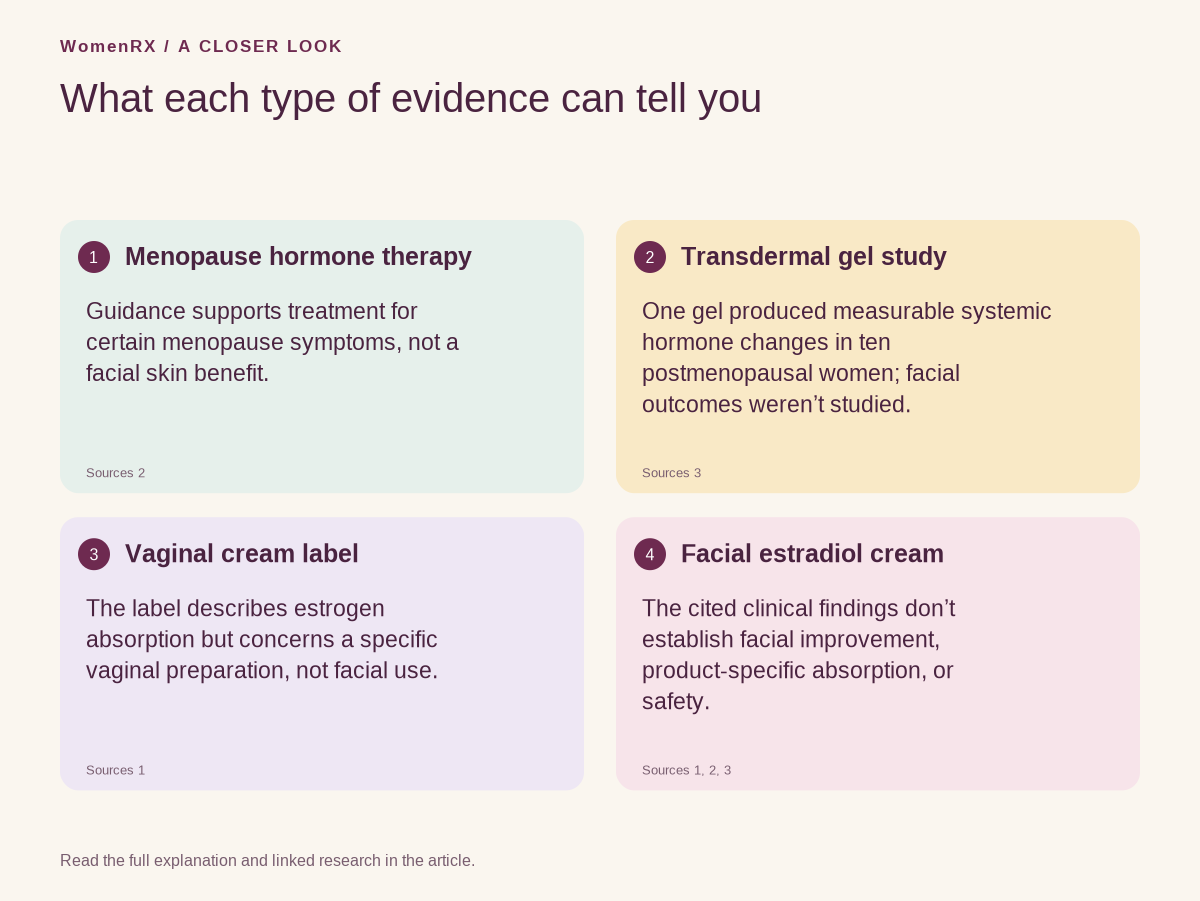
What each type of evidence can tell you
Menopause hormone therapy: Guidance supports treatment for certain menopause symptoms, not a facial skin benefit.2
Transdermal gel study: One gel produced measurable systemic hormone changes in ten postmenopausal women; facial outcomes weren’t studied.3
Vaginal cream label: The label describes estrogen absorption but concerns a specific vaginal preparation, not facial use.1
Facial estradiol cream: The cited clinical findings don’t establish facial improvement, product-specific absorption, or safety.123
Read the figure as text
These distinctions show why evidence for menopause treatment or another estrogen formulation can’t establish facial benefit or product-specific absorption.- Menopause hormone therapy: Guidance supports treatment for certain menopause symptoms, not a facial skin benefit.2
- Transdermal gel study: One gel produced measurable systemic hormone changes in ten postmenopausal women; facial outcomes weren’t studied.3
- Vaginal cream label: The label describes estrogen absorption but concerns a specific vaginal preparation, not facial use.1
- Facial estradiol cream: The cited clinical findings don’t establish facial improvement, product-specific absorption, or safety.123
Sources you can check
- ESTRACE (ESTRADIOL) CREAM [ALLERGAN, INC.] | US prescribing information and patient instructionsAccessed 2026-09-25Return to first citation
- The 2022 hormone therapy position statement of The North American Menopause Society.“The 2022 Hormone Therapy Position Statement of The North American Menopause Society” Advisory Panel. · Menopause (New York, N.Y.) · 2022Return to first citation
- Study on the Pharmacokinetics and Pharmacodynamics of Transdermal Estradiol Gel Administered Repeatedly in Postmenopausal Women.Sirviö J, Ahtola-Sätilä T, Kirjavainen M, Rytilä P. · Drugs in R&D · 2026Return to first citation