How to Apply Tretinoin Cream Without Overdoing It
A light layer on clean, dry skin is the starting point; your prescription directions and your skin’s response guide the rest.
For the acne creams described in US prescribing information, tretinoin is applied in a light layer over the affected area, usually before bed. Wash gently and let your skin dry first. Keep the cream away from your eyes, mouth, and nose creases. Follow your own prescription directions, and stop and contact your prescriber if irritation is severe or persistent. 1 2
Start with your prescription directions
Tretinoin creams come in different strengths, and your prescription label and prescriber’s instructions take priority. The US acne cream labels cited here describe applying tretinoin once before bed, using enough to cover the affected area lightly. Think of it as a thin layer across the acne-affected skin, not a thick coating or a dab on each spot. If you’re unsure which areas you were told to treat, ask your pharmacist or prescriber before applying it elsewhere. 1 2
The application steps
- Wash gently. Use a mild, non-medicated cleanser. Scrubbing or washing repeatedly can add irritation rather than help acne. 1 2
- Let your skin dry. The patient instructions for these creams say to pat skin dry and wait 20 to 30 minutes after washing before applying tretinoin. Check the directions for your own cream. 1 2
- Apply a light layer where directed. Keep the cream away from your eyes, mouth, the creases beside your nose, and other mucous membranes. Don’t use it on other areas or skin concerns unless that’s what your prescriber directed. 1 2
- Protect treated skin outdoors. The labels advise minimizing sunlight and sunlamp exposure. When sun exposure can’t be avoided, they recommend sunscreen and protective clothing over treated areas. Don’t apply tretinoin to sunburned skin until it has fully recovered. Wind and cold may also make treated skin more uncomfortable. 1 2
Where does moisturizer fit?
You don’t have to guess at the order of every product on your shelf. If dryness is a problem, a fragrance-free, water-based moisturizer is one option mentioned in acne guidance. The tretinoin cream instructions also say cosmetics may be used, provided the treatment area is cleansed before applying the medicine. For where moisturizer fits around your prescription cream, follow its leaflet or ask your pharmacist or prescriber. 1 3
Bring up other acne treatments you use, too. Washing too much, rubbing, or using other medicines that weren’t recommended as part of your treatment can worsen irritation. That’s a good reason to check before adding another acne product to the same routine. 1 2
When irritation calls for a change
Mild irritation or stinging can occur with topical retinoids. Tretinoin cream can also cause redness and peeling. If irritation becomes severe or persistent, stop using it and contact your prescriber rather than trying to push through or making up a new schedule. The product information describes less frequent use, a temporary pause, or discontinuation as possible responses when irritation warrants a change. 1 2 4
Marked redness, swelling, blistering, or crusting is a reason to stop and get advice before restarting. If you have eczema on the area you plan to treat, check before using tretinoin there: the labels warn it can cause severe irritation on eczematous skin. 1 2
If pregnancy is possible or planned
If you’re pregnant or planning a pregnancy, review your tretinoin prescription with your prescriber. Acne treatment guidance says topical retinoids are not suitable during pregnancy because of a possible risk of birth defects. Ask about a plan for your circumstances rather than assuming a particular stopping interval. 4
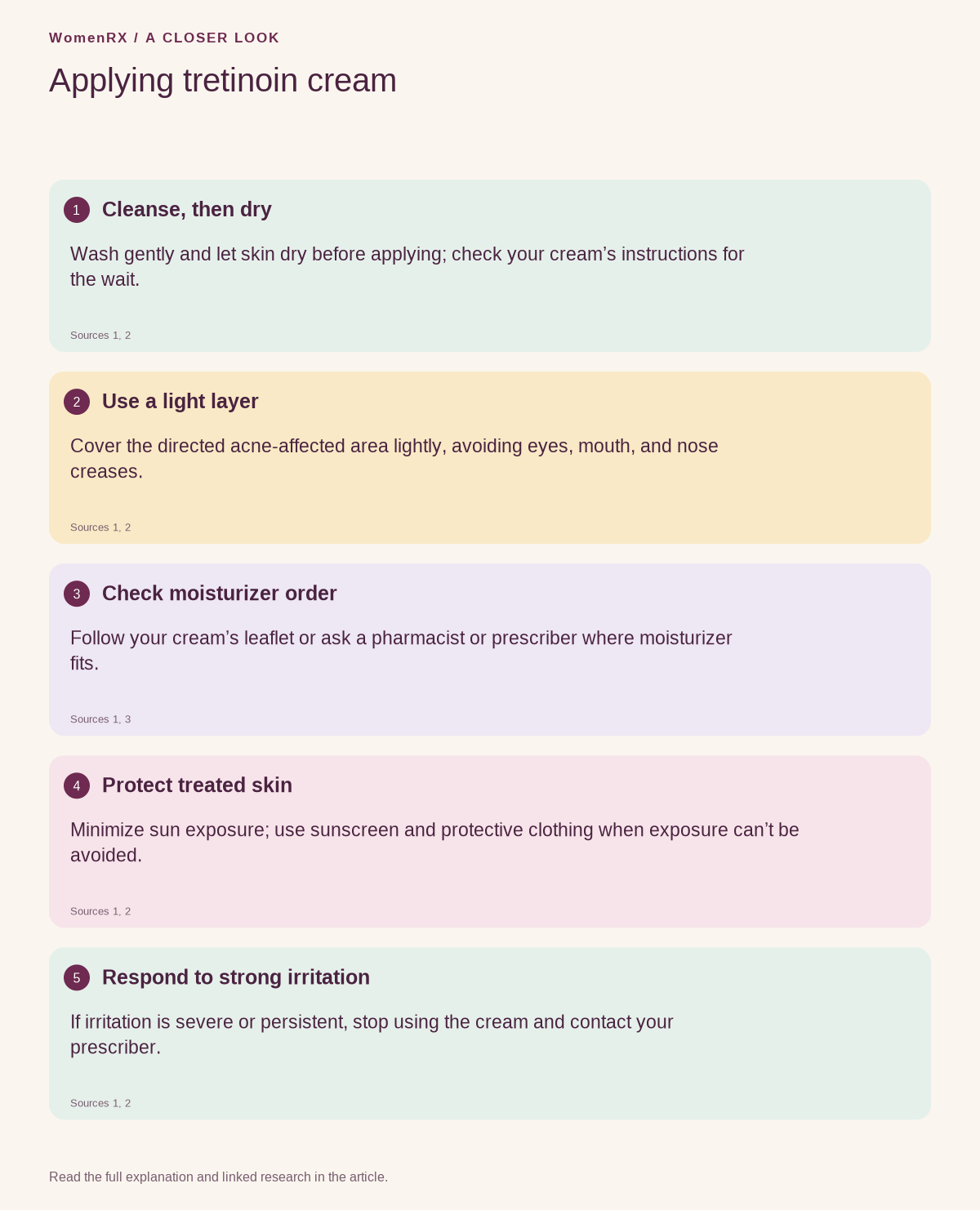
Applying tretinoin cream
Cleanse, then dry: Wash gently and let skin dry before applying; check your cream’s instructions for the wait.12
Use a light layer: Cover the directed acne-affected area lightly, avoiding eyes, mouth, and nose creases.12
Check moisturizer order: Follow your cream’s leaflet or ask a pharmacist or prescriber where moisturizer fits.13
Protect treated skin: Minimize sun exposure; use sunscreen and protective clothing when exposure can’t be avoided.12
Respond to strong irritation: If irritation is severe or persistent, stop using the cream and contact your prescriber.12
Read the figure as text
The application basics and the points worth checking against your own prescription.- Cleanse, then dry: Wash gently and let skin dry before applying; check your cream’s instructions for the wait.12
- Use a light layer: Cover the directed acne-affected area lightly, avoiding eyes, mouth, and nose creases.12
- Check moisturizer order: Follow your cream’s leaflet or ask a pharmacist or prescriber where moisturizer fits.13
- Protect treated skin: Minimize sun exposure; use sunscreen and protective clothing when exposure can’t be avoided.12
- Respond to strong irritation: If irritation is severe or persistent, stop using the cream and contact your prescriber.12
What the moisturizer study found
A mild cleanser is a better partner for tretinoin than harsh scrubbing. If your skin feels dry, a moisturizer may help, though it won’t necessarily prevent irritation. In a randomized split-face study, participants applied tretinoin to the whole face and a particular moisturizing sunscreen to one side. Most had irritation on both sides, but irritation was predominantly mild on the moisturized side, which participants tended to prefer. The study involved people with healthy skin, so it can’t tell you how every moisturizer will work for acne-prone skin. 1 4
Give the treatment time without adding extra cream
Acne treatment can take several months to show improvement, so a slow response alone isn’t a reason to apply extra cream. If acne remains troublesome, or you develop painful nodules or cysts, arrange a review. Those deeper spots need appropriate treatment because they carry a risk of scarring. 2 3
Sources you can check
- TRETINOIN CREAM [REDPHARM DRUG] | US prescribing information and patient instructionsAccessed 2026-09-25Return to first citation
- TRETINOIN GEL TRETINOIN CREAM [PADAGIS US LLC] | US prescribing information and patient instructionsAccessed 2026-09-25Return to first citation
- Acne - NHSAccessed 2026-09-25Return to first citation
- Acne - Treatment - NHSAccessed 2026-09-25Return to first citation
- Adjunctive use of a facial moisturizer SPF 30 containing ceramide precursor improves tolerability of topical tretinoin 0.05%: a randomized, investigator-blinded, split-face study.Schorr ES, Sidou F, Kerrouche N. · Journal of drugs in dermatology : JDD · 2012