What Tretinoin Cream Treats, and What It Doesn’t
Tretinoin cream has a clear established use for acne; other skin concerns call for a closer look at the evidence and the specific product.
Tretinoin cream is an established prescription treatment for acne vulgaris. It’s also discussed for photoaging, but that use isn’t established by the acne product labeling. Stretch marks have limited treatment evidence, including a small study where tretinoin was combined with a procedure. Don’t use an acne prescription on other spots or growths without checking with the prescriber. 1 5 6
Start with the reason it was prescribed
If tretinoin cream was offered for acne, that matches its established use: US product labeling indicates it for topical treatment of acne vulgaris. Topical retinoids help prevent dead skin cells from building up inside hair follicles, where blockages contribute to acne. The aim is to treat acne-prone areas, not to apply the cream to an unrelated mark, growth, or lesion. 1 3
The word “tretinoin” can also appear in conversations about wrinkles, sun damage, uneven tone, or stretch marks. Those mentions don’t all mean the same thing. A use may be discussed in research without being the labeled indication for a particular cream, and a study of a combination treatment doesn’t show that tretinoin alone caused the improvement.
How the other uses compare
Photoaging: discussed, but not the acne cream’s labeled use
Tretinoin has been studied and used in connection with photodamage, and a review describes it as a treatment associated with photoaging. But the acne cream labels say that long-term safety and effectiveness for other disorders have not been established. So it’s reasonable to ask a prescriber whether tretinoin is appropriate for sun-related skin changes, but don’t treat that as interchangeable with the cream’s acne indication. 1 2 4 5
Stretch marks: some research, with important limits
A review reports modest benefit from topical tretinoin for stretch marks, with results varying by concentration and treatment duration. It also describes limitations across stretch-mark studies, including small samples and inconsistent ways of measuring results. 5
One small randomized pilot study enrolled 18 Chinese women with pregnancy-related stretch marks. It compared sites receiving tretinoin, a radiofrequency procedure, both treatments, or control. The reported significant improvement was at sites receiving the combination, so the study does not establish that tretinoin cream by itself was effective. 6
Other spots, scars, and marks: don’t assume
The product labeling specifically says the acne cream should not be applied to other body areas or to other growths or lesions, and that its long-term use for other disorders hasn’t been established. An acne prescription shouldn’t be repurposed as a general treatment for scars, pigmentation, or an unexplained spot. 1
What to consider before using it
Tretinoin can cause redness and peeling where it’s applied. The product information advises minimizing sun exposure and using sun protection when exposure can’t be avoided. Harsh or drying skin products, including products containing salicylic acid, sulfur, or resorcinol, may add irritation or interact with treatment; check before layering them. 1 2
Pregnancy changes the decision: clinical acne-treatment guidance says topical retinoids, including tretinoin, are not suitable for use during pregnancy because of a possible risk of birth defects. If you’re pregnant or think you might be, speak with your prescriber before using the cream, as its patient instructions advise. That precaution doesn’t mean an accidental topical exposure is known to cause harm: human case reports have not established whether topical tretinoin affected fetal development. 3 1 7
Studies of one cream included too few people aged 65 and older to determine whether they respond differently. For stretch marks, a review notes that treatment results are difficult to compare across studies and that pigmentation risks can affect treatment choices for darker skin. Those findings don’t establish whether tretinoin works differently for acne across skin tones. 1 5
A useful question for the prescriber is: “Is this being prescribed for acne, or for another concern, and what evidence applies to that use?” The answer can help clarify whether you’re considering an established acne treatment, a clinician-guided use beyond the label, or a claim that goes beyond what is known.
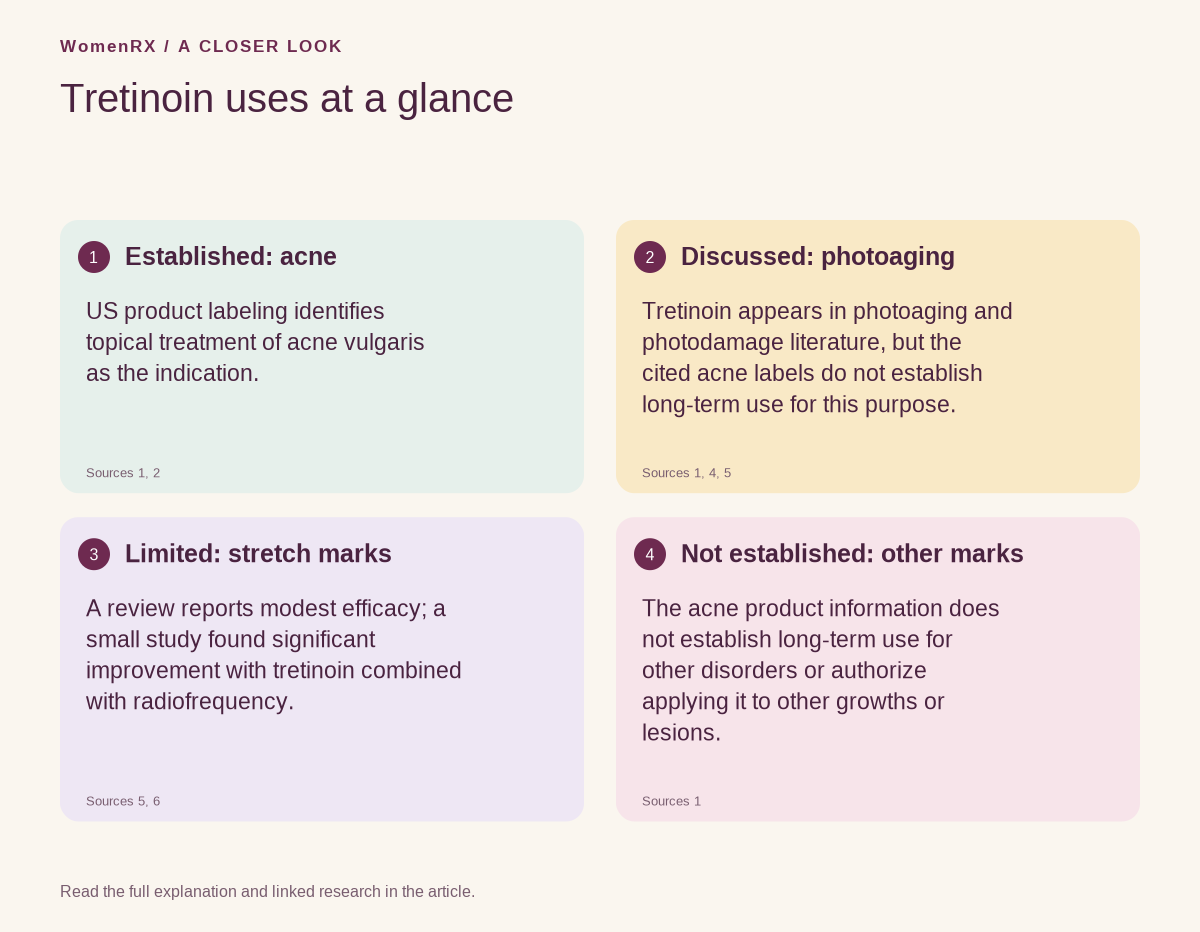
Tretinoin uses at a glance
Established: acne: US product labeling identifies topical treatment of acne vulgaris as the indication.12
Discussed: photoaging: Tretinoin appears in photoaging and photodamage literature, but the cited acne labels do not establish long-term use for this purpose.145
Limited: stretch marks: A review reports modest efficacy; a small study found significant improvement with tretinoin combined with radiofrequency.56
Not established: other marks: The acne product information does not establish long-term use for other disorders or authorize applying it to other growths or lesions.1
Read the figure as text
The main distinction is between the acne indication, other uses discussed in research, and concerns the acne labeling does not establish.- Established: acne: US product labeling identifies topical treatment of acne vulgaris as the indication.12
- Discussed: photoaging: Tretinoin appears in photoaging and photodamage literature, but the cited acne labels do not establish long-term use for this purpose.145
- Limited: stretch marks: A review reports modest efficacy; a small study found significant improvement with tretinoin combined with radiofrequency.56
- Not established: other marks: The acne product information does not establish long-term use for other disorders or authorize applying it to other growths or lesions.1
More questions, answered
Does tretinoin cream treat acne scars?
The acne cream is labeled for acne, not acne scars, and its long-term effectiveness for other disorders has not been established. Ask about the specific type of mark and treatment being considered. 1
Is tretinoin cream suitable during pregnancy?
Clinical acne-treatment guidance says topical retinoids, including tretinoin, are not suitable during pregnancy because of a possible risk of birth defects. If you’re pregnant or think you might be, the cream’s patient instructions advise speaking with your prescriber before use. Case reports of topical exposure have not established whether it affected fetal development. 3 1 7
Sources you can check
- TRETINOIN CREAM [REDPHARM DRUG] | US prescribing information and patient instructionsAccessed 2026-09-25Return to first citation
- TRETINOIN GEL TRETINOIN CREAM [PADAGIS US LLC] | US prescribing information and patient instructionsAccessed 2026-09-25Return to first citation
- Acne - Treatment - NHSAccessed 2026-09-25Return to first citation
- Use of topical tretinoin and the development of noncutaneous adverse events: evidence from a systematic review of the literature.Shapiro S, Heremans A, Mays DA, Martin AL, Hernandez-Medina M, Lanes S. · Journal of the American Academy of Dermatology · 2011Return to first citation
- Advancements in treating stretch marks across all skin types: a comprehensive review of therapeutic modalities.Chaudhury H, Remmert N, Chen H, Tarbox M. · International journal of women's dermatology · 2026Return to first citation
- Efficacy and Safety of a Sublative Bipolar Fractional Radiofrequency System Combined With Topical Tretinoin in Treating Striae Gravidarum: A Randomized Pilot Study.Tian T, Luo YJ, Wang H, Chen HD, Li YH. · Dermatologic surgery : official publication for American Society for Dermatologic Surgery [et al.] · 2019Return to first citation
- Use of Topical Tazarotene for the Treatment of Acne Vulgaris in Pregnancy: A Literature Review.Han G, Wu JJ, Del Rosso JQ. · The Journal of clinical and aesthetic dermatology · 2020Return to first citation