What Bremelanotide Treats, and What It Doesn’t
Bremelanotide is intended for a specific pattern of low desire, not every change in sexual interest or sexual function.
Bremelanotide (Vyleesi) is indicated for premenopausal women with acquired, generalized hypoactive sexual desire disorder (HSDD): low desire that causes marked distress or interpersonal difficulty and isn’t explained by a medical or psychiatric condition or a medication or drug. It isn’t a general treatment for sexual pain, arousal difficulties, relationship concerns, or low desire with another identifiable cause. 1
The specific concern it’s meant to address
Bremelanotide, sold as Vyleesi, is indicated for premenopausal women with acquired, generalized hypoactive sexual desire disorder, or HSDD. “Acquired” means desire problems began after a period without them. “Generalized” means low desire occurs across situations, types of stimulation, or partners, rather than only in one setting. The concern must also cause marked distress or interpersonal difficulty. 1
That definition matters because a change in desire isn’t automatically a disorder. The treatment is not intended for every woman who wants sex less often, has a different level of desire from a partner, or notices a change during a stressful period. The impact and the pattern of the change are part of the clinical picture, not afterthoughts. 1
What it does, and what the trials measured
Bremelanotide is a melanocortin receptor agonist. Its action on sexual desire is thought to involve signaling in the brain, but the biological explanation is not settled. 37
In two placebo-controlled studies described in the US prescribing information, women receiving bremelanotide had greater improvement in measured sexual desire and distress about low desire than women receiving placebo. However, the studies did not find a significant difference between groups in the change in the number of satisfying sexual events. So improvement on desire and distress measures should not be taken to mean that sex will necessarily happen more often or feel satisfying in every way. 1
The broader interpretation deserves some care: a review of the trial outcome measures questioned how well some measures captured meaningful change for women with HSDD, and found that reported benefits were modest across the outcomes it examined. 4 This doesn’t erase the results in the prescribing information, but it does make a simple promise such as “it will restore your sex life” stronger than the evidence supports.
Concerns that call for a different assessment
Low desire linked to a health condition or medication. The indication specifically excludes low desire due to a co-existing medical or psychiatric condition or the effects of a medication or drug substance. Chronic illness and medicines can affect sexual health, so identifying a possible contributor matters before assuming the concern fits the labeled use. 12
Pain or discomfort with sex. Bremelanotide’s labeled use is for HSDD, not sexual pain. If discomfort is the main issue, it is a different concern from the treatment’s labeled target. 1
Arousal, orgasm, or lubrication difficulties without generalized low desire. These are not the condition named in the indication. A woman may have more than one sexual concern, but a medicine studied and indicated for HSDD shouldn’t be assumed to address each one. 14
Desire that changes only with a particular partner or situation. Because the labeled condition is generalized, a concern limited to one context does not match that definition by itself. Relationship and social factors can matter in sexual health, but that does not make every relationship difficulty HSDD. 16
A useful way to decide what question to ask
Start with the shape of the problem: Is low desire present across situations, and does it cause marked distress or interpersonal difficulty? Did it begin after a period when desire wasn’t a problem? Are pain, a health condition, a medication, or a particular relationship context central to what’s changed? These questions don’t diagnose HSDD; they help separate the concern the medication is intended for from issues that may need another explanation or approach. 12
HSDD can involve biological, psychological, and social factors, and reviews describe care as potentially involving more than medication. A treatment choice should fit the pattern that’s actually troubling you, not just the broad label of “low libido.” 56
Which concern is driving the change?
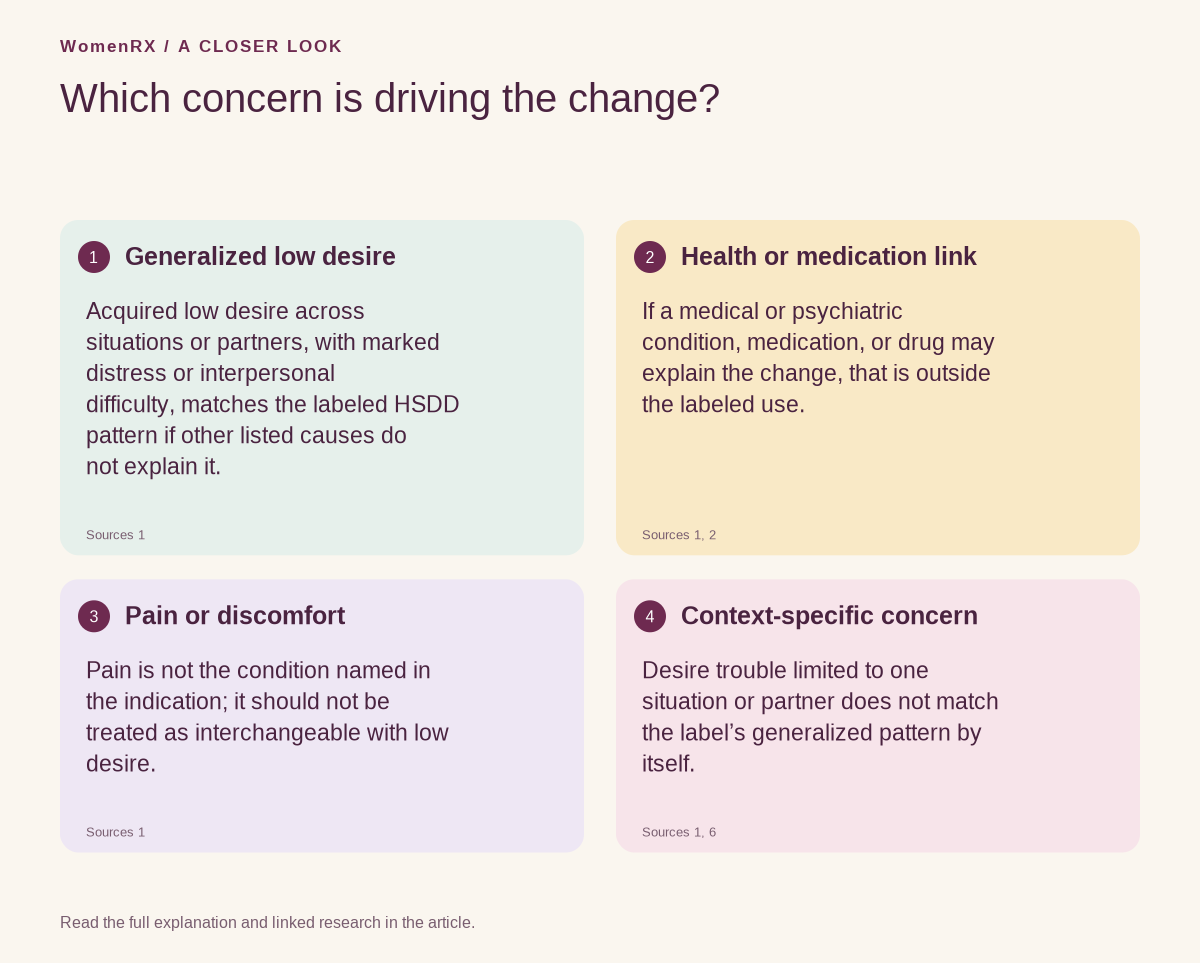
Generalized low desire: Acquired low desire across situations or partners, with marked distress or interpersonal difficulty, matches the labeled HSDD pattern if other listed causes do not explain it.1
Health or medication link: If a medical or psychiatric condition, medication, or drug may explain the change, that is outside the labeled use.12
Pain or discomfort: Pain is not the condition named in the indication; it should not be treated as interchangeable with low desire.1
Context-specific concern: Desire trouble limited to one situation or partner does not match the label’s generalized pattern by itself.16
Read the figure as text
Bremelanotide’s labeled use is narrow. These distinctions can help clarify whether the main concern resembles acquired, generalized HSDD or calls for another assessment.- Generalized low desire: Acquired low desire across situations or partners, with marked distress or interpersonal difficulty, matches the labeled HSDD pattern if other listed causes do not explain it.1
- Health or medication link: If a medical or psychiatric condition, medication, or drug may explain the change, that is outside the labeled use.12
- Pain or discomfort: Pain is not the condition named in the indication; it should not be treated as interchangeable with low desire.1
- Context-specific concern: Desire trouble limited to one situation or partner does not match the label’s generalized pattern by itself.16
More questions, answered
Does low desire have to cause distress to fit the labeled use?
Not necessarily personal distress. The US indication specifies marked distress or interpersonal difficulty, alongside an acquired and generalized pattern in a premenopausal woman and the other listed criteria. 1
Does bremelanotide increase the number of satisfying sexual events?
In the two studies summarized in the prescribing information, the change in satisfying sexual events did not differ significantly between bremelanotide and placebo. The studies did find differences in measured desire and distress, which are separate outcomes. 1
Sources you can check
- VYLEESI (BREMELANOTIDE) INJECTION [COSETTE PHARMACEUTICALS, INC.] | US prescribing information and patient instructionsAccessed 2026-09-25Return to first citation
- Sexual Health | MedlinePlusAccessed 2026-09-25Return to first citation
- Female Syrian hamster analyses of bremelanotide, a US FDA approved drug for the treatment of female hypoactive sexual desire disorder.Borland JM, Kohut-Jackson AL, Peyla AC, Hall MA, Mermelstein PG, Meisel RL. · Neuropharmacology · 2025Return to first citation
- Small Effects, Questionable Outcomes: Bremelanotide for Hypoactive Sexual Desire Disorder.Spielmans GI, Ellefson EM. · Journal of sex research · 2024Return to first citation
- Pharmacotherapy of Hypoactive Sexual Desire Disorder in Premenopausal Women.Barakeh D, Mdaihly H, Karaoui LR. · The Annals of pharmacotherapy · 2025Return to first citation
- What Women Want? The State of the Art regarding the Treatment of Young Women with Hypoactive Sexual Desire Disorder.de Oliveira L, Vignozzi L, Giraldi A, Varod S, Corona G, Reisman Y. · Pharmacology · 2024Return to first citation
- Bremelanotide for Treatment of Female Hypoactive Sexual Desire.Edinoff AN, Sanders NM, Lewis KB, Apgar TL, Cornett EM, Kaye AM, Kaye AD. · Neurology international · 2022Return to first citation