Does Bremelanotide Affect Weight? What the Evidence Shows
Weight loss isn’t an established expected effect of Vyleesi, though small, short-term studies tested its effect on appetite and weight.
Bremelanotide, sold as Vyleesi, isn’t established as a weight-loss treatment. Weight change has not been established as an expected effect of occasional use. Small Phase 1 studies found short-term weight loss in women with obesity who received frequent daily injections, a very different pattern from the occasional use studied for low sexual desire. Those findings don’t show what to expect with approved treatment. 1 5
The short answer: weight change isn’t an established treatment effect
Vyleesi was studied and approved for acquired, generalized hypoactive sexual desire disorder (HSDD) in premenopausal women. Its main clinical-trial outcomes were sexual desire and distress related to low desire. In those trials, most participants used it two or three times a month, and no more than once a week. 3 1
That distinction matters: a drug can affect appetite under some conditions without weight change being a predictable result of the way it’s normally used. The evidence doesn’t establish that you should expect to lose or gain weight while taking Vyleesi.
What the weight studies actually tested
There is human research directly measuring weight, but it came from two small, early-phase studies in premenopausal women with obesity, not from trials designed to establish Vyleesi’s effect on weight during treatment for HSDD. In one study, women received injections three times a day for 15 days. The bremelanotide group had a greater reduction in weight than the placebo group after 16 days, and average calorie intake was lower. 5
The other study tested daily or twice-daily injections over short treatment periods. Only 15 of 27 participants completed all three periods. These frequent-injection schedules and brief, controlled study conditions don’t match the occasional use examined in the HSDD trials. The findings are a reason to study appetite and weight further, not a basis to predict weight loss for an individual using Vyleesi as directed. 5 1
Don’t confuse weight subgroups with weight change
A separate analysis of the Phase 3 HSDD studies looked at whether treatment outcomes differed across participant groups defined by baseline weight and BMI. It reported improvements in desire and distress across several of those groups. That analysis was about whether the sexual-health outcomes differed by starting weight; it does not show that Vyleesi changed participants’ weight. 3
This is an easy distinction to miss. A study can include weight as a characteristic of its participants without measuring weight change as a treatment outcome.
If your weight changes while you’re taking it
A change that happens during treatment isn’t automatically caused by the medicine. Consider when it began, whether it’s continuing, and whether anything else changed around the same time, such as your appetite, eating patterns, other medicines, or health. As one practical example, you might note your weight under similar conditions on a few occasions and record when you used Vyleesi and whether you felt nauseated. This can help you describe the pattern without treating one scale reading as proof of a drug effect.
Nausea is a common adverse effect reported in reviews of bremelanotide trials, but that doesn’t establish that it causes weight loss or gain. If nausea is changing how much you eat, mention that along with the weight change. 4
A sudden or ongoing unintended change is worth discussing with your prescriber, including whether other explanations should be considered. Weight reflects more than body fat: water, muscle, and other everyday factors can affect the number on the scale. 2
The useful takeaway is modest: weight change is possible in life while using any medicine, but current evidence doesn’t establish it as an expected effect of Vyleesi’s occasional-use treatment for HSDD.
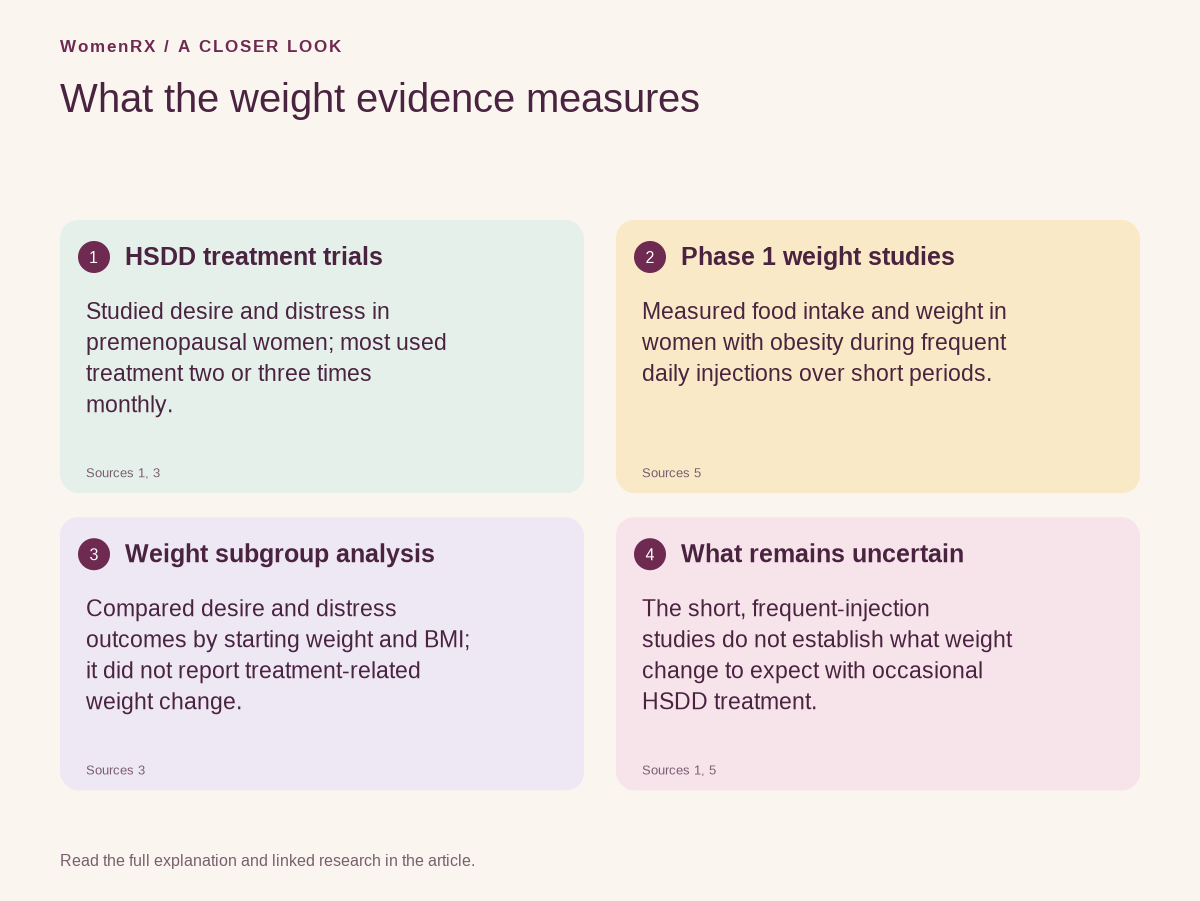
What the weight evidence measures
HSDD treatment trials: Studied desire and distress in premenopausal women; most used treatment two or three times monthly.13
Phase 1 weight studies: Measured food intake and weight in women with obesity during frequent daily injections over short periods.5
Weight subgroup analysis: Compared desire and distress outcomes by starting weight and BMI; it did not report treatment-related weight change.3
What remains uncertain: The short, frequent-injection studies do not establish what weight change to expect with occasional HSDD treatment.15
Read the figure as text
These studies answer different questions: short-term weight response under frequent injections is not the same as weight change during occasional HSDD treatment.- HSDD treatment trials: Studied desire and distress in premenopausal women; most used treatment two or three times monthly.13
- Phase 1 weight studies: Measured food intake and weight in women with obesity during frequent daily injections over short periods.5
- Weight subgroup analysis: Compared desire and distress outcomes by starting weight and BMI; it did not report treatment-related weight change.3
- What remains uncertain: The short, frequent-injection studies do not establish what weight change to expect with occasional HSDD treatment.15
More questions, answered
Was Vyleesi tested as a weight-loss medicine?
The weight-focused research consisted of two small Phase 1 studies in women with obesity, using frequent injections over short periods. That is not the same as establishing weight loss as a benefit of the occasional-use treatment studied for HSDD. 5 1
Does starting BMI tell me whether my weight will change?
Not from the available HSDD subgroup analysis. It examined desire and distress outcomes among groups with different starting weights and BMIs, not weight change during treatment. 3
Sources you can check
- VYLEESI (BREMELANOTIDE) INJECTION [COSETTE PHARMACEUTICALS, INC.] | US prescribing information and patient instructionsAccessed 2026-09-25Return to first citation
- Body Weight: MedlinePlusAccessed 2026-09-25Return to first citation
- Prespecified and Integrated Subgroup Analyses from the RECONNECT Phase 3 Studies of Bremelanotide.Simon JA, Kingsberg SA, Portman D, Jordan R, Lucas J, Sadiq A, Krop J, Clayton AH. · Journal of women's health (2002) · 2022Return to first citation
- Bremelanotide: New Drug Approved for Treating Hypoactive Sexual Desire Disorder.Mayer D, Lynch SE. · The Annals of pharmacotherapy · 2020Return to first citation
- Effect of bremelanotide on body weight of obese women: Data from two phase 1 randomized controlled trials.Spana C, Jordan R, Fischkoff S. · Diabetes, obesity & metabolism · 2022Return to first citation