Who Should Avoid Bremelanotide Before Taking Vyleesi?
Known cardiovascular disease or uncontrolled high blood pressure rules out Vyleesi; pregnancy, breastfeeding, and certain oral medicines raise different questions.
Vyleesi (bremelanotide) should not be used if you have uncontrolled high blood pressure or known cardiovascular disease. It’s also not recommended during pregnancy or for people at high risk of cardiovascular disease. If you’re breastfeeding or take oral medicines, discuss those details before use. The label says to avoid Vyleesi while taking oral medicines that need to reach a threshold concentration to work, such as some antibiotics, or oral naltrexone intended to treat alcohol or opioid addiction. These are different kinds of cautions, not all formal contraindications. 1
First, is Vyleesi meant for your situation?
Vyleesi is indicated for premenopausal women whose sexual desire used to be different and is now persistently low across situations, causing marked distress or interpersonal difficulty. The diagnosis is called acquired, generalized hypoactive sexual desire disorder (HSDD). To fit the indication, the low desire must not be due to another medical or mental health condition, relationship problems, or a medication or drug substance. Vyleesi is not indicated for postmenopausal women or to enhance sexual performance. That distinction matters before weighing any other safety question: a medicine for HSDD may not address what’s behind a different kind of change in desire. 1
Two conditions that rule it out
The prescribing information names uncontrolled hypertension and known cardiovascular disease as contraindications. In plain language, these are reasons not to use Vyleesi, rather than conditions to monitor while taking it. If you’ve been told you have a heart or blood-vessel condition, give the prescriber the specific diagnosis instead of assuming that a recent blood pressure reading settles the question. 1
The reason for this firm boundary is that bremelanotide can temporarily raise blood pressure and lower heart rate after each dose. Those changes usually resolve within 12 hours, but the prescribing information calls for cardiovascular risk to be considered before treatment and periodically during it, with blood pressure well controlled. It also says Vyleesi is not recommended for people at high risk for cardiovascular disease. The prescriber needs to assess that risk; this warning is not an additional formal contraindication. 1 A review of the clinical development program likewise reported small, temporary blood pressure increases and advised caution for people at cardiovascular risk. 2
Pregnancy and breastfeeding are different questions
Vyleesi is not recommended during pregnancy. The small number of pregnancies reported in its clinical trials cannot establish whether it poses a risk in humans. Animal studies found potential for fetal harm, so the prescribing information advises effective contraception while taking Vyleesi and says to stop using it if pregnancy is suspected. If you’re pregnant, planning a pregnancy, or think you might be pregnant, raise that before use rather than treating an unconfirmed pregnancy as a minor detail. 1
For breastfeeding, the uncertainty is different. There is no information on whether bremelanotide or its metabolites enter human milk, affect a breastfed child, or affect milk production. Breastfeeding is not listed as a contraindication. Instead, the prescribing information calls for weighing the benefits of breastfeeding and the mother’s need for treatment against possible effects on the child. It does not establish a waiting period after a dose that would make breastfeeding risk-free. 1
Check oral medicines before a prescription decision
Bremelanotide may slow stomach emptying, which can reduce or delay absorption of medicines taken by mouth. The prescribing information says to avoid Vyleesi while taking oral medicines that need to reach a threshold concentration to work, such as some antibiotics. If an oral medicine needs to act quickly, such as a pain-relief medicine, a delayed effect may be a reason to consider stopping Vyleesi. Other oral medicines still need review, but not every oral medicine has an avoid-use warning. 1
One interaction has a particularly clear consequence: Vyleesi may substantially lower exposure to oral naltrexone. The prescribing information says to avoid using them together when the naltrexone-containing product is intended to treat alcohol or opioid addiction, because treatment failure could have serious consequences. A review of bremelanotide’s clinical development also identified reduced naltrexone and indomethacin exposure as notable interactions. If you take either medicine, name the product and its purpose during the prescribing discussion rather than guessing whether changing the time you take it solves the problem. 12
Tolerability can affect the decision, too
Even when none of these exclusions or cautions applies, side effects may change whether Vyleesi feels like a reasonable option. In the integrated double-blind portion of the phase 3 studies, nausea was reported by 40.0% of people receiving bremelanotide versus 1.3% receiving placebo. The prescribing information also warns about patches of darker color on the skin or gums that may not fully resolve after stopping. These are not contraindications, but they are useful to understand before deciding whether the potential benefit is worth trying the medicine. 12
The useful distinction is this: known cardiovascular disease or uncontrolled hypertension rules Vyleesi out; high cardiovascular risk and pregnancy bring label-based recommendations against use; breastfeeding and other oral medicines call for a decision specific to your circumstances, while threshold-dependent oral medicines and oral naltrexone for addiction carry avoid-use warnings. 1
Five things to check before Vyleesi
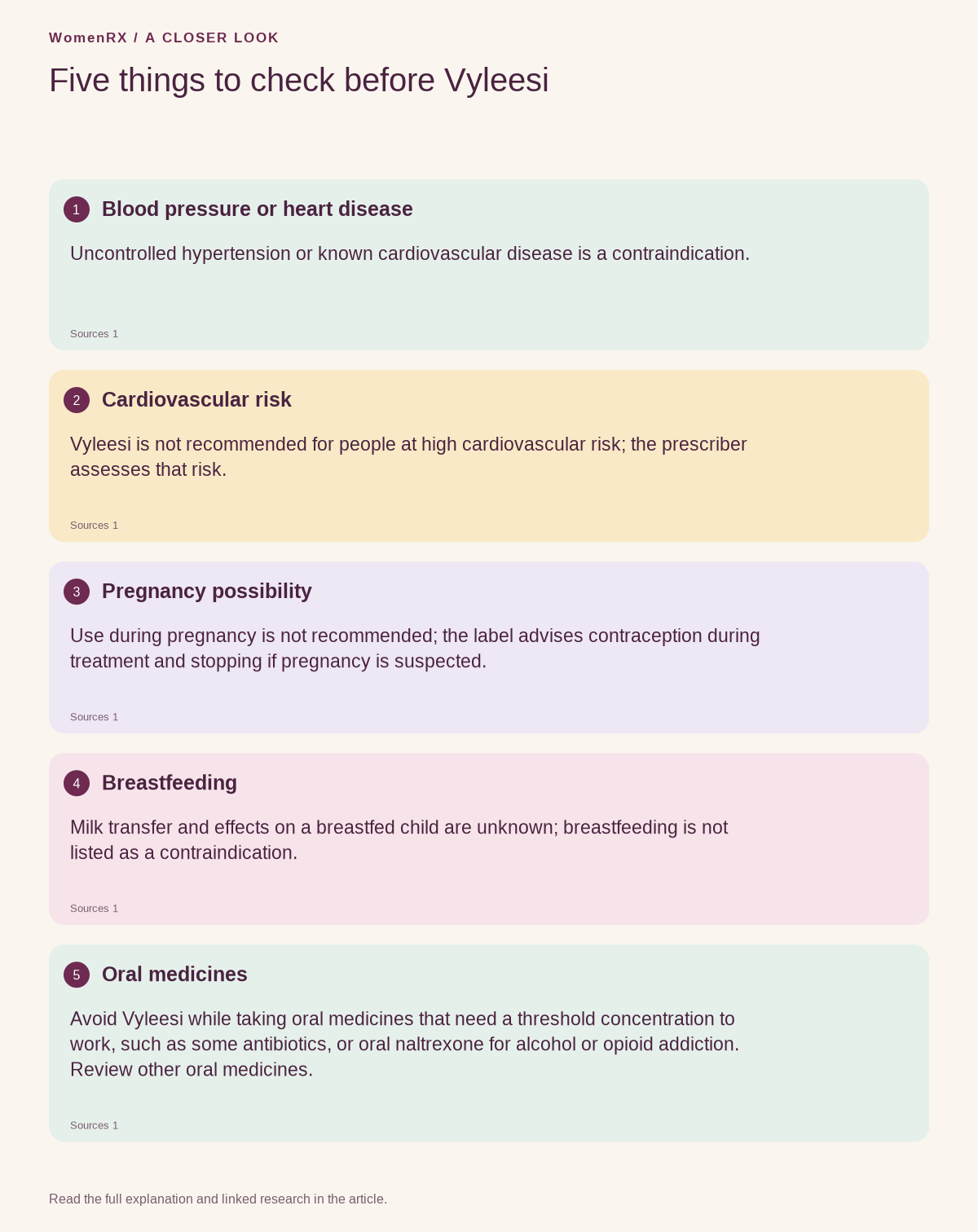
Blood pressure or heart disease: Uncontrolled hypertension or known cardiovascular disease is a contraindication.1
Cardiovascular risk: Vyleesi is not recommended for people at high cardiovascular risk; the prescriber assesses that risk.1
Pregnancy possibility: Use during pregnancy is not recommended; the label advises contraception during treatment and stopping if pregnancy is suspected.1
Breastfeeding: Milk transfer and effects on a breastfed child are unknown; breastfeeding is not listed as a contraindication.1
Oral medicines: Avoid Vyleesi while taking oral medicines that need a threshold concentration to work, such as some antibiotics, or oral naltrexone for alcohol or opioid addiction. Review other oral medicines.1
Read the figure as text
These categories have different meanings: some rule out use, while others need a more individual decision.- Blood pressure or heart disease: Uncontrolled hypertension or known cardiovascular disease is a contraindication.1
- Cardiovascular risk: Vyleesi is not recommended for people at high cardiovascular risk; the prescriber assesses that risk.1
- Pregnancy possibility: Use during pregnancy is not recommended; the label advises contraception during treatment and stopping if pregnancy is suspected.1
- Breastfeeding: Milk transfer and effects on a breastfed child are unknown; breastfeeding is not listed as a contraindication.1
- Oral medicines: Avoid Vyleesi while taking oral medicines that need a threshold concentration to work, such as some antibiotics, or oral naltrexone for alcohol or opioid addiction. Review other oral medicines.1
More questions, answered
If my blood pressure is controlled, does that mean Vyleesi is suitable?
Not necessarily. Uncontrolled hypertension is a contraindication, and the prescribing information says blood pressure should be well controlled during treatment. It also says Vyleesi is not recommended for people at high cardiovascular risk, so a controlled reading is only one part of the assessment. 1
Sources you can check
- VYLEESI (BREMELANOTIDE) INJECTION [COSETTE PHARMACEUTICALS, INC.] | US prescribing information and patient instructionsAccessed 2026-09-25Return to first citation
- Safety Profile of Bremelanotide Across the Clinical Development Program.Clayton AH, Kingsberg SA, Portman D, Sadiq A, Krop J, Jordan R, Lucas J, Simon JA. · Journal of women's health (2002) · 2022Return to first citation