Bremelanotide (PT-141): Who It’s For and What It Can Do
In US trials, bremelanotide modestly improved desire and related distress for a specific group of premenopausal women, but nausea and other effects were common.
Bremelanotide, sold by prescription in the US as Vyleesi, is intended for premenopausal women whose low desire began after a period without that problem, occurs across situations, and causes significant distress or relationship difficulty. In two placebo-controlled trials, it improved desire and desire-related distress on average, but it didn’t increase the number of satisfying sexual events. It’s not approved as a general libido or sexual-performance enhancer. 1

The distinction that matters before you try it
Being offered “PT-141” for low libido can make it sound like a broad solution to a common experience. Bremelanotide is more specific than that. Its US prescription product, Vyleesi, is indicated for acquired, generalized hypoactive sexual desire disorder (HSDD) in premenopausal women. Acquired means desire changed after a time when it wasn’t a problem. Generalized means the low desire isn’t limited to a particular partner, situation, or kind of stimulation. It must cause marked distress or interpersonal difficulty, and it must not be explained by a medical or psychiatric condition, a relationship problem, or the effects of a medication or drug. Vyleesi isn’t indicated for postmenopausal women or for enhancing sexual performance. 1
That definition isn’t a judgment about whether your concern is real. It helps separate the question studied in the trials from other reasons desire can change. For example, if low desire began after starting a medication, the medication deserves attention rather than assuming bremelanotide addresses the cause. Medicines and chronic conditions can affect sexual health, and an HSDD assessment also considers relationship and mental-health factors. 123
What the trials found, and what they didn’t
Two randomized, double-blind trials compared Vyleesi with placebo over 24 weeks in premenopausal women with acquired, generalized HSDD. Women taking Vyleesi reported a greater average improvement in desire on a questionnaire than women taking placebo: the mean changes were 0.5 versus 0.2 points in one trial and 0.6 versus 0.2 points in the other, on a desire scale running from 1.2 to 6. They also reported a greater average reduction in how often they felt bothered by low desire: 0.7 versus 0.4 points in both trials, on a 0-to-4 question. These are group averages, not a prediction of how much desire any one woman will feel. 1
There’s an especially useful limit to that result. The trials did not find a significant difference between Vyleesi and placebo in the change in the number of satisfying sexual events. Improvement on desire and distress questionnaires therefore shouldn’t be translated into a promise of more sex, better performance, or satisfaction every time. More women receiving Vyleesi also left the 24-week treatment period early than women receiving placebo, which matters when weighing a modest average benefit against the experience of taking it. 1
An earlier phase 2b trial included premenopausal women with HSDD, sexual arousal disorder, or both. Its responder analyses found greater improvement than placebo on several patient-reported measures at the dose subsequently studied in phase 3. Because that population included other diagnoses and the analyses examined ways to define a meaningful response, the later trials and the US indication are the better guide to what Vyleesi is intended to treat. 41
Safety may be the deciding factor
Nausea is the standout adverse effect. In the two placebo-controlled trials, it was reported by 40% of Vyleesi recipients versus 1.3% of placebo recipients; 8% of Vyleesi recipients stopped the trials because of nausea. Flushing occurred in 20.3% versus 0.3%, and headache in 11.3% versus 1.9%. Injection-site reactions were also reported. These figures come from the studied premenopausal population, not from every woman who might be offered a product called PT-141. 1
Vyleesi can temporarily raise blood pressure and lower heart rate after a dose. It is contraindicated if you have uncontrolled high blood pressure or known cardiovascular disease. It can also cause darker patches of skin, including on the face, gums, or breasts; these changes may not fully fade after stopping, and the label notes particular concern in people with darker skin. 1
Medication use matters here too. Bremelanotide can slow stomach emptying and affect how oral medicines are absorbed. The US label specifically advises avoiding its use with oral naltrexone-containing treatment for alcohol or opioid addiction, because reduced naltrexone exposure could undermine that treatment. It also cautions about oral medicines that need to reach a threshold concentration to work, such as certain antibiotics. If either applies to you, this is a concrete reason to review the proposed treatment before using it. 1
If pregnancy is possible, the label advises effective contraception during treatment and stopping Vyleesi if pregnancy is suspected. That’s another part of the decision, not a detail to sort out after starting. 1
Check the product and the reason it was offered
In the US, Vyleesi is a prescription bremelanotide injection with the defined indication above. Hearing the names “bremelanotide” or “PT-141” doesn’t, by itself, establish that a different product has the same authorization, formulation, or supporting clinical evidence. The US prescribing information also cannot establish whether a product is authorized where you live outside the US. 1
A useful way to weigh an offer is to separate three questions: Does your experience fit the acquired, generalized condition studied? Is the proposed product the US prescription product, or something else? And do its likely benefits feel worthwhile given nausea, blood-pressure effects, your health history, and any medicines you take? The trial results can inform that decision. They can’t turn every cause of low desire into the same diagnosis. 12
Where the Bremelanotide Evidence Applies
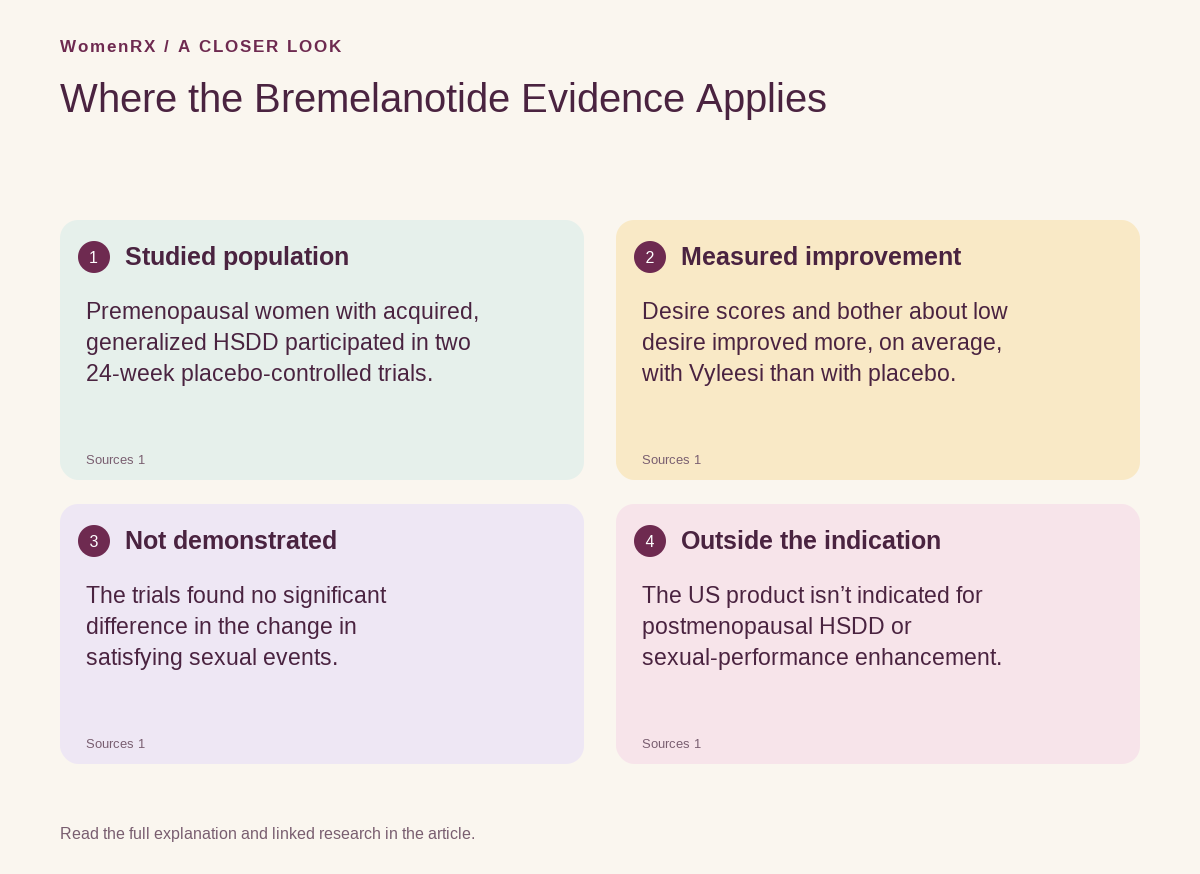
Studied population: Premenopausal women with acquired, generalized HSDD participated in two 24-week placebo-controlled trials.1
Measured improvement: Desire scores and bother about low desire improved more, on average, with Vyleesi than with placebo.1
Not demonstrated: The trials found no significant difference in the change in satisfying sexual events.1
Outside the indication: The US product isn’t indicated for postmenopausal HSDD or sexual-performance enhancement.1
Read the figure as text
The studied diagnosis, measured benefit, and limits are different parts of the same decision.- Studied population: Premenopausal women with acquired, generalized HSDD participated in two 24-week placebo-controlled trials.1
- Measured improvement: Desire scores and bother about low desire improved more, on average, with Vyleesi than with placebo.1
- Not demonstrated: The trials found no significant difference in the change in satisfying sexual events.1
- Outside the indication: The US product isn’t indicated for postmenopausal HSDD or sexual-performance enhancement.1
Sources you can check
- VYLEESI (BREMELANOTIDE) INJECTION [COSETTE PHARMACEUTICALS, INC.] | US prescribing information and patient instructionsAccessed 2026-09-25Return to first citation
- Sexual Health | MedlinePlusAccessed 2026-09-25Return to first citation
- International Society for the Study of Women's Sexual Health Clinical Practice Guideline for the Use of Systemic Testosterone for Hypoactive Sexual Desire Disorder in Women.Parish SJ, Simon JA, Davis SR, Giraldi A, Goldstein I, Goldstein SW, Kim NN, Kingsberg SA, Morgentaler A, Nappi RE, Park K, Stuenkel CA, Traish AM, Vignozzi L. · Journal of women's health (2002) · 2021Return to first citation
- Responder Analyses from a Phase 2b Dose-Ranging Study of Bremelanotide.Althof S, Derogatis LR, Greenberg S, Clayton AH, Jordan R, Lucas J, Spana C. · The journal of sexual medicine · 2019Return to first citation