Could Bremelanotide Fit Your Low-Desire Concerns?
Bremelanotide is intended for a specific pattern of distressing low desire in premenopausal women, not as a general libido booster.
Bremelanotide may be worth discussing if you’re premenopausal, your desire dropped after previously being typical for you, the change happens across situations, and it causes significant distress. The studied condition excludes low desire explained by another medical or psychiatric condition or by a medication or drug. Trials found improvements in desire and related distress, but common side effects and blood-pressure concerns matter too. 2 3 6
Start with the pattern, not a libido score
Bremelanotide, sold as Vyleesi, is approved for premenopausal women with acquired, generalized hypoactive sexual desire disorder (HSDD). “Acquired” means desire was not always low for you. “Generalized” means the change isn’t limited to a particular situation, kind of stimulation, or partner. The low desire must also cause marked distress or interpersonal difficulty. 2
That distinction matters because desire varies, and low interest by itself doesn’t establish that you have HSDD. A more useful starting question is whether the change feels persistent and upsetting to you, rather than whether your desire matches someone else’s expectations. The medication’s indication is not for desire changes explained by a co-existing medical or psychiatric condition, or by a medication or drug. 2 4
Look for what may be shaping desire
Sexual interest can be affected by more than one thing at once. Medical conditions and medicines can affect sexual health, and biological, psychological, and social factors may all contribute to HSDD. For example, a new medication, a chronic health condition, or worry about unplanned pregnancy may be relevant to understanding what has changed. These examples don’t diagnose the cause; they help frame a more useful conversation. 1 4
If the change began around a new medicine, health problem, or mood change, that context deserves attention before treating low desire as a standalone condition. The product indication specifically excludes desire changes due to another medical or psychiatric condition or a medication or drug. 2
What the studies found, and what they didn’t
The main evidence comes from two 24-week randomized, placebo-controlled trials in premenopausal women diagnosed with HSDD. Across 1,267 women randomized, the group receiving bremelanotide had statistically significant improvements in desire and distress related to low desire compared with the placebo group. The results describe average changes on study measures; they can’t promise that an individual will feel a meaningful benefit. 3
The trials were designed around desire and distress, not a promise of more sexual activity or satisfaction in every encounter. A review of the evidence describes the overall clinical benefit as modest, which is one reason it helps to be clear about what change would matter to you before considering treatment. 3 5
The research and US indication center on premenopausal women. The pivotal trials enrolled premenopausal women, so their results don’t establish whether treatment helps after menopause. 2 3
The treatment approach and tradeoffs
Bremelanotide is an injection used as needed before anticipated sexual activity, rather than a daily libido supplement. The prescribing information says it is administered under the skin in the abdomen or thigh at least 45 minutes beforehand, with no more than one dose in 24 hours. 2
Side effects are a substantial part of the decision. In the integrated blinded phase 3 trials, nausea occurred in 40.0% of people taking bremelanotide versus 1.3% taking placebo; flushing occurred in 20.3% versus 1.3%, and headache in 11.3% versus 1.9%. Nausea was the most common reason for stopping treatment. 6
The safety analysis also found small, temporary increases in blood pressure and advises caution for people at cardiovascular risk, with blood pressure well controlled during treatment. It reported that bremelanotide lowered plasma concentrations of indomethacin and naltrexone. If you take either, include it in a medication review; don’t assume the interaction is irrelevant just because it may not be on your mind as a sexual-health medicine. 6
A practical decision checklist
Before considering it, see whether these points fit:
- The pattern: Desire decreased after previously being typical for you, across situations, and the change is distressing. 2
- The context: You’ve considered whether a health condition, mental health concern, medicine, or other life factor could explain the change. 1 2 4
- The goal: You can name the change you hope for, such as less distress about desire, rather than expecting a universal increase in libido or guaranteed satisfying sex. 3 5
- The tradeoff: You’re willing to weigh an as-needed injection and common nausea, flushing, or headache against the possibility of improvement. Blood pressure, cardiovascular risk, and medicines including indomethacin or naltrexone also belong in the discussion. 2 6
A focused question to take forward is: “Does my pattern fit acquired, generalized HSDD, or is there another factor that should be addressed first?” That keeps the decision centered on your experience and treatment goal, not on the idea that low desire always needs medication.
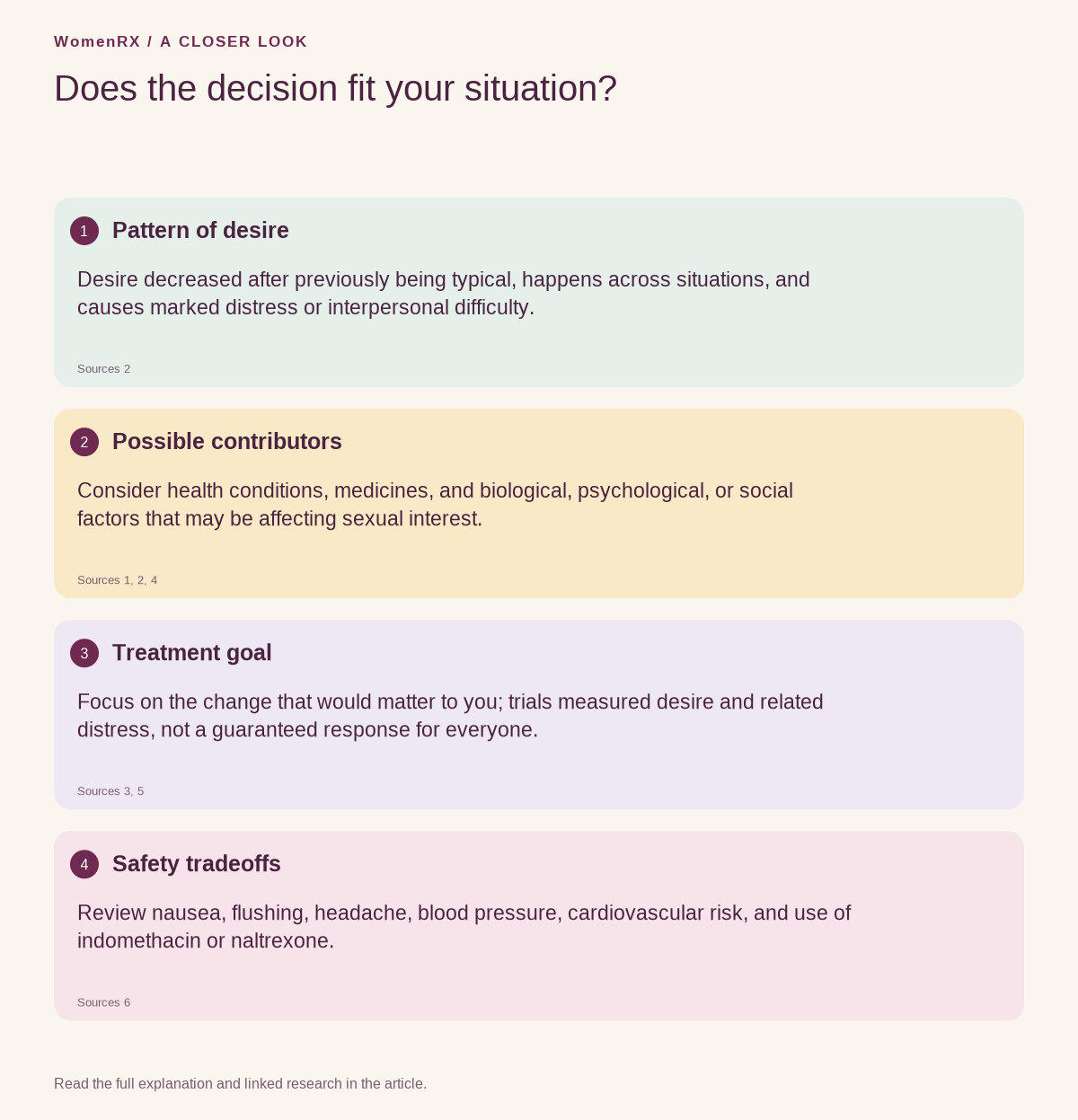
Does the decision fit your situation?
Pattern of desire: Desire decreased after previously being typical, happens across situations, and causes marked distress or interpersonal difficulty.2
Possible contributors: Consider health conditions, medicines, and biological, psychological, or social factors that may be affecting sexual interest.124
Treatment goal: Focus on the change that would matter to you; trials measured desire and related distress, not a guaranteed response for everyone.35
Safety tradeoffs: Review nausea, flushing, headache, blood pressure, cardiovascular risk, and use of indomethacin or naltrexone.6
Read the figure as text
Four distinct questions help separate the studied condition from other causes of low desire and clarify the treatment tradeoffs.- Pattern of desire: Desire decreased after previously being typical, happens across situations, and causes marked distress or interpersonal difficulty.2
- Possible contributors: Consider health conditions, medicines, and biological, psychological, or social factors that may be affecting sexual interest.124
- Treatment goal: Focus on the change that would matter to you; trials measured desire and related distress, not a guaranteed response for everyone.35
- Safety tradeoffs: Review nausea, flushing, headache, blood pressure, cardiovascular risk, and use of indomethacin or naltrexone.6
More questions, answered
Is bremelanotide for anyone who wants more sexual desire?
No. Its indication is for premenopausal women with acquired, generalized HSDD that causes marked distress or interpersonal difficulty, and not for desire changes due to another medical or psychiatric condition or a medication or drug. 2
What medicines should I mention when discussing bremelanotide?
Mention all medicines, and specifically flag indomethacin or naltrexone: a safety analysis reported that bremelanotide lowered plasma concentrations of both. The same analysis found that most other drug interactions it assessed were not clinically significant, but that doesn’t replace reviewing your own medication list. 6
Sources you can check
- Sexual Health | MedlinePlusAccessed 2026-09-25Return to first citation
- VYLEESI (BREMELANOTIDE) INJECTION [COSETTE PHARMACEUTICALS, INC.] | US prescribing information and patient instructionsAccessed 2026-09-25Return to first citation
- Bremelanotide for the Treatment of Hypoactive Sexual Desire Disorder: Two Randomized Phase 3 Trials.Kingsberg SA, Clayton AH, Portman D, Williams LA, Krop J, Jordan R, Lucas J, Simon JA. · Obstetrics and gynecology · 2019Return to first citation
- Clinical trial evidence on emerging pharmacological therapies for hypoactive sexual desire disorder in women: a systematic review and analysis of completed studies registered on ClinicalTrials.gov.Ashour AM. · Frontiers in medicine · 2026Return to first citation
- An evaluation of bremelanotide injection for the treatment of hypoactive sexual desire disorder.Cipriani S, Alfaroli C, Maseroli E, Vignozzi L. · Expert opinion on pharmacotherapy · 2023Return to first citation
- Safety Profile of Bremelanotide Across the Clinical Development Program.Clayton AH, Kingsberg SA, Portman D, Sadiq A, Krop J, Jordan R, Lucas J, Simon JA. · Journal of women's health (2002) · 2022Return to first citation