Before Flibanserin: What a Low-Desire Assessment Should Cover
Flibanserin is considered for a specific pattern of persistent, distressing low desire, not for every change in libido.
Before considering flibanserin, a clinician should clarify whether low desire is acquired, happens across situations and partners, and causes significant distress. They should also look for medical or mental health conditions, relationship problems, pain, and medication or substance effects that could explain the change. In the US, the indication is for women younger than 65; menopause status and the evidence behind treatment deserve a separate discussion. 2 4
First, understand the change
Sexual desire varies. A quieter period, wanting sex less often than a partner, or having little spontaneous desire does not by itself mean you have a disorder. Desire may also emerge in response to closeness or stimulation rather than appearing out of the blue. What matters in an HSDD assessment is the pattern, how long it has lasted, and whether it causes significant distress for you. 6
For flibanserin, the US prescribing information describes acquired, generalized hypoactive sexual desire disorder (HSDD). “Acquired” means desire was not always a problem; “generalized” means the change is not limited to a particular situation, type of stimulation, or partner. Low desire must cause marked distress or interpersonal difficulty. 2
That last phrase needs context: distress can be part of the problem, but a relationship difficulty that is causing the low desire is a different explanation. The indication does not cover low desire due to relationship problems. 2
Look for what could be driving it
A useful assessment connects the change in desire with what else is happening in your life and health. MedlinePlus identifies chronic illness and medicines that affect sexual desire or performance as possible influences on sexual health. The prescribing information also excludes low desire due to a coexisting medical or psychiatric condition, or the effects of a medication or other drug substance. 1 2
The clinician may ask whether desire is low across partners and settings or mainly in one circumstance; whether there is pain or another sexual concern; and whether a health, mood, relationship, medication, or substance change happened around the same time. These questions help distinguish a broad desire change from one tied to a particular context. HSDD discussions also recognize biological, psychological, and social influences, and reduced desire secondary to sexual pain is treated as a separate issue. 4 6
You do not need to arrive with a diagnosis. The practical goal is to identify a plausible contributor that might be addressed first or alongside any medication discussion. For example, if a medication change lines up with the onset of low desire, that is relevant to review; it does not mean you should stop or change it on your own. 1 2
Where menopause fits
The US indication covers women younger than 65 and does not make menopause status its dividing line. However, the original pivotal trials described in the prescribing information enrolled premenopausal women. A 2024 meta-analysis reported benefits in both premenopausal and postmenopausal groups, but those findings do not mean the evidence is equally established for every life stage or individual. Ask how your menopause status and health circumstances affect the evidence and expected tradeoffs in your case. 2 3
Weigh the likely benefit against the burden
Even when the pattern fits, flibanserin is one option, not an automatic next step. A clinician can discuss addressing an identified contributor, psychosocial approaches, or medication. A review of treatment in premenopausal women describes care as potentially multimodal, including nonpharmacologic approaches as well as medication. 5
In a meta-analysis of eight randomized trials involving 7,906 women with HSDD, flibanserin improved several desire and distress measures compared with placebo; the estimated difference in satisfying sexual events for premenopausal women was 0.69 per month. The same analysis found higher risks of dizziness, fatigue, nausea, sleepiness, and insomnia. These group averages can inform a discussion, but they cannot predict how much benefit or which side effects one person will experience. 3
Before deciding, make sure the discussion covers what matters to you: whether the potential change in desire or distress would feel meaningful, what side effects could disrupt daily life, and whether medication or substance effects need review. Alcohol taken with flibanserin may increase sedation-, low-blood-pressure-, and fainting-related adverse effects, according to the review’s summary of the evidence. 3
A reasonable next step is to describe when the change began, where it does and does not occur, how it affects you, and what else changed around that time. That gives the clinician a clearer basis to decide whether the flibanserin indication fits, whether another factor deserves attention first, or whether a different approach better matches your priorities.
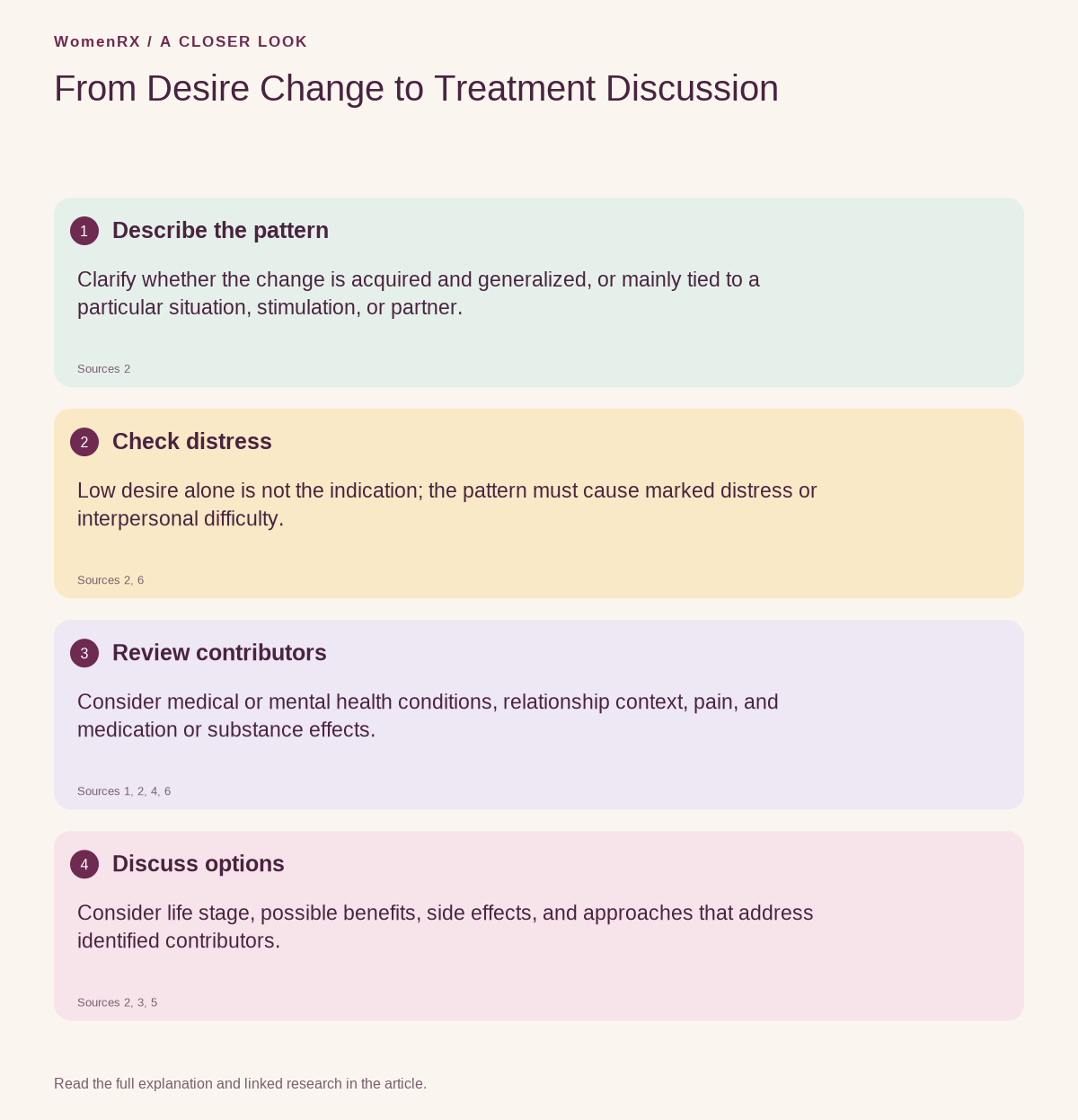
From Desire Change to Treatment Discussion
Describe the pattern: Clarify whether the change is acquired and generalized, or mainly tied to a particular situation, stimulation, or partner.2
Check distress: Low desire alone is not the indication; the pattern must cause marked distress or interpersonal difficulty.26
Review contributors: Consider medical or mental health conditions, relationship context, pain, and medication or substance effects.1246
Discuss options: Consider life stage, possible benefits, side effects, and approaches that address identified contributors.235
Read the figure as text
The assessment moves from understanding the pattern and distress to checking possible causes, then weighing whether the indication and treatment tradeoffs fit.- Describe the pattern: Clarify whether the change is acquired and generalized, or mainly tied to a particular situation, stimulation, or partner.2
- Check distress: Low desire alone is not the indication; the pattern must cause marked distress or interpersonal difficulty.26
- Review contributors: Consider medical or mental health conditions, relationship context, pain, and medication or substance effects.1246
- Discuss options: Consider life stage, possible benefits, side effects, and approaches that address identified contributors.235
More questions, answered
Does low desire have to happen in every situation to fit the indication?
The indication describes generalized HSDD: low desire that is not limited to a particular situation, type of stimulation, or partner. A change limited to one context may point toward a different explanation that is worth discussing. 2
Does being postmenopausal automatically rule out flibanserin?
The US indication is for women younger than 65, rather than being limited by menopause status. The pivotal trials described in the prescribing information enrolled premenopausal women, while a meta-analysis also reported benefits in postmenopausal trial participants. Ask how that difference in the evidence applies to you. 2 3
Sources you can check
- Sexual Health | MedlinePlusAccessed 2026-09-25Return to first citation
- ADDYI (FLIBANSERIN) TABLET, FILM COATED [SPROUT PHARMACEUTICALS, INC.] | US prescribing information and patient instructionsAccessed 2026-09-25Return to first citation
- Role of flibanserin in managing hypoactive sexual desire disorder in women: A systematic review and meta-analysis.Kamrul-Hasan ABM, Hannan MA, Alam MS, Aalpona FTZ, Nagendra L, Selim S, Dutta D. · Medicine · 2024Return to first citation
- Effects of Flibanserin on Subdomain Scores of the Female Sexual Function Index in Women With Hypoactive Sexual Desire Disorder.Simon JA, Clayton AH, Goldstein I, Kingsberg SA, Shapiro M, Patel S, Kim NN. · Sexual medicine · 2022Return to first citation
- Pharmacotherapy of Hypoactive Sexual Desire Disorder in Premenopausal Women.Barakeh D, Mdaihly H, Karaoui LR. · The Annals of pharmacotherapy · 2025Return to first citation
- What Women Want? The State of the Art regarding the Treatment of Young Women with Hypoactive Sexual Desire Disorder.de Oliveira L, Vignozzi L, Giraldi A, Varod S, Corona G, Reisman Y. · Pharmacology · 2024Return to first citation