What to Cover in an Online PCOS Assessment
A useful first visit should clarify what supports a possible PCOS diagnosis, what still needs checking, and which concerns matter most to you.
An online PCOS visit can cover your symptoms, menstrual and medical history, family history, and goals. Ask what the clinician can assess remotely, whether an exam or tests are needed, and how you’ll get results. There’s no single test for PCOS, so the visit should make clear what supports a diagnosis and what remains uncertain. 1 4
First, name what you want from the visit
A visit to find out whether you might have PCOS has a different job from a visit to manage a diagnosis you already have. If you’re seeking an assessment, the focus is how your symptoms fit together and what else might explain them. If you already have a diagnosis, you can start with what you want help with now.
You don’t need a perfect symptom timeline. It can help to describe what has changed, roughly when it began, and how it affects your day-to-day life. Menstrual or ovulation changes and signs of higher androgen levels can be part of PCOS, but the mix of concerns varies. 1 4
If you’re asking, “Could this be PCOS?”
Expect questions about your menstrual and medical history and relevant family health history. The clinician may ask about signs of higher androgen levels and other changes you’ve noticed. There isn’t one specific test for PCOS; assessment can include a physical exam and, when appropriate, blood tests. 1
For adults, a diagnostic framework described in a clinical review considers two of three features: irregular cycles or ovulatory dysfunction; clinical or biochemical signs of higher androgen levels; and either multiple ovarian follicles on ultrasound or elevated anti-Müllerian hormone. A single symptom or test isn’t the whole assessment. 4
Useful questions include: “Which features do you see in my case?” “What is still uncertain?” and “Could something else explain these symptoms?” Ask what can be assessed during the video visit and whether you’ll need an in-person exam or tests. A remote conversation can begin the evaluation without necessarily completing it. 1
If you’re an adolescent, ask how your age and time since your first period affect the clinician’s interpretation. PCOS can develop around the time periods begin, but adult diagnostic criteria shouldn’t simply be assumed to settle a younger person’s assessment. 1 4
If you already have a diagnosis
Start with the concern you want addressed, rather than feeling you need to cover every possible PCOS-related issue in one visit. For example, you might want help with cycle changes, symptoms related to androgen levels, or a pregnancy goal. PCOS is associated with fertility concerns, but many people with PCOS can still become pregnant. Fertility may or may not be your priority. 1
It’s also reasonable to ask how the clinician will consider your broader health. Research describes a higher prevalence of diabetes among people with PCOS. 3 Anxiety and depression are also linked with PCOS, although not everyone has these conditions. 1 You can ask which parts of your own health history call for attention and what the clinician thinks should be monitored.
Treatment choices should connect to your goals and circumstances. Ask what a proposed option is meant to help with, what alternatives could be considered, and how you’ll tell whether the plan is working. A plan focused on a particular symptom may differ from one focused on fertility or a broader health concern. Patient-experience research has identified unclear treatment recommendations as a gap in PCOS care, so it’s worth making room for those questions. 2
Leave with a clear next step
Before the call ends, ask what the visit resolved and what remains open. If an exam or testing is needed, find out who will arrange it, who will explain the results, and when you’ll revisit the plan. If you’re discussing ongoing care, ask how to follow up if your main concern isn’t improving.
Remote care has worked differently for different people. In a Canadian survey conducted during the COVID-19 pandemic, some respondents with PCOS found virtual appointments beneficial, while others described difficulties accessing care, appointments, or lab work. That experience isn’t a prediction of how your visit will go. It’s a reminder to get specific about the next step before you log off. 3
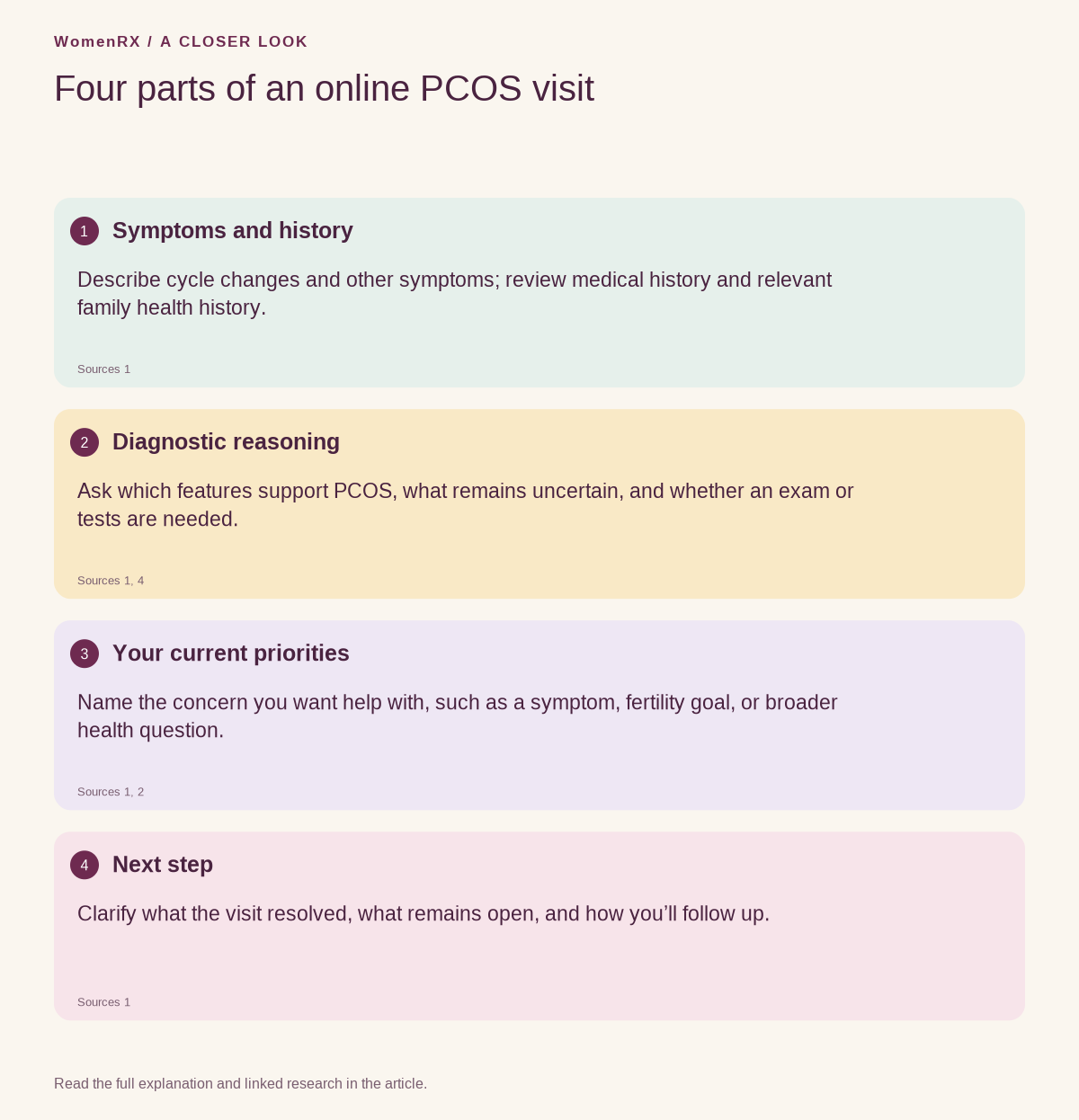
Four parts of an online PCOS visit
Symptoms and history: Describe cycle changes and other symptoms; review medical history and relevant family health history.1
Diagnostic reasoning: Ask which features support PCOS, what remains uncertain, and whether an exam or tests are needed.14
Your current priorities: Name the concern you want help with, such as a symptom, fertility goal, or broader health question.12
Next step: Clarify what the visit resolved, what remains open, and how you’ll follow up.1
Read the figure as text
Use these topics to keep a possible-diagnosis assessment distinct from ongoing care and clarify what the remote appointment can resolve.- Symptoms and history: Describe cycle changes and other symptoms; review medical history and relevant family health history.1
- Diagnostic reasoning: Ask which features support PCOS, what remains uncertain, and whether an exam or tests are needed.14
- Your current priorities: Name the concern you want help with, such as a symptom, fertility goal, or broader health question.12
- Next step: Clarify what the visit resolved, what remains open, and how you’ll follow up.1
More questions, answered
Does PCOS always mean ovarian cysts?
No. Ovarian appearance is only one possible part of the adult diagnostic framework. Ask how your symptoms and any test findings fit together rather than treating an ultrasound as the entire assessment. 1 4
What if the online visit can’t settle the diagnosis?
Ask which part of the assessment is still missing and whether an exam, blood tests, or another step would help answer the question. PCOS doesn’t have one definitive test. 1
Sources you can check
- PCOS | Polycystic Ovary Syndrome | MedlinePlusAccessed 2026-09-25Return to first citation
- Opportunities to improve the care of individuals with polycystic ovary syndrome in Canada: Systematic review.Patrick H, McAlister L, Pourtousi A, Badesha J, Liu SL, Tunio S, Clemens KK. · Canadian family physician Medecin de famille canadien · 2026Return to first citation
- The Impact of the COVID-19 Pandemic on Health and Health Care Experience in Those With Polycystic Ovary Syndrome.Sydora BC, Wilke MS, Ghosh M, Vine DF. · International journal of women's health · 2025Return to first citation
- From polycystic ovary syndrome to polyendocrine metabolic ovarian syndrome: what obstetricians and gynecologists need to know.Bahri-Khomami M, Hoeger KM, Huddleston H, Mahalingaiah S, Teede HJ, Dokras A. · American journal of obstetrics and gynecology · 2026Return to first citation