What Findings Are Needed to Diagnose PCOS?
For adults, PCOS is usually diagnosed from two of three findings, and ovarian appearance is only one possible part of the picture.
In adults, PCOS is generally diagnosed when at least two of three features are present: irregular ovulation or periods, clinical or blood-test evidence of higher androgens, and polycystic ovarian appearance on ultrasound or elevated AMH. Ultrasound isn’t required when the first two features are present. Adolescents need a more cautious assessment: both menstrual irregularity and androgen excess are needed, and ovarian appearance shouldn’t be used within eight years of the first period. 4 3
PCOS isn’t diagnosed by one symptom or test
There isn’t a single test that confirms PCOS. The diagnosis combines a pattern of findings with an assessment of other possible explanations. For adults, the criteria generally require at least two of these three features: irregular periods or ovulation, clinical or biochemical hyperandrogenism, and polycystic ovarian morphology. For the third feature, adults may have either an ultrasound showing that morphology or an elevated anti-Müllerian hormone (AMH) result. 1 4
That “two of three” rule is useful because PCOS can look different from one person to another. Someone with irregular cycles and signs of androgen excess may meet the criteria without an ultrasound. Someone with only one of those findings does not meet the adult criteria on that finding alone. 4 5
What each finding means
Irregular ovulation or periods: A history of irregular or absent periods can point to ovulatory dysfunction. A clinician considers the person’s menstrual pattern and circumstances rather than treating one missed or unusual period as proof of PCOS. Irregular periods can have other explanations, including thyroid problems, and missed periods can also occur with pregnancy. 2
Androgen excess: Androgens are hormones that everyone makes, though amounts and effects differ. Clinical signs can include excess facial or body hair; biochemical evidence comes from blood testing. A physical exam and hormone tests may help assess this part of the criteria. One sign by itself, such as unwanted hair, doesn’t establish PCOS because the diagnosis depends on the overall pattern. 1 4
Ovarian morphology: An ultrasound may show many small follicles, sometimes described as polycystic ovarian morphology. These aren’t necessarily pathologic cysts. In adults, this finding can count as one criterion, but it doesn’t diagnose PCOS on its own. AMH can also be used as an alternative way to assess this criterion in adults; levels used for interpretation vary by population and laboratory. 4 5
Why the rules differ for adolescents
During the years after periods begin, cycle patterns and ovarian appearance are still changing. Applying adult criteria without considering that development can lead to overdiagnosis. Adolescent criteria therefore call for menstrual irregularity, interpreted in relation to time since the first period, and clinical or biochemical evidence of androgen excess. 3
Ultrasound findings shouldn’t be used to diagnose PCOS in adolescents within eight years of menarche, because ovarian appearance can overlap with normal development. A young person with one suggestive feature may warrant follow-up rather than an immediate PCOS diagnosis. 4 3
Ruling out other explanations is part of the evaluation
The same symptoms can arise for reasons other than PCOS, so the evaluation may include tests for alternatives. Depending on the person’s history and examination, examples include checking thyroid function, prolactin, or 17-hydroxyprogesterone, which can help assess other hormone-related causes. The exact workup varies; those tests aren’t a checklist that everyone needs. 4
The practical takeaway: ask how each finding fits the criteria, whether your age and time since menarche change how it should be interpreted, and what other causes have been considered. If an adult has irregular cycles plus androgen excess, an ultrasound may add information but isn’t necessary to satisfy the two-of-three criteria. If an adolescent has only one feature, that finding alone doesn’t confirm PCOS.
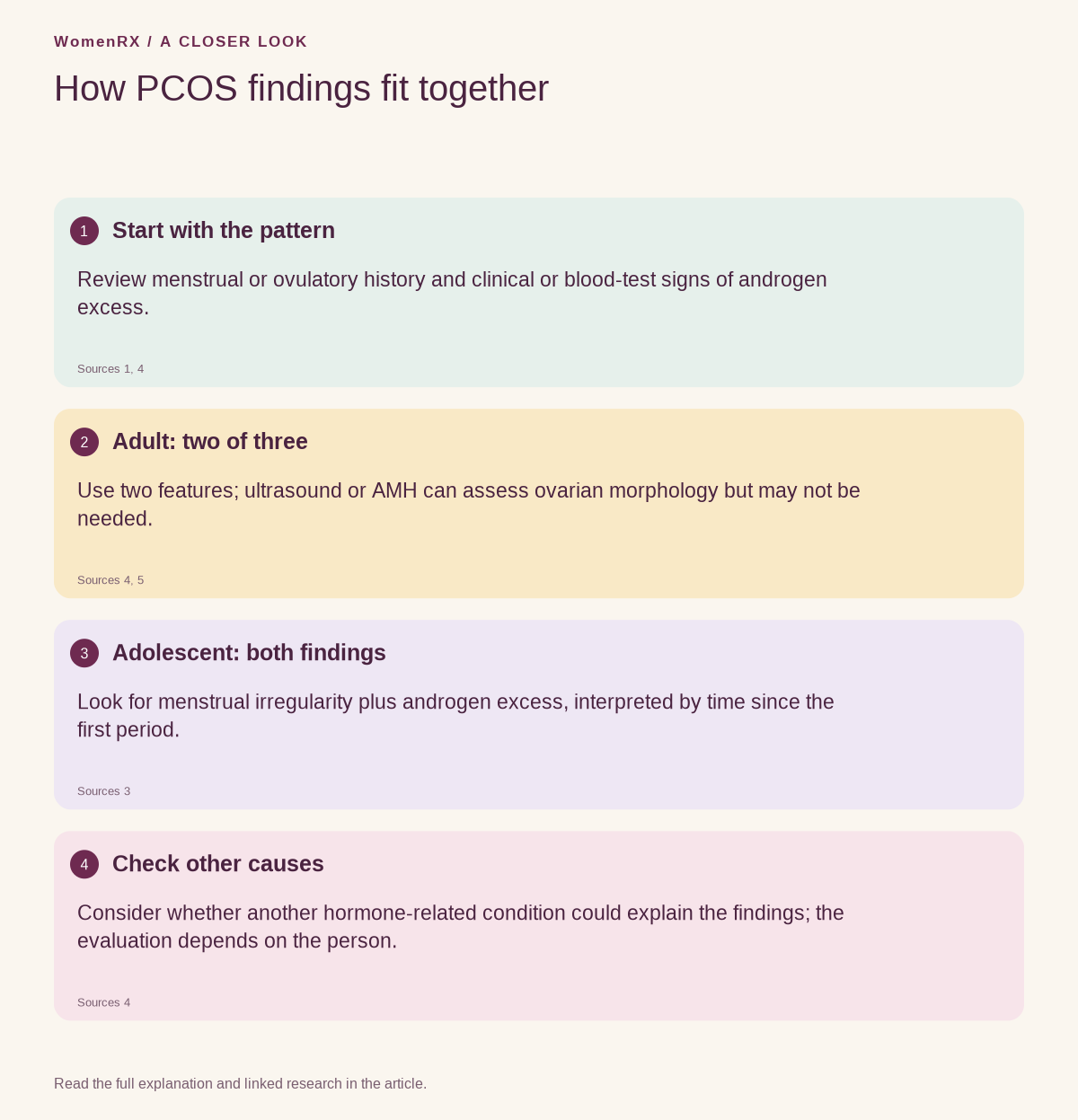
How PCOS findings fit together
Start with the pattern: Review menstrual or ovulatory history and clinical or blood-test signs of androgen excess.14
Adult: two of three: Use two features; ultrasound or AMH can assess ovarian morphology but may not be needed.45
Adolescent: both findings: Look for menstrual irregularity plus androgen excess, interpreted by time since the first period.3
Check other causes: Consider whether another hormone-related condition could explain the findings; the evaluation depends on the person.4
Read the figure as text
The diagnostic route depends on whether the person is an adult or an adolescent, and other explanations may need assessment.- Start with the pattern: Review menstrual or ovulatory history and clinical or blood-test signs of androgen excess.14
- Adult: two of three: Use two features; ultrasound or AMH can assess ovarian morphology but may not be needed.45
- Adolescent: both findings: Look for menstrual irregularity plus androgen excess, interpreted by time since the first period.3
- Check other causes: Consider whether another hormone-related condition could explain the findings; the evaluation depends on the person.4
More questions, answered
Can an ultrasound alone diagnose PCOS?
No. Ovarian morphology is one possible adult criterion, but PCOS generally requires at least two of three features. In adolescents within eight years of their first period, ultrasound morphology shouldn’t be used to make the diagnosis. 4 5
Can someone meet the adult criteria without an ultrasound?
Yes. If an adult has both irregular ovulation or periods and clinical or biochemical androgen excess, those two findings can meet the criteria without ultrasound. 4
Sources you can check
- PCOS | Polycystic Ovary Syndrome | MedlinePlusAccessed 2026-09-25Return to first citation
- Irregular periods - NHSAccessed 2026-09-25Return to first citation
- Prevalence of polycystic ovary syndrome among adolescents depending on the adopted diagnostic criteria.Jakubowska-Kowal K, Skrzyńska K, Kowalczyk K, Gawlik-Starzyk A. · Frontiers in endocrinology · 2026Return to first citation
- Approach to the Patient: Diagnostic Challenges in the Workup for Polycystic Ovary Syndrome.Joham AE, Tay CT, Laven J, Louwers YV, Azziz R. · The Journal of clinical endocrinology and metabolism · 2025Return to first citation
- From polycystic ovary syndrome to polyendocrine metabolic ovarian syndrome: what obstetricians and gynecologists need to know.Bahri-Khomami M, Hoeger KM, Huddleston H, Mahalingaiah S, Teede HJ, Dokras A. · American journal of obstetrics and gynecology · 2026Return to first citation