PCOS Diagnosis and Treatment Depend on Your Goals
A PCOS evaluation looks at the pattern behind your symptoms, then connects care to what matters most to you.
PCOS isn’t confirmed by one missed period, one hormone result, or an ultrasound alone. In adults, diagnosis generally requires two of three features: androgen excess, irregular ovulation, or a characteristic ovarian finding. 34 Pregnancy, hormonal contraception, and thyroid problems can also affect periods. 2 Adolescents need a different approach. Care then depends on whether your priority is periods, hair or acne, metabolic health, or pregnancy. 54
Start with the pattern, not the name
Periods that come unpredictably, new facial hair, persistent acne, or trouble getting pregnant can all prompt a PCOS evaluation. They don’t all have to happen together. Irregular ovulation can make periods infrequent and conception harder, while higher androgen activity can show up as excess facial or body hair. PCOS also involves health concerns beyond the ovaries, including a higher risk of type 2 diabetes. 13
That range of experiences is why the first question is what is happening in your body, not simply whether an ultrasound shows “cysts.” An adult can have PCOS without that ovarian appearance, and the appearance alone doesn’t establish the diagnosis. 13
What an adult evaluation can clarify
Adult diagnostic guidance looks for two of three features: clinical or blood-test evidence of androgen excess; irregular ovulation; and characteristic ovarian findings assessed by ultrasound or, in adults, an appropriately interpreted anti-Müllerian hormone (AMH) result. AMH is an alternative way to assess the ovarian feature, not a stand-alone PCOS test. Its interpretation depends on factors including age, the laboratory assay, and use of combined oral contraceptives. 34
An evaluation may include your cycle history, symptoms, an examination, and hormone blood tests. A change in your periods can also have other explanations. For example, pregnancy, hormonal contraception, and thyroid problems can affect bleeding patterns. Which tests help will depend on your symptoms and circumstances; there’s no single blood test that settles every PCOS question. 12
The assessment shouldn’t stop once the diagnosis is made. PCOS is associated with metabolic risks, so guidance summarized in 2024 recommends assessing blood pressure, blood sugar status, and blood lipids, with later follow-up shaped by a person’s risk profile. That matters even if the symptom that brought you in was acne or irregular periods. 4
Why teenagers are assessed differently
Irregular cycles can be part of the years after a first period, and ovarian findings common in adolescence can be misleading. For an adolescent PCOS diagnosis, international recommendations require both irregular cycles, judged by time since the first period, and clinical or biochemical androgen excess, after other conditions that resemble PCOS are excluded. Ultrasound appearance and AMH should not be used to diagnose PCOS during adolescence. 5
A teenager with just one of the two required features can be considered at risk rather than given a firm PCOS diagnosis. That isn’t a reason to ignore a bothersome symptom: the adolescent recommendations support symptom care and follow-up while the picture becomes clearer. They also call for attention to metabolic and emotional health. 5
Treatment starts with what you want help with
There isn’t one medicine that addresses every part of PCOS. For example, someone who wants more predictable periods and relief from androgen-related symptoms, and isn’t trying to conceive, may discuss hormonal birth control. Combined oral contraceptive pills are also an option in adolescent guidance for irregular periods and clinical androgen excess. Whether a particular contraceptive is suitable is a separate decision from whether PCOS is present. 15
If metabolic health is the main concern, follow-up of blood sugar, blood pressure, and lipids deserves its own place in the plan. Healthy lifestyle support is recommended across PCOS care, but the guideline summary does not identify one specific diet or exercise type as best for everyone. Metformin may be considered for metabolic features in adolescents; it should not be treated as an automatic substitute for every other PCOS treatment. 45
If you’re trying to get pregnant, the conversation changes. Hormonal birth control used to manage symptoms doesn’t fit that immediate goal. Irregular ovulation may be part of the difficulty, but other causes of infertility also need consideration. For PCOS-related anovulation when fertility treatment is needed, a summary of the international guideline identifies letrozole as the first-line medication to induce ovulation after other causes of infertility are excluded. It also notes that metformin may be considered for infertility, while more effective ovulation-induction medicines are available. These are treatment choices to discuss in the context of your full fertility evaluation, not a reason to assume PCOS is the only factor. 124
PCOS care can change as your goals change. A plan focused on acne today may need a different approach if pregnancy becomes a goal; meanwhile, metabolic follow-up still matters. The useful outcome of an evaluation is both a clearer diagnosis and a plan that names which concern each part of care is meant to address. 14
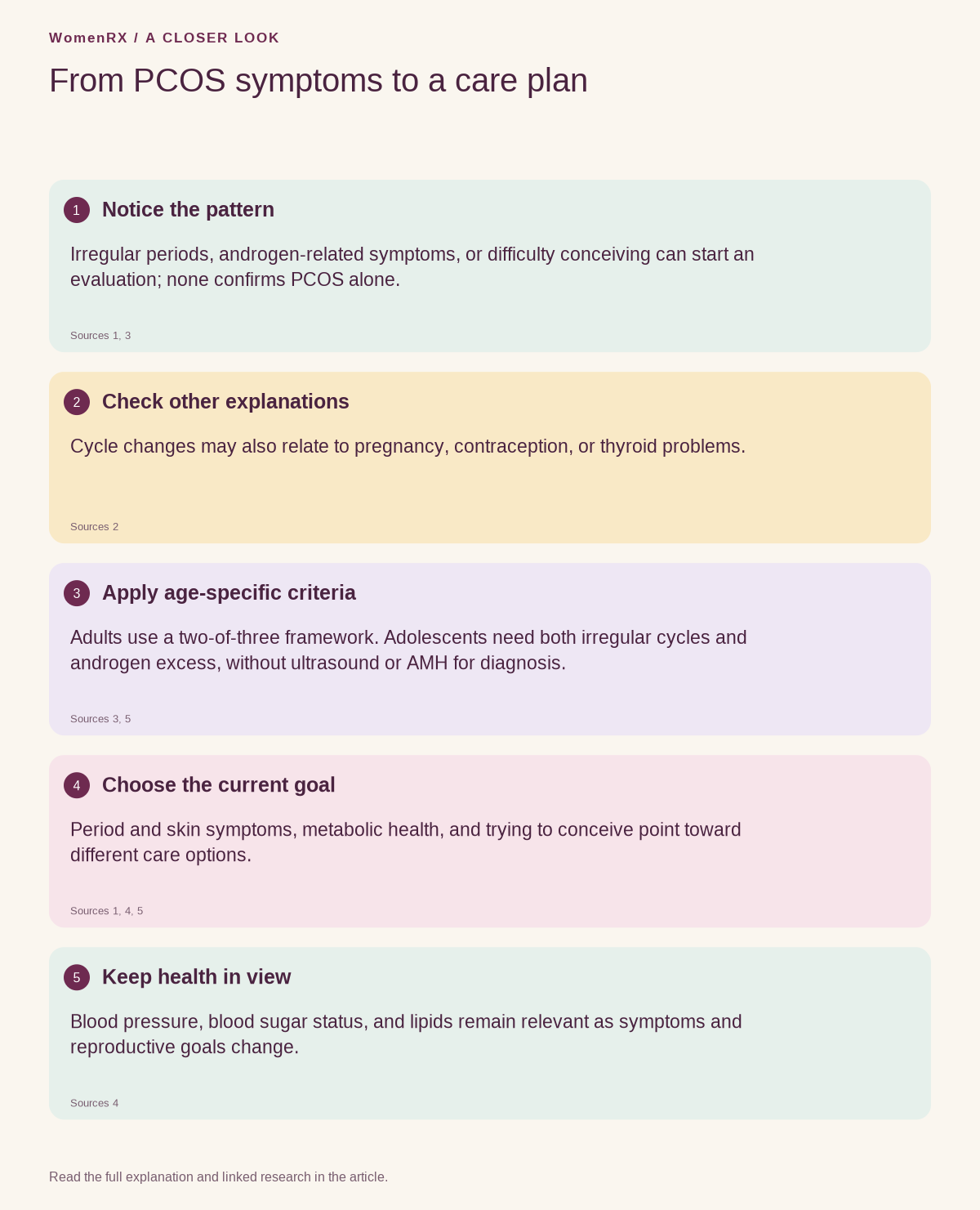
From PCOS symptoms to a care plan
Notice the pattern: Irregular periods, androgen-related symptoms, or difficulty conceiving can start an evaluation; none confirms PCOS alone.13
Check other explanations: Cycle changes may also relate to pregnancy, contraception, or thyroid problems.2
Apply age-specific criteria: Adults use a two-of-three framework. Adolescents need both irregular cycles and androgen excess, without ultrasound or AMH for diagnosis.35
Choose the current goal: Period and skin symptoms, metabolic health, and trying to conceive point toward different care options.145
Keep health in view: Blood pressure, blood sugar status, and lipids remain relevant as symptoms and reproductive goals change.4
Read the figure as text
The steps show why diagnosis and treatment depend on more than one symptom.- Notice the pattern: Irregular periods, androgen-related symptoms, or difficulty conceiving can start an evaluation; none confirms PCOS alone.13
- Check other explanations: Cycle changes may also relate to pregnancy, contraception, or thyroid problems.2
- Apply age-specific criteria: Adults use a two-of-three framework. Adolescents need both irregular cycles and androgen excess, without ultrasound or AMH for diagnosis.35
- Choose the current goal: Period and skin symptoms, metabolic health, and trying to conceive point toward different care options.145
- Keep health in view: Blood pressure, blood sugar status, and lipids remain relevant as symptoms and reproductive goals change.4
More questions, answered
Can I have PCOS if an ultrasound looks normal?
Yes. In adults, androgen excess and irregular ovulation can meet two diagnostic features without a characteristic ovarian finding. Ultrasound isn’t used to diagnose PCOS in adolescents. 135
Does PCOS mean I can’t get pregnant?
No. Many women with PCOS can get pregnant. Irregular ovulation can make conception harder, and if you’re having difficulty, an evaluation can look beyond PCOS as well as discuss treatment for ovulation. 14
Sources you can check
- PCOS | Polycystic Ovary Syndrome | MedlinePlusAccessed 2026-09-25Return to first citation
- Irregular periods - NHSAccessed 2026-09-25Return to first citation
- Polycystic ovary syndrome.Stener-Victorin E, Teede H, Norman RJ, Legro R, Goodarzi MO, Dokras A, Laven J, Hoeger K, Piltonen TT. · Nature reviews. Disease primers · 2024Return to first citation
- International evidence-based guideline on assessment and management of PCOS-A Nordic perspective.Forslund M, Melin J, Stener-Victorin E, Hirschberg AL, Teede H, Vanky E, Piltonen T. · Acta obstetricia et gynecologica Scandinavica · 2024Return to first citation
- International evidence-based recommendations for polycystic ovary syndrome in adolescents.Peña AS, Witchel SF, Boivin J, Burgert TS, Ee C, Hoeger KM, Lujan ME, Mousa A, Oberfield S, Tay CT, Teede H. · BMC medicine · 2025Return to first citation