How PCOS Is Diagnosed and What Tests May Help
A PCOS diagnosis brings together cycle patterns, signs of higher androgens, and sometimes ovarian findings, while checking for other possible causes.
There’s no single test for PCOS. In adults, diagnosis generally requires two of three findings: ovulatory dysfunction, signs or blood-test evidence of higher androgens, and characteristic ovarian findings on ultrasound or an elevated anti-Müllerian hormone (AMH) level. A clinician also considers other causes of irregular periods. Adolescents are assessed differently: ultrasound findings and AMH aren’t used as diagnostic criteria. 1456
The adult criteria: two findings, not one decisive test
If your periods are unpredictable, you’ve noticed more facial hair, or an ultrasound report mentions polycystic ovaries, it’s reasonable to wonder whether you have PCOS. Each can be a clue, but none establishes the diagnosis on its own.
For adults, the commonly used approach looks for at least two of three findings: ovulatory dysfunction, clinical or blood-test evidence of higher androgens, and characteristic ovarian findings. Under the 2023 international guideline, an elevated anti-Müllerian hormone (AMH) level can be used instead of ultrasound to assess the ovarian-finding criterion in adults. Irregular periods can have other explanations, too. 4567
Those criteria can fit different combinations. For example, if an adult has irregular ovulation and clear evidence of higher androgens, an ovarian ultrasound isn’t needed to supply a second criterion. On the other hand, an ultrasound finding alone supplies only one piece of the picture. PCOS can also be present without characteristic ovarian findings. 15
What each part of the assessment tells you
Cycle history looks for ovulatory dysfunction. A clinician may ask when your periods began, how often they come, whether their pattern has changed, and whether you use hormonal contraception. Irregular periods can suggest that ovulation isn’t happening regularly, but they have other possible causes, including pregnancy, thyroid problems, changes around puberty or menopause, and hormonal contraception. 14
Symptoms and hormone blood tests assess androgens. The exam may look for signs such as extra facial or body hair. Blood tests may help assess hormone levels when the picture isn’t clear. A hormone result is interpreted alongside symptoms and cycle history, rather than serving as a stand-alone PCOS test. 15
Ultrasound or AMH may assess the ovarian criterion in adults. The ultrasound finding describes an ovarian appearance; it isn’t the whole diagnosis. AMH is an alternative way to assess that same criterion in adults, not a fourth criterion or a universal PCOS blood test. If the other two criteria are already established, neither test is necessarily needed to complete the diagnostic picture. 567
Why other causes may lead to different tests
Part of a useful PCOS evaluation is asking whether something else better explains a missed period or a particular set of symptoms. That’s why the tests one person needs may differ from another’s. There’s no single PCOS blood-test panel that settles every case. 14
For example, pregnancy is a possible explanation for a missed period and belongs in the discussion when it’s possible. Thyroid problems can affect periods; if thyroid disease is a concern, a thyroid-stimulating hormone (TSH) blood test is usually the first thyroid test ordered. These checks address alternative explanations, not the ovarian or androgen criteria for PCOS. 24
A clinician may also pursue a less common cause when the overall pattern points to one. For example, Cushing’s syndrome can involve changes such as relatively more fat around the trunk, easy bruising, and stretch marks. When it’s suspected, testing may measure cortisol in blood, urine, or saliva. That’s a targeted investigation, not a test everyone with possible PCOS needs. 3
The rules are different for teenagers
Periods can be irregular when they first start, so an irregular cycle in a teenager deserves context rather than an automatic PCOS label. Unlike adult assessment, adolescent diagnosis does not use ovarian ultrasound appearance or AMH as criteria. A clinician can look at cycle patterns and signs of higher androgens while considering other explanations. 145
The useful question, at any age, is which findings the clinician thinks are present and what else could explain them. That makes it easier to understand why an ultrasound might add something in one adult evaluation, while a thyroid test or a closer look at cycle history matters more in another. 125
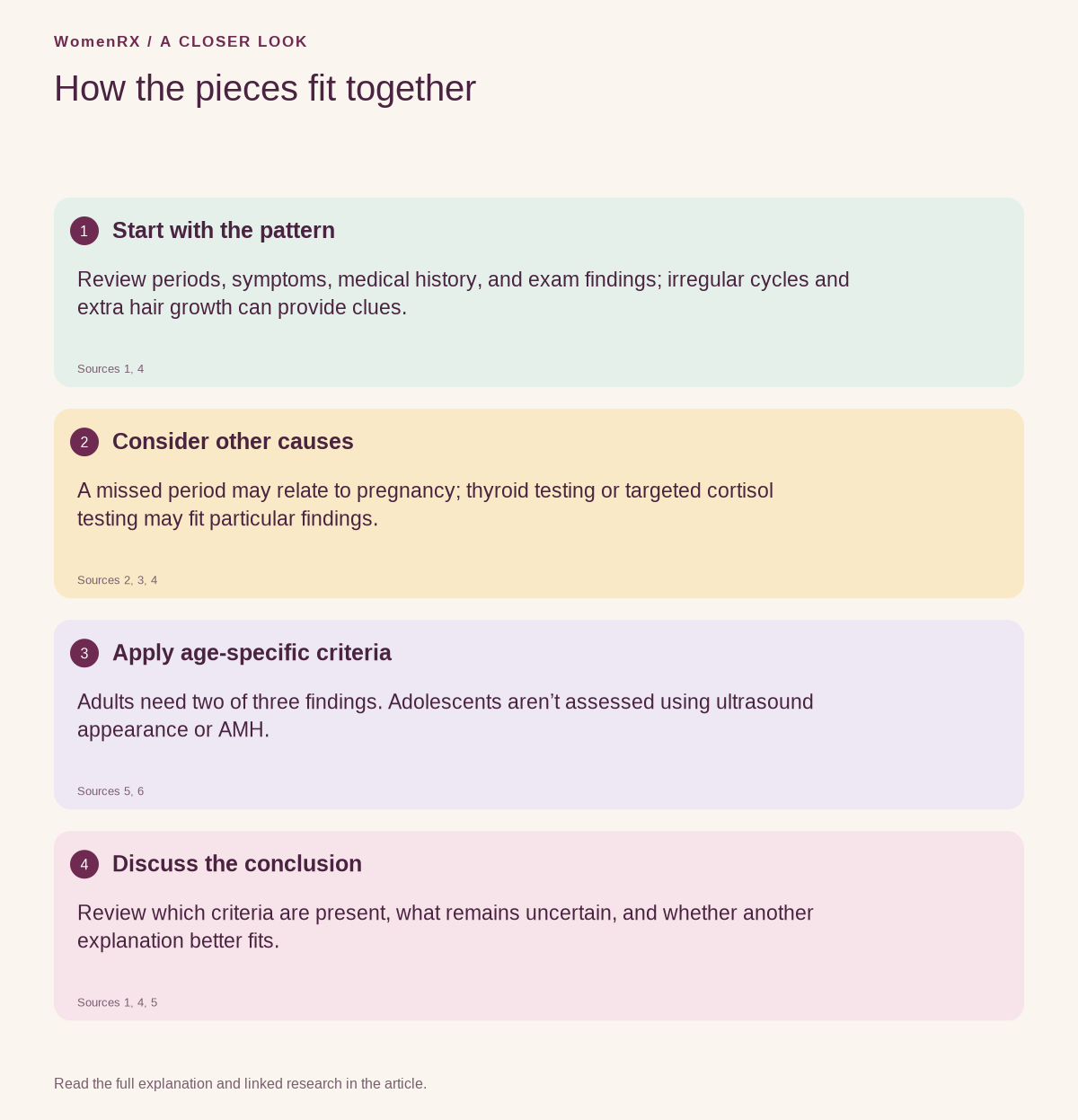
How the pieces fit together
Start with the pattern: Review periods, symptoms, medical history, and exam findings; irregular cycles and extra hair growth can provide clues.14
Consider other causes: A missed period may relate to pregnancy; thyroid testing or targeted cortisol testing may fit particular findings.234
Apply age-specific criteria: Adults need two of three findings. Adolescents aren’t assessed using ultrasound appearance or AMH.56
Discuss the conclusion: Review which criteria are present, what remains uncertain, and whether another explanation better fits.145
Read the figure as text
A PCOS evaluation considers diagnostic findings and other explanations before reaching a conclusion.- Start with the pattern: Review periods, symptoms, medical history, and exam findings; irregular cycles and extra hair growth can provide clues.14
- Consider other causes: A missed period may relate to pregnancy; thyroid testing or targeted cortisol testing may fit particular findings.234
- Apply age-specific criteria: Adults need two of three findings. Adolescents aren’t assessed using ultrasound appearance or AMH.56
- Discuss the conclusion: Review which criteria are present, what remains uncertain, and whether another explanation better fits.145
More questions, answered
Can I have PCOS if my ultrasound looks normal?
Yes. An adult can meet the criteria through ovulatory dysfunction and higher androgens without the ovarian-finding criterion. Ultrasound also isn’t used as a diagnostic criterion in adolescents. 15
Does a high AMH result mean I have PCOS?
Not by itself. In adults, elevated AMH can be used instead of ultrasound to assess one of the three diagnostic criteria. It doesn’t replace assessment of cycle patterns, androgens, and other possible causes of irregular periods. AMH isn’t used as a diagnostic criterion in adolescents. 456
Sources you can check
- PCOS | Polycystic Ovary Syndrome | MedlinePlusAccessed 2026-09-25Return to first citation
- Thyroid Tests: MedlinePlusAccessed 2026-09-25Return to first citation
- Cushing's syndrome - NHSAccessed 2026-09-25Return to first citation
- Irregular periods - NHSAccessed 2026-09-25Return to first citation
- Polycystic ovary syndrome.Stener-Victorin E, Teede H, Norman RJ, Legro R, Goodarzi MO, Dokras A, Laven J, Hoeger K, Piltonen TT. · Nature reviews. Disease primers · 2024Return to first citation
- Recommendations from the 2023 international evidence-based guideline for the assessment and management of polycystic ovary syndrome.Teede HJ, Tay CT, Laven JJE, Dokras A, Moran LJ, Piltonen TT, Costello MF, Boivin J, Redman LM, Boyle JA, Norman RJ, Mousa A, Joham AE, International PCOS Network. · European journal of endocrinology · 2023Return to first citation
- A New Diagnostic Strategy for Polycystic Ovary Syndrome Combining Japanese and International Diagnostic Criteria Using Anti-Müllerian Hormone.Noguchi H, Iwasa T, Iwase A, Kanasaki H, Kimura F, Kugu K, Saito K, Baba T, Hara T, Matsuzaki T. · The journal of obstetrics and gynaecology research · 2026Return to first citation