Why Metformin May Be Offered for PCOS
Metformin is usually considered for a specific metabolic or cycle-related goal, not as a treatment that fixes every part of PCOS.
Metformin may be offered when PCOS care is focused on insulin-related metabolic concerns, or sometimes on irregular cycles and ovulation. The useful question is what you want to improve: metabolic measures, cycle patterns, or fertility planning. Those goals call for different ways to review progress, and metformin doesn’t guarantee regular cycles, ovulation, or pregnancy. 2 1
Start with the reason it was offered
PCOS can affect metabolic health, menstrual cycles, ovulation, and androgen-related symptoms in different ways. Metformin is an insulin-sensitizing medicine. In PCOS, the treatment rationale may be to address elevated insulin levels and related metabolic concerns; changes in insulin can also affect ovarian function and cycle patterns. That doesn’t make metformin a general PCOS treatment, or mean it’s necessary for everyone. 2
Before starting, or at a follow-up, try to name the main goal in plain language: “We’re focusing on my metabolic health,” “We’re hoping my cycles become more predictable,” or “I’m trying to conceive.” One goal may matter more than another, and the plan should reflect that.
Match the review to your priority
If metabolic health is the focus
Ask which starting measures are relevant to you and which ones will be revisited. A clinical trial in women with PCOS tracked fasting blood glucose and lipid measures, among other outcomes. Those are examples of measures that can help frame a conversation about metabolic goals; the study does not establish that every person taking metformin needs the same testing schedule. 1
It may also help to agree on what would count as a meaningful change for you. A change in a lab measure, for example, is different from a change in how you feel day to day. Don’t assume that changes in weight, symptoms, or a single test result will tell the whole story.
If cycles or ovulation are the focus
Keep the outcome specific. You might review whether bleeding is becoming more predictable, or whether there’s evidence of ovulation if that’s part of your care plan. Metformin may improve menstrual cyclicity and promote ovulation in some women with PCOS, but individual responses can differ. A cycle change is not the same thing as proof of ovulation, and neither guarantees pregnancy. 2 1
If pregnancy isn’t your goal, mention that too. A treatment associated with ovulation returning can affect pregnancy plans, even when cycles have been infrequent. 2
If you’re planning a pregnancy
Clarify whether the goal is to improve metabolic health, support ovulation, or pursue pregnancy, since these aren’t interchangeable outcomes. One randomized trial enrolled 196 infertile women with PCOS and compared metformin, myoinositol, a herbal extract, and placebo over 12 weeks. Participants also received letrozole for ovulation induction; pregnancy rates didn’t differ significantly between the groups. Because letrozole was used alongside the study treatments, those results don’t show that metformin alone caused pregnancies or that it guarantees a fertility benefit. 1
Ask how metformin fits alongside any specific ovulation-induction plan, and how the team will assess the outcome you care about. If acne or excess hair growth is your main concern, say so: those symptoms involve androgen effects, and treatments aimed at those effects work differently from metformin’s insulin-related rationale. 2
A practical way to check whether the plan fits
At a follow-up, you could ask: “What was the main goal for prescribing metformin? What change are we looking for, and how will we assess it? If that change doesn’t happen, when should we revisit the plan?” These questions keep the conversation tied to your priority rather than an expectation that one medication will address every PCOS symptom.
Metformin’s possible benefits are not identical for everyone. The most useful review is therefore a comparison between your original goal and the outcome you agreed to watch, not a vague judgment that PCOS is either “fixed” or “not fixed.” 2
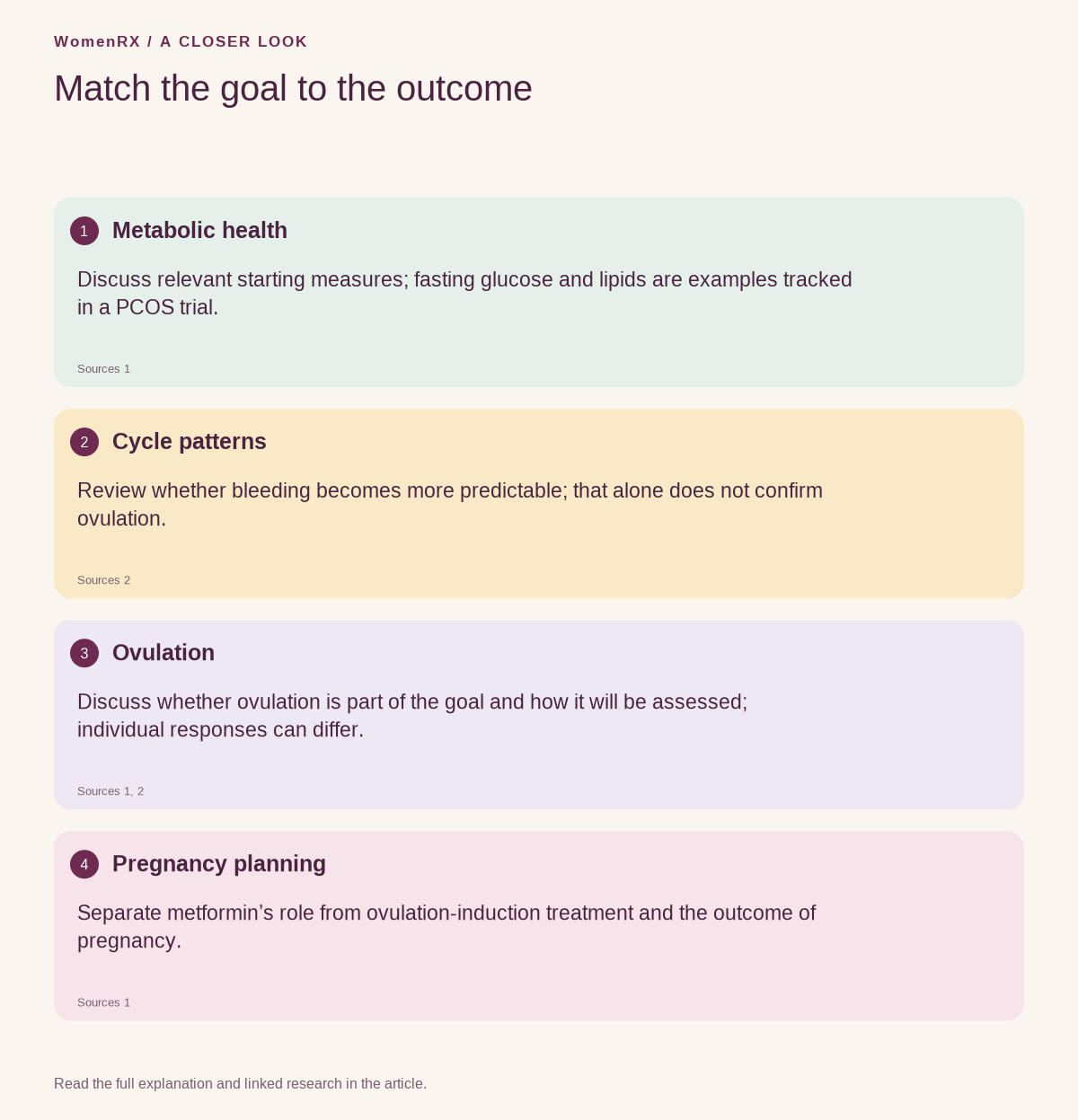
Match the goal to the outcome
Metabolic health: Discuss relevant starting measures; fasting glucose and lipids are examples tracked in a PCOS trial.1
Cycle patterns: Review whether bleeding becomes more predictable; that alone does not confirm ovulation.2
Ovulation: Discuss whether ovulation is part of the goal and how it will be assessed; individual responses can differ.12
Pregnancy planning: Separate metformin’s role from ovulation-induction treatment and the outcome of pregnancy.1
Read the figure as text
Metformin may be discussed for different PCOS priorities. This flow separates the goal from the outcome to review, without implying a guaranteed result.- Metabolic health: Discuss relevant starting measures; fasting glucose and lipids are examples tracked in a PCOS trial.1
- Cycle patterns: Review whether bleeding becomes more predictable; that alone does not confirm ovulation.2
- Ovulation: Discuss whether ovulation is part of the goal and how it will be assessed; individual responses can differ.12
- Pregnancy planning: Separate metformin’s role from ovulation-induction treatment and the outcome of pregnancy.1
More questions, answered
Does metformin guarantee ovulation or pregnancy?
No. Reviews describe possible improvements in menstrual cyclicity and ovulation, but that isn’t a guarantee of pregnancy. In one trial where women also received letrozole, pregnancy rates did not differ significantly among the four study groups. 2 1
Sources you can check
- Effects of Ziziphus jujuba, metformin, and myoinositol on pregnancy rates and metabolic parameters in infertile women with PCOS: a randomized controlled trial.Mashhadi F, Ghaebi NK, Rakhshandeh H, Khadem-Rezaiyan M, Roudi F, Nematy M. · Journal of ovarian research · 2026Return to first citation
- The role of combined Metformin and pharmaceutical molecules with anti-androgenic properties in the therapy of PCOS in adult women.Antoniou-Tsigkos A, Karras G, Papagianni M, Christopoulos P, F Vlahos N, Mastorakos G. · Endocrine · 2025Return to first citation