PCOS Treatment Options: What Can Stand in for Metformin?
Lifestyle support, inositol, and other medicines may help with particular PCOS goals, but they don’t all target the same things as metformin.
The evidence doesn’t establish a nonprescription option as equivalent to metformin across PCOS outcomes. Lifestyle support is recommended broadly, while metformin is used for metabolic concerns. Inositol has evidence for changes in some hormone markers. A review also reports comparable cycle normalization with metformin and a short trial reporting improved hirsutism scores, but these findings do not establish equivalence for metabolic concerns or across PCOS outcomes. Other medicines may address weight or cycles instead, so the right comparison depends on your goal. 2 4 5
First, match the treatment to the goal
Metformin is an insulin-sensitizing medicine used in PCOS care, so it’s most relevant when the concern is metabolic. An option that helps with periods, acne, hair growth, or weight may still be useful, but it isn’t automatically a like-for-like replacement. PCOS can involve reproductive, hormonal, and metabolic concerns, and treatment is chosen to address the ones that matter to you. 1 5
If metformin is hard to tolerate, the useful question is not simply “What’s natural?” It’s “Which concern was metformin meant to address, and what evidence-based option targets that same concern?” Neither lifestyle recommendations nor inositol’s hormone-marker findings establish that either can replace metformin across PCOS outcomes. 2 4
Lifestyle support: a foundation, not a pill substitute
Lifestyle approaches, including changes to eating, physical activity, and behavioral support, are recommended across PCOS presentations and weight categories. The benefits described in the guideline summary include metabolic health, general health, quality of life, body composition, and weight management. That makes lifestyle support relevant whether or not you take metformin. It doesn’t establish that lifestyle changes will produce the same effect as metformin for a particular metabolic measure or symptom. 2
A practical distinction: lifestyle support is broad care that can accompany medication; it is not a supplement with a specific dose or a proven one-for-one replacement effect. That broad recommendation does not establish any particular diet or exercise plan as metformin-equivalent. 2
Inositol: promising hormone-marker findings, unanswered symptom questions
Myo-inositol and related inositol supplements are often considered because they’re involved in insulin signaling. A 2026 systematic review and meta-analysis included nine randomized trials with 440 women with PCOS. It found improvements in measured androgen markers, including total and free testosterone measures, and an increase in SHBG. Results varied across studies. The clearest subgroup finding was in normal-weight participants; the authors treated subgroup results as exploratory. 4
Those lab changes alone don’t establish symptom benefits. There is some separate clinical evidence: a narrative review summarizes a 26-trial meta-analysis that found myo-inositol and metformin comparable for cycle normalization. It also reports a 12-week trial in which myo-inositol reduced hirsutism scores compared with metformin. 5 These outcome-specific findings do not establish that inositol works as well as metformin for metabolic concerns or across PCOS outcomes. The androgen-marker review called for better trials measuring hirsutism, ovulatory function, and patient-reported outcomes. 4 A broader network meta-analysis of 16 trials found no statistically significant effect on HOMA-IR for the treatments it compared, and noted heterogeneity; that result does not prove the treatments have no effects, but it underscores how uncertain comparisons can be. 2 4
Pregnancy intentions matter here. Studies of androgen markers cannot establish pregnancy safety. “Natural” doesn’t establish safety during pregnancy, and those findings don’t settle whether to use inositol while trying to conceive or pregnant. 4
Other medicines may target a different outcome
For irregular periods, acne, or excess facial and body hair, hormonal birth control may help regulate periods and improve acne and hair symptoms. It is an option only if you’re not currently trying to get pregnant, so it serves a different purpose from metabolic treatment. 1
For weight concerns, GLP-1 receptor agonists have been studied in women with PCOS, including in an add-on comparison. A systematic review of 11 randomized trials concluded that these medicines are associated with modest short-term weight loss in women with PCOS and overweight or obesity. Its add-on comparison found a modest BMI reduction versus control, with low-certainty evidence. The review couldn’t draw firm conclusions about glucose, insulin, hirsutism, or menstrual regularity. This is emerging medication evidence, not proof that these drugs replace metformin for all PCOS goals. 3 That review does not establish pregnancy safety for GLP-1 medicines. 3
A useful comparison if metformin isn’t working for you
Write down the outcome you hoped metformin would improve: for example, a metabolic concern, weight, or cycle regularity. Then compare possible alternatives against that specific outcome, not against the word “PCOS” as a whole. Ask whether the evidence measures a meaningful symptom or only a lab value, whether the option is meant to be added to other care, and whether pregnancy intentions change the choice. For inositol in particular, findings about androgen markers don’t establish pregnancy safety. 3 4
The evidence does not support treating lifestyle changes, inositol, hormonal birth control, or GLP-1 medicines as interchangeable. Each has a different target and different limits. If metformin was prescribed for a metabolic reason, a treatment aimed mainly at cycle symptoms may not address that reason; if your main concern is periods or acne, metformin may not be the most directly targeted option. 1 3 5
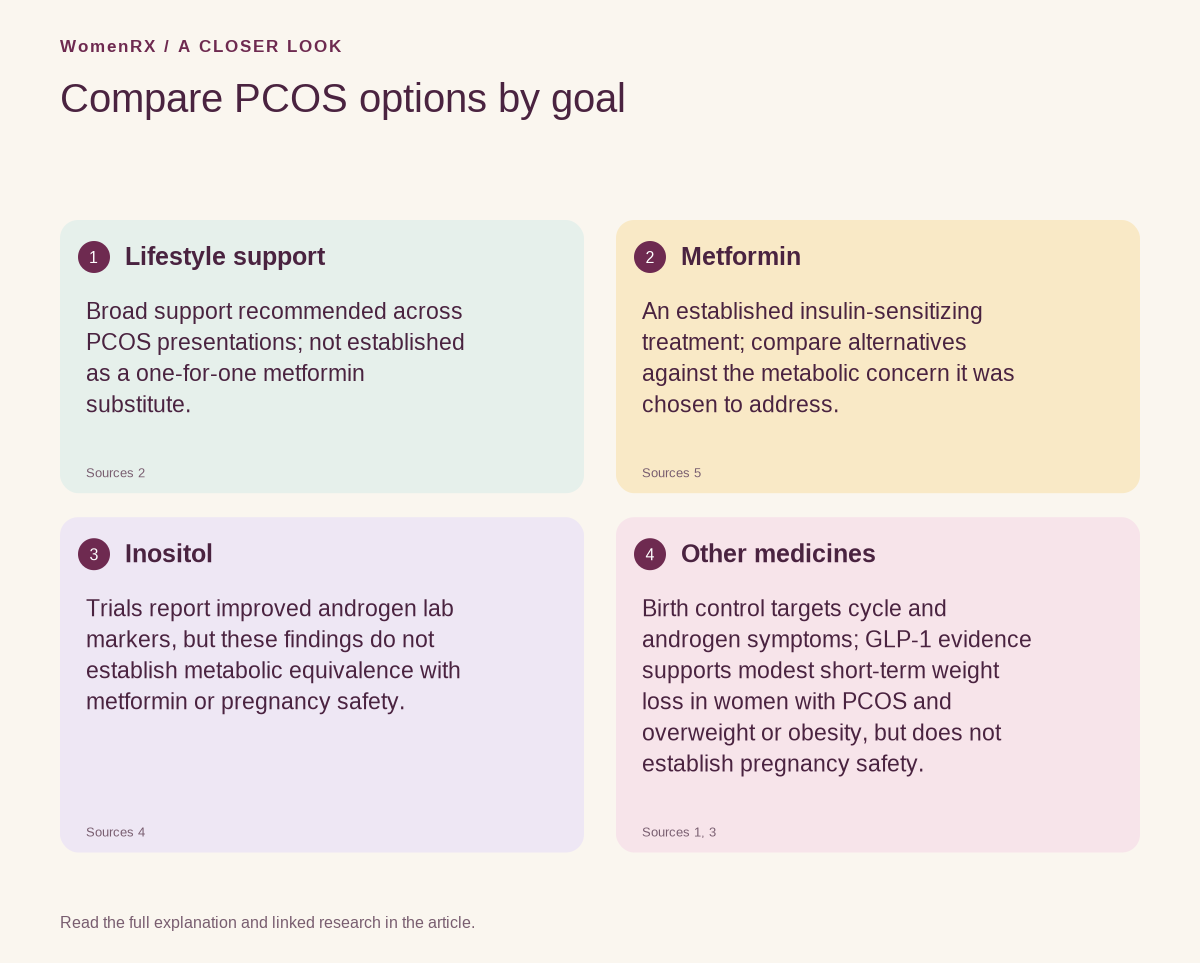
Compare PCOS options by goal
Lifestyle support: Broad support recommended across PCOS presentations; not established as a one-for-one metformin substitute.2
Metformin: An established insulin-sensitizing treatment; compare alternatives against the metabolic concern it was chosen to address.5
Inositol: Trials report improved androgen lab markers, but these findings do not establish metabolic equivalence with metformin or pregnancy safety.4
Other medicines: Birth control targets cycle and androgen symptoms; GLP-1 evidence supports modest short-term weight loss in women with PCOS and overweight or obesity, but does not establish pregnancy safety.13
Read the figure as text
These options address different concerns; whether one could replace metformin depends on the outcome being treated.- Lifestyle support: Broad support recommended across PCOS presentations; not established as a one-for-one metformin substitute.2
- Metformin: An established insulin-sensitizing treatment; compare alternatives against the metabolic concern it was chosen to address.5
- Inositol: Trials report improved androgen lab markers, but these findings do not establish metabolic equivalence with metformin or pregnancy safety.4
- Other medicines: Birth control targets cycle and androgen symptoms; GLP-1 evidence supports modest short-term weight loss in women with PCOS and overweight or obesity, but does not establish pregnancy safety.13
More questions, answered
Does inositol work as well as metformin for PCOS?
Not across PCOS outcomes. A narrative review summarizes a 26-trial meta-analysis reporting comparable cycle normalization with myo-inositol and metformin, and a 12-week trial reporting reduced hirsutism scores with myo-inositol compared with metformin. 5 A separate review found improvements in androgen lab markers but called for better trials of clinical outcomes. These findings do not establish that inositol matches metformin for metabolic concerns or reliably improves ovulatory function. 2 4
Is inositol safe if I’m pregnant or trying to conceive?
Studies of androgen markers don’t answer pregnancy-safety questions. They don’t support assuming that inositol is safe in pregnancy just because it’s a supplement. 4
Sources you can check
- PCOS | Polycystic Ovary Syndrome | MedlinePlusAccessed 2026-09-25Return to first citation
- Comparative analysis of glucagon-like peptide-1 receptor agonists, metformin, and inositol in improving anthropometric and metabolic outcomes in women with polycystic ovary syndrome: a network meta-analysis.Omarion A, Ayasa Y, Omarion Z, Jayouse B, Ayesh H. · Frontiers in endocrinology · 2026Return to first citation
- GLP-1 receptor agonist treatment in women with polycystic ovary syndrome-a systematic review and meta-analysis.Forslund M, Wändell P, Forsberg L, Österberg M, Dagerhamn J, Wernersson E, Kärrman Fredriksson M, Ringborg A, Lindén Hirschberg A. · European journal of endocrinology · 2026Return to first citation
- Metabolic Phenotype Predicts Biochemical Response to Inositol Supplementation in Polycystic Ovary Syndrome: A Systematic Review and Meta-Analysis.Tienforti D, Puocci G, Venditti C, Gizzi V, Pisanò C, Cocci E, Perfetto E, D'Alessandro F, Spagnolo L, Baroni MG, Barbonetti A. · Clinical endocrinology · 2026Return to first citation
- Revisiting Metformin in the Management of Polycystic Ovary Syndrome (PCOS).Telagarapu VML, Nallamothu PD, Telagarapu VN, Nalluri SRC, Nathani S, Kopani CP, Yarraguntla V, Vyasalapu S. · Cureus · 2025Return to first citation