Eating Patterns That Can Fit Into PCOS Care
PCOS studies have tested several eating patterns, but short, small trials don’t establish one as best for everyone.
A sustainable PCOS eating approach depends on what you’re trying to support, such as blood sugar, cholesterol, symptoms, or fertility, and what you can maintain. Small, short studies suggest some patterns may affect particular measures, but they don’t show that one diet works best for everyone. A useful starting point is to choose a goal and discuss realistic options with your care team. 1234
Start with the goal, not a food rule
PCOS can involve different concerns, including metabolic health, menstrual patterns, symptoms related to hormones, and fertility. Those goals aren’t interchangeable, and a change in a lab value doesn’t automatically mean a visible symptom or fertility outcome will improve.
That distinction matters because PCOS diet studies have often tested specific outcomes over a short period. A 12-week trial of 29 adult women compared a lower-carbohydrate diet plus strength training with a standard diet plus strength training. It found differences between groups in some hormone measurements, but the abstract doesn’t establish that participants’ acne, excess hair growth, or hair loss improved. 1
Before trying to follow a named diet, ask: “What are we hoping this will help, and how will we tell?” The answer might involve blood sugar or lipids, cycle patterns, symptoms, or a fertility goal. If the main goal is pregnancy, ask how an eating change fits alongside other fertility care rather than treating diet as a guarantee of ovulation or conception.
What the diet comparisons can, and can’t, tell you
Lower carbohydrate: In a small randomized trial, 46 women with PCOS who were overweight or had obesity were assigned to a portfolio-style moderate-carbohydrate diet or a ketogenic diet; 40 completed the study. After eight weeks, both groups showed changes in several body measurements, metabolic markers, and reproductive hormones. The authors reported some differences between diets for particular measures, while Ferriman-Gallwey scores, a measure of excess hair growth, did not change significantly within or between groups. This short, small trial can’t show that either approach is best for PCOS overall. 4
Lower-AGEs: A separate 12-week trial compared two energy-restricted diets in people with overweight and a specific PCOS phenotype. Among participants who completed it, weight loss was similar between groups, while the low-AGEs group had a greater decrease in fasting glucose. Because both diets restricted energy and the study focused on a selected group, it doesn’t show that reducing dietary AGEs is necessary or the right choice for everyone with PCOS. 2
DASH: A published study protocol describes a planned comparison of DASH and a very low-carbohydrate diet, with blood sugar as its primary outcome and symptoms among its secondary outcomes. A protocol describes what researchers intend to test, not what the results are, so it can’t rank these approaches. The researchers also describe disagreement among experts about the best nutritional advice for PCOS. 3
Taken together, these studies suggest that different approaches may affect different measures. Their size, duration, and selected participant groups make it difficult to conclude which changes last, which matter most in daily life, or which results apply to you. Many studies focus on people with overweight or obesity, so their findings may not transfer to every person with PCOS. 1234
Make sustainability part of the comparison
A diet can look promising in a study and still be a poor fit for your routine, preferences, budget, or relationship with food. When you discuss options, consider these practical questions:
- What outcome matters most right now? A plan chosen for blood sugar may not answer a question about fertility or a specific symptom.
- What would be difficult to keep up? Be direct about food preferences, family meals, work schedules, and past experiences with restrictive rules.
- How will we assess the result? Agree on a relevant measure rather than assuming that weight change predicts every PCOS outcome.
- What other support belongs in the plan? Ask how food choices fit alongside movement, medical care, and any fertility support relevant to your goals.
A lifestyle-promotion trial in adolescents included balanced-diet advice, physical activity, and behavior-change support. It reported improvements in some outcomes, including menstrual regularity and acne, but because it tested a combined program in adolescents, it can’t show that diet alone caused those changes or that the same results apply to adults. 5
A useful next move
Bring one priority and one concern to a discussion with your clinician or a registered dietitian. For example: “My main goal is improving blood sugar, but I don’t want a highly restrictive plan. What eating approaches could fit, and what would we monitor?” If your priority is fertility or symptoms, name that instead. The aim is not to find a universally perfect PCOS diet; it’s to choose an approach that matches your goal and is realistic to continue.
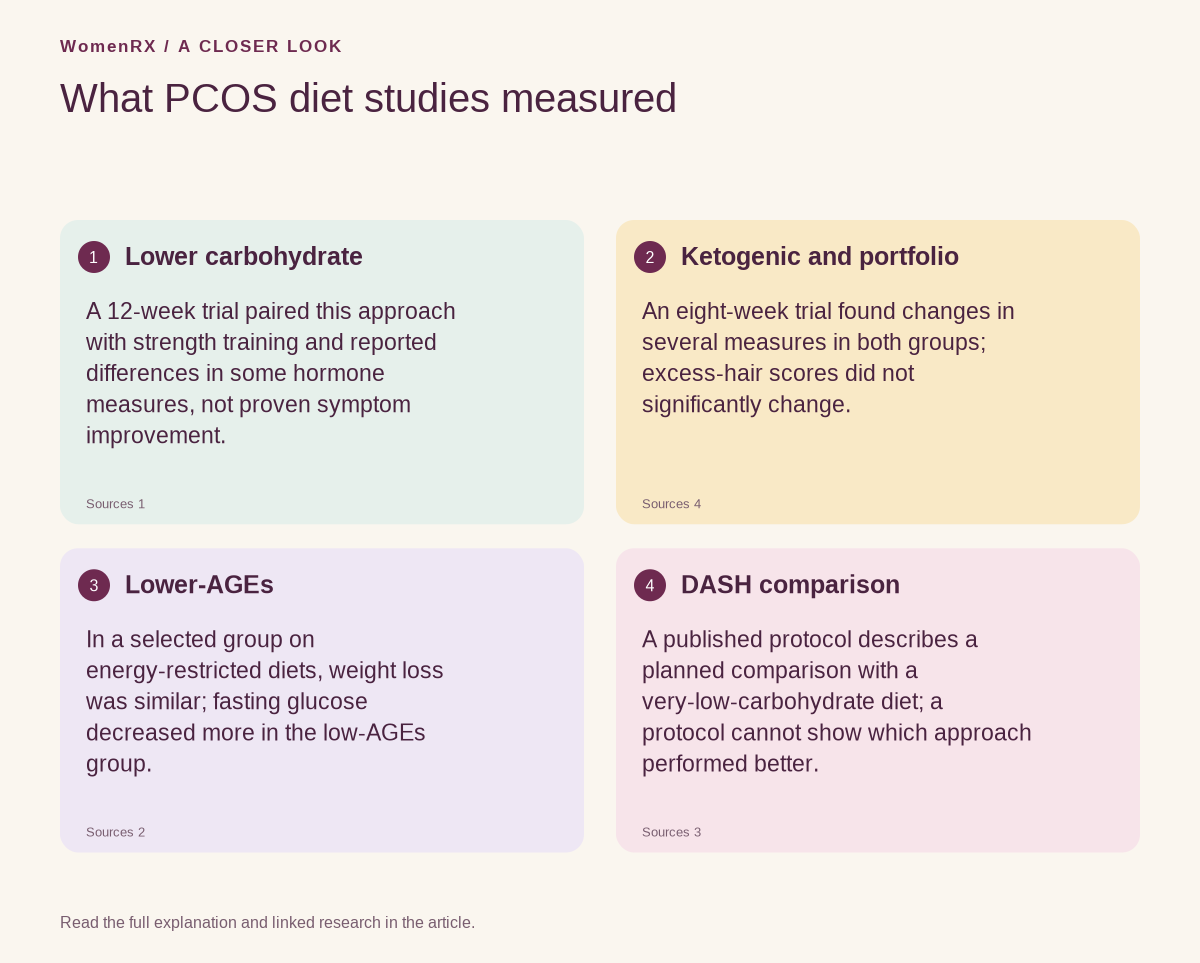
What PCOS diet studies measured
Lower carbohydrate: A 12-week trial paired this approach with strength training and reported differences in some hormone measures, not proven symptom improvement.1
Ketogenic and portfolio: An eight-week trial found changes in several measures in both groups; excess-hair scores did not significantly change.4
Lower-AGEs: In a selected group on energy-restricted diets, weight loss was similar; fasting glucose decreased more in the low-AGEs group.2
DASH comparison: A published protocol describes a planned comparison with a very-low-carbohydrate diet; a protocol cannot show which approach performed better.3
Read the figure as text
These approaches were studied for different outcomes and in specific groups; the comparisons don’t identify a universal best diet.- Lower carbohydrate: A 12-week trial paired this approach with strength training and reported differences in some hormone measures, not proven symptom improvement.1
- Ketogenic and portfolio: An eight-week trial found changes in several measures in both groups; excess-hair scores did not significantly change.4
- Lower-AGEs: In a selected group on energy-restricted diets, weight loss was similar; fasting glucose decreased more in the low-AGEs group.2
- DASH comparison: A published protocol describes a planned comparison with a very-low-carbohydrate diet; a protocol cannot show which approach performed better.3
More questions, answered
Do I need to cut out carbohydrates for PCOS?
The available small trials don’t establish that everyone with PCOS needs a low-carbohydrate or ketogenic diet. One trial compared two diets over eight weeks, while a separate study protocol describes a longer comparison but provides no trial results. Discuss the goal and tradeoffs before adopting a restrictive approach. 34
Does a PCOS eating plan improve fertility?
The studies summarized here mainly report short-term changes in metabolic markers, hormones, or menstrual patterns. They don’t establish that a particular eating pattern improves the chance of pregnancy. If fertility is your goal, make that explicit when discussing care rather than assuming a change in a hormone measure predicts conception. 1234
Sources you can check
- Effects of carbohydrate reduced diet associated with strength training on clinical signs of women with polycystic ovary syndrome: Randomized clinical trial.Colonetti L, Uggioni MLR, Prestes GDS, Stangherlin L, Junior JCD, Moura R, Sipriano EDS, Madeira K, Cardoso HS, Ferraz SD, Baptista MM, Grande AJ, Ceretta LB, da Rosa MI, Colonetti... · Nutrition (Burbank, Los Angeles County, Calif.) · 2025Return to first citation
- Comparison of Metabolic and Hormonal Profiles between Low-Advanced Glycation End Products (AGEs) and Standard AGEs-Containing Weight-Loss Diets in Overweight Phenotype-A PCOS Patients: A Randomized Clinical Trial.Ozdemir M, Mumusoglu S, Bilgic P. · Reproductive sciences (Thousand Oaks, Calif.) · 2025Return to first citation
- Protocol for a randomized comparative effectiveness trial comparing a very low-carbohydrate diet to DASH diet for polycystic ovary syndrome: the SUPER (Supporting Understanding of PCOS Education and Research) trial.Greenwell S, Jones A, Smith YR, Marriott D, Aikens JE, Padmanabhan V, Saslow LR. · Trials · 2024Return to first citation
- The effects of portfolio moderate-carbohydrate and ketogenic diets on anthropometric indices, metabolic status, and hormonal levels in overweight or obese women with polycystic ovary syndrome: a randomized controlled trial.Sharifi M, Saber A, Moludi J, Salimi Y, Jahan-Mihan A. · Nutrition journal · 2024Return to first citation
- The impact of a lifestyle promotion program on anthropometric and clinical manifestations in adolescents with polycystic ovarian syndrome: a randomized controlled trial.Nahidi F, Ramezani Tehrani F, Ghodsi D, Jafari M, Majd HA, Abdolahian S. · BMC women's health · 2024Return to first citation