Is There a Diet That Balances Hormones?
A useful diet claim names the condition, the outcome, and the women in whom it was studied.
There’s no established diet that generally “balances hormones.” In small studies of women with PCOS, specific diets changed some metabolic measures, reproductive hormone measures, or cycle outcomes, but the findings don’t establish a fertility benefit. For menopause hot flashes, dietary modification and soy aren’t recommended as evidence-based treatments. 2 4 5
First, name the result you want
“Balance your hormones” sounds like a goal, but it leaves out the part that matters to you. Are you hoping for more predictable periods, relief from hot flashes, or help with a fertility concern? Those are different outcomes. Even a measured change in a hormone level doesn’t, by itself, show that a diet improves a symptom or the chance of pregnancy.
To assess a food or diet claim, ask four questions: What condition did the women have? What did they eat? What changed? How long were they studied? Here’s what that looks like for two situations often folded into the same hormone-balance promise.
PCOS: the answer depends on the outcome
In an eight-week, open-label randomized trial, 40 women with PCOS who were overweight or had obesity completed either a plant-based, moderate-carbohydrate diet or a ketogenic diet. Both groups had improvements in some measured metabolic and reproductive hormone outcomes. The ketogenic group had a larger reduction in body mass index and a larger change in luteinizing hormone; LDL cholesterol improved more in the plant-based diet group. Neither group had a significant change in a score measuring excess hair growth. 4
There isn’t one winner for every concern in that comparison. It was also a small, short study in a particular group of women with PCOS. Changes in blood measurements shouldn’t be read as proof that either diet improves fertility or works equally well for someone without PCOS. 4
A separate 12-week study examined a 5:2 intermittent-fasting approach with meal replacements in women with obesity and PCOS. Researchers reported improvements in metabolic measures, menstrual regularity, and ovulation frequency in that group, while the reproductive hormone levels they measured did not change significantly. The study wasn’t randomized, and meal replacements were part of the approach, so it cannot establish that fasting alone caused those results. 5
That distinction matters if a claim says a diet must have “balanced estrogen and progesterone” because periods became more regular. In this study, reported cycle changes and measured hormone changes did not line up that way. A review of intermittent-fasting research also describes small samples, differing approaches, short follow-up, and limited evidence for lean premenopausal women. 3 5
Hot flashes call for a different comparison
A PCOS diet finding doesn’t tell you whether a food will ease menopause hot flashes. The North American Menopause Society’s 2023 evidence review does not recommend dietary modification, soy foods, soy extracts, or herbal supplements as treatments for vasomotor symptoms such as hot flashes. It does recommend several options with evidence for symptom relief, including cognitive-behavioral therapy, clinical hypnosis, and certain prescription treatments. The review separately lists weight loss as a recommended option, with more limited evidence than some of those treatments. 2
That’s a distinction, not a reason to stop caring about how you eat. It means a general promise to “balance hormones” is a poor substitute for choosing an approach studied for the symptom that’s bothering you. Hormone therapy remains the most effective treatment for vasomotor symptoms, although whether it’s appropriate depends on individual risks and circumstances. 1
When to look beyond a meal plan
If your concern is persistent irregular periods, difficulty conceiving, or hot flashes that disrupt your life, don’t let a diet advertisement decide what the problem is. The PCOS diet studies involved women who already had a diagnosis; they weren’t designed to identify the cause of an individual’s symptoms or determine which tests she needs. 4 5 A care conversation can start with the concern itself, rather than a request for a vague “hormone balance” test.
Keep the four-question filter handy when you see a promising food list: condition, diet, outcome, timeframe. If the claim skips those details, it hasn’t told you enough to judge whether it applies to you.
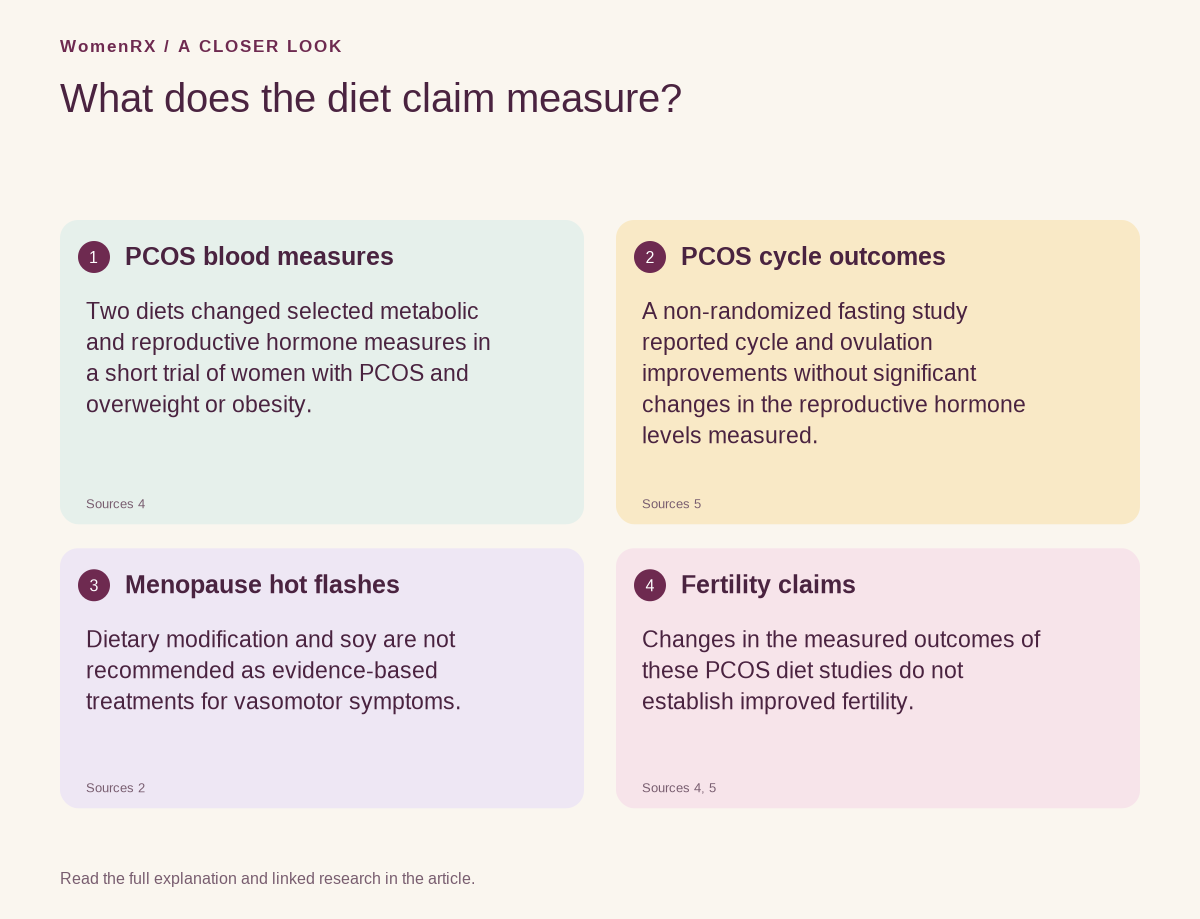
What does the diet claim measure?
PCOS blood measures: Two diets changed selected metabolic and reproductive hormone measures in a short trial of women with PCOS and overweight or obesity.4
PCOS cycle outcomes: A non-randomized fasting study reported cycle and ovulation improvements without significant changes in the reproductive hormone levels measured.5
Menopause hot flashes: Dietary modification and soy are not recommended as evidence-based treatments for vasomotor symptoms.2
Fertility claims: Changes in the measured outcomes of these PCOS diet studies do not establish improved fertility.45
Read the figure as text
The same broad promise can refer to different outcomes. Match the claim to the women studied and the result measured.- PCOS blood measures: Two diets changed selected metabolic and reproductive hormone measures in a short trial of women with PCOS and overweight or obesity.4
- PCOS cycle outcomes: A non-randomized fasting study reported cycle and ovulation improvements without significant changes in the reproductive hormone levels measured.5
- Menopause hot flashes: Dietary modification and soy are not recommended as evidence-based treatments for vasomotor symptoms.2
- Fertility claims: Changes in the measured outcomes of these PCOS diet studies do not establish improved fertility.45
Sources you can check
- The 2022 hormone therapy position statement of The North American Menopause Society.“The 2022 Hormone Therapy Position Statement of The North American Menopause Society” Advisory Panel. · Menopause (New York, N.Y.) · 2022Return to first citation
- The 2023 nonhormone therapy position statement of The North American Menopause Society.Menopause (New York, N.Y.) · 2023Return to first citation
- Effects of Intermittent Fasting on Male and Female Reproductive Hormones, Fertility, and Sexual Function: A Comprehensive Review with Emphasis on the Existing Evidence Gap in Women.La Vignera S, Condorelli RA. · Nutrients · 2026Return to first citation
- The effects of portfolio moderate-carbohydrate and ketogenic diets on anthropometric indices, metabolic status, and hormonal levels in overweight or obese women with polycystic ovary syndrome: a randomized controlled trial.Sharifi M, Saber A, Moludi J, Salimi Y, Jahan-Mihan A. · Nutrition journal · 2024Return to first citation
- Effect of a 5:2 intermittent fasting diet on obese patients with polycystic ovary syndrome.An W, Chen F, Wang B, Zhou S, Jiang L, An B, Cui Z, Ou X, Huang W, Yan H. · Frontiers in endocrinology · 2026Return to first citation