Hormones and Headaches in Midlife: What We Know
Perimenopause can change migraine patterns, but the link is clearer for migraine than for headaches in general.
Estrogen changes are linked to menstrual migraine, and hormonal fluctuations during perimenopause may make migraine more frequent or less predictable. After menopause, migraine without aura often improves, while migraine with aura tends to persist. These are tendencies, not a forecast for you. A changed headache pattern may also involve another headache type or factors besides hormones. 7 6 1
First, what kind of headache is it?
Migraine often brings throbbing or pulsing pain, sometimes on one side, with nausea or sensitivity to light and sound. Some people also have aura, which can include flashing lights or zigzag lines. A tension-type headache is another common pattern and may involve tight muscles in the neck, shoulders, scalp, or jaw. A headache that appears during perimenopause isn’t automatically a migraine, and its timing alone doesn’t establish a hormonal cause. 2 1
The clearest hormone-related pattern is menstrual migraine: attacks just before or during a period. Estrogen withdrawal around menstruation is implicated in these attacks, which are often longer and more severe than migraine attacks at other times. If you’ve noticed that pattern for years, changing cycles in perimenopause may make it less predictable. 7 3
What may change during and after perimenopause
During perimenopause, fluctuating hormones are associated with increased or less predictable migraine, particularly menstrual migraine. That describes a pattern seen across women, not what must happen to any one person. 6 7
After menopause, migraine without aura often improves, while migraine with aura tends to persist, according to a review of migraine across the transition. Neither tendency means attacks will stop or continue on a set schedule. Research that separates women by menopausal stage and migraine subtype remains limited. 6
That distinction is more useful than saying menopause simply “helps” or “worsens” headaches. It also leaves room for other things happening at the same time. For example, tension-type headaches can be associated with stress, poor sleep, missed meals, and muscle tightness. Sleep disturbance, vasomotor symptoms, and mood disorders may also coexist with migraine in midlife and complicate its management; their presence doesn’t prove what caused a particular attack. 1 6
Use the pattern to decide what to do next
If headaches have changed, note when they occur, what the pain feels like, whether nausea or light and sound sensitivity come with it, and whether you notice a connection with periods, sleep, or missed meals. A short headache log can help reveal possible patterns or triggers. It can’t diagnose the headache by itself, but it gives you something more specific to discuss if attacks are recurring or getting harder to manage. 2 3 1
Don’t assume a sudden, severe headache is part of menopause. A headache that comes on suddenly and is extremely painful needs emergency help now. 3 Get medical help right away if a headache comes with a stiff neck, fever, confusion, loss of consciousness, or pain in the eye or ear. 1
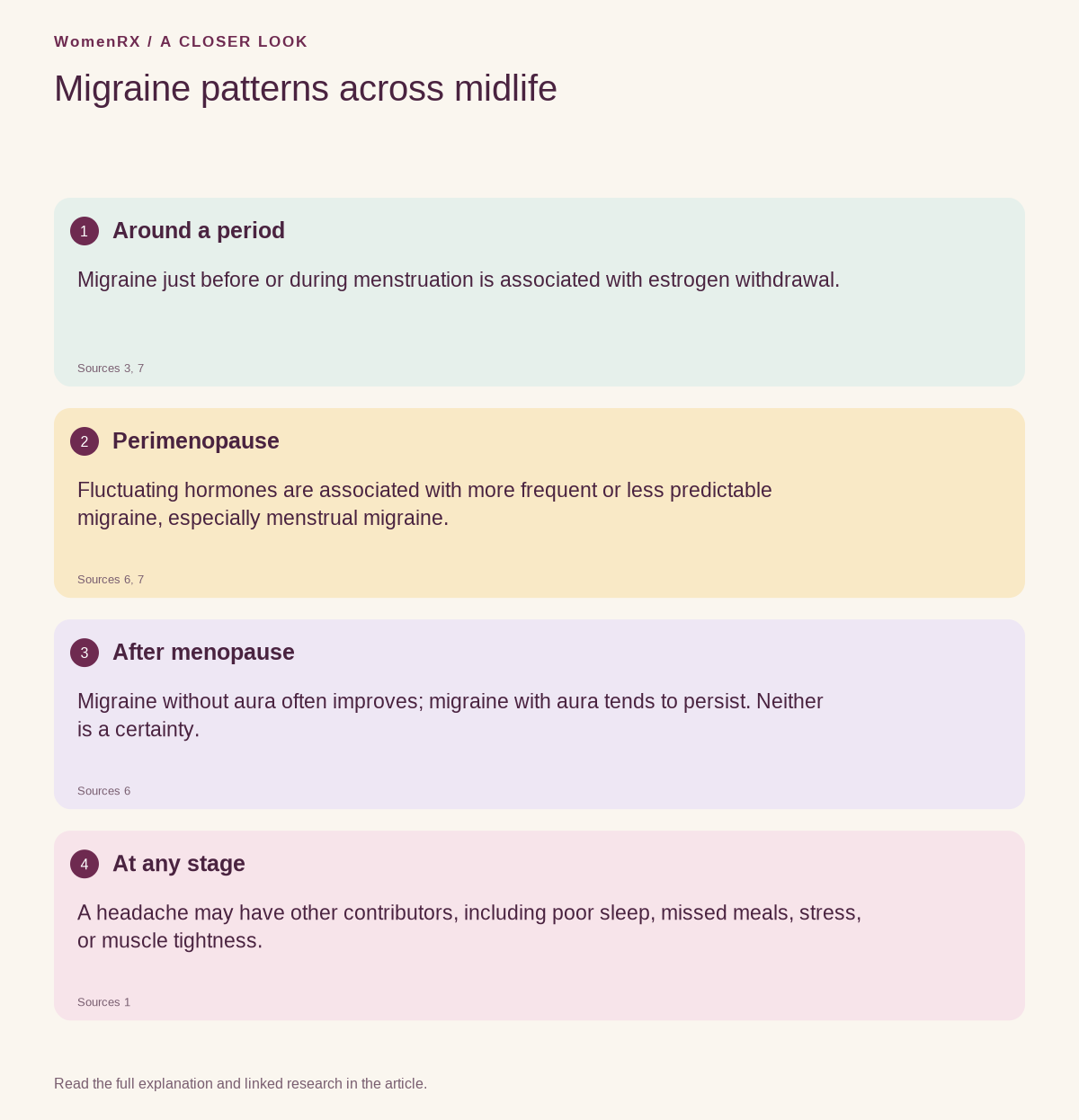
Migraine patterns across midlife
Around a period: Migraine just before or during menstruation is associated with estrogen withdrawal.37
Perimenopause: Fluctuating hormones are associated with more frequent or less predictable migraine, especially menstrual migraine.67
After menopause: Migraine without aura often improves; migraine with aura tends to persist. Neither is a certainty.6
At any stage: A headache may have other contributors, including poor sleep, missed meals, stress, or muscle tightness.1
Read the figure as text
The reported associations change across reproductive stages, but no stage determines one person’s migraine pattern.- Around a period: Migraine just before or during menstruation is associated with estrogen withdrawal.37
- Perimenopause: Fluctuating hormones are associated with more frequent or less predictable migraine, especially menstrual migraine.67
- After menopause: Migraine without aura often improves; migraine with aura tends to persist. Neither is a certainty.6
- At any stage: A headache may have other contributors, including poor sleep, missed meals, stress, or muscle tightness.1
More questions, answered
Will menopause hormone therapy help my migraine?
Not reliably. Its effects on migraine vary, and direct trial evidence for migraine outcomes during perimenopause is limited. If you’re considering hormone therapy for menopause symptoms, mention your migraine history, including whether you get aura, so both concerns are part of the discussion. 5 6 4
Sources you can check
- Headache | MedlinePlusAccessed 2026-09-25Return to first citation
- Migraine | MedlinePlusAccessed 2026-09-25Return to first citation
- Migraine - NHSAccessed 2026-09-25Return to first citation
- The 2022 hormone therapy position statement of The North American Menopause Society.“The 2022 Hormone Therapy Position Statement of The North American Menopause Society” Advisory Panel. · Menopause (New York, N.Y.) · 2022Return to first citation
- Perimenopausal migraine: a narrative review.Kamourieh S, MacGregor EA. · Climacteric : the journal of the International Menopause Society · 2026Return to first citation
- Migraine across the menopausal transition and beyond: A narrative review.Korn TF, Bernstein C. · Headache · 2026Return to first citation
- Menstrual and perimenopausal migraine: A narrative review.MacGregor EA. · Maturitas · 2020Return to first citation