Headaches Around Menopause: Track the Pattern, Choose Safer Relief
Hormone changes can shift migraine patterns, but timing, symptoms, medicine use, and warning signs help determine what to do next.
Perimenopause can make migraine more frequent or less predictable, including around periods; after menopause, migraine without aura often improves, though patterns vary. Keep a simple record of headache timing, symptoms, cycle changes, and medicines used. Migraine with aura changes the conversation about combined oral contraceptives, while menopause hormone therapy calls for an individualized discussion. 6 7 5 4
Follow the pattern, not just the calendar
Hormone shifts can affect migraine, but a headache during midlife isn’t automatically caused by menopause. During perimenopause, changing hormone levels and irregular cycles are associated with more frequent or less predictable migraine, including attacks around menstruation. After menopause, migraine without aura often improves, but this doesn’t happen for everyone; migraine with aura may persist. 6 7
Timing is one clue, not a diagnosis. A headache that clusters around a period may have a different pattern from one that follows missed meals, poor sleep, or stress. Tension-type headaches, for example, are associated with tight muscles in the neck, shoulders, scalp, or jaw, and may be related to stress or not getting enough sleep. 1 3
Compare what you feel
Migraine often causes moderate to severe throbbing or pulsing pain, sometimes on one side, along with nausea or sensitivity to light and sound. Aura can include flashing lights or zigzag lines, or sensory changes such as feeling touched or grabbed. 3
Tension-type headache clues include tight muscles around the neck, shoulders, scalp, or jaw. These patterns can overlap, so noting what happens is more useful than trying to diagnose yourself from one symptom. 1
A brief record can make the pattern easier to explain. Write down when a headache starts and ends, where it hurts, what it feels like, and whether you have nausea, light or sound sensitivity, or aura. Note whether a period was near, plus any missed meals or poor sleep. List each medicine you use and how often. A headache diary may help reveal patterns and triggers. 2 3
Choose relief without losing sight of medicine use
Keeping meals and sleep reasonably regular, drinking water, and finding ways to relax are practical starting points. Missed meals, inadequate sleep, and stress can be relevant to headaches, though no routine works for everyone. 1 2 3
Medicine can help, but taking migraine medicine too often can contribute to headaches. There isn’t one frequency threshold here that applies to every medicine, so record what you take and how often. If you’re using medicine frequently or headaches keep returning, discuss a plan for relief and prevention rather than simply repeating the same approach. 3
Arrange an assessment if headaches are regular, getting worse, or not improving. A new or changing pattern deserves attention instead of being assumed to be a menopause symptom. 1 2
Aura changes the contraception conversation
Migraine with aura is a contraindication to combined oral contraceptives because of stroke risk. That contraceptive guidance should not be treated as an automatic rule against menopause hormone therapy: the two are different treatments, and the evidence and decisions aren’t interchangeable. 5
For menopause hormone therapy (MHT), the risks and benefits depend on factors including the type, dose, route, duration, timing, and whether a progestogen is used. MHT can affect migraine differently from person to person, so it shouldn’t be assumed to be a headache treatment. 4 7
Evidence about modern MHT-related stroke risk specifically in people with migraine aura remains limited. A UK medical-record study described hormone prescribing in people with aura; it did not measure whether those treatments caused strokes or establish what is safe for an individual. If MHT is being considered for menopause symptoms, share whether you have aura and discuss your personal risks and reasons for treatment. 5
Know which changes need prompt attention
Tell your care team about a sudden, severe headache. Get medical help right away for a headache after a blow to the head, or one that comes with a stiff neck, fever, confusion, loss of consciousness, or pain in the eye or ear. 1
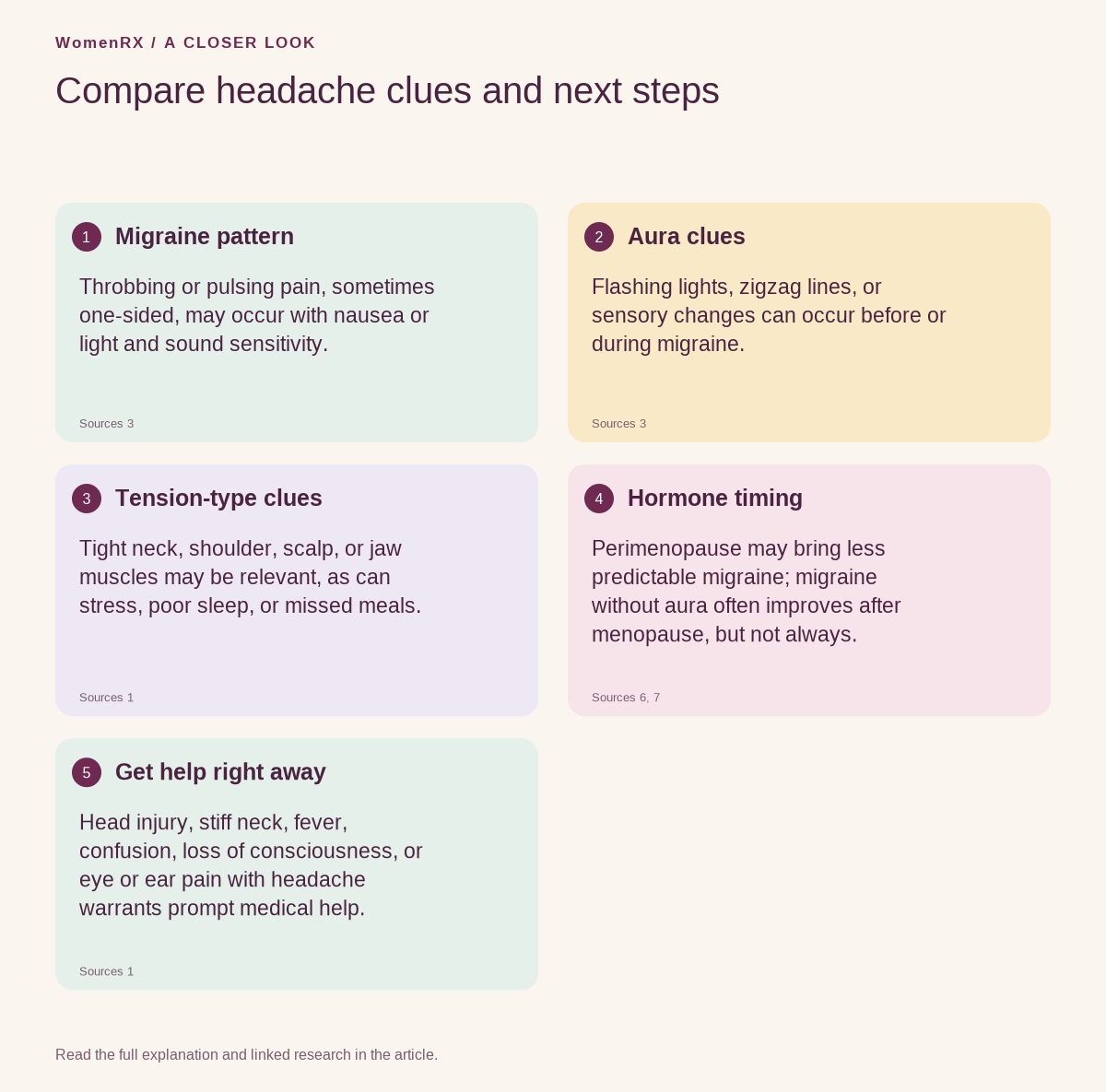
Compare headache clues and next steps
Migraine pattern: Throbbing or pulsing pain, sometimes one-sided, may occur with nausea or light and sound sensitivity.3
Aura clues: Flashing lights, zigzag lines, or sensory changes can occur before or during migraine.3
Tension-type clues: Tight neck, shoulder, scalp, or jaw muscles may be relevant, as can stress, poor sleep, or missed meals.1
Hormone timing: Perimenopause may bring less predictable migraine; migraine without aura often improves after menopause, but not always.67
Get help right away: Head injury, stiff neck, fever, confusion, loss of consciousness, or eye or ear pain with headache warrants prompt medical help.1
Read the figure as text
These patterns can help you describe what is happening and distinguish routine tracking from symptoms that need medical attention.- Migraine pattern: Throbbing or pulsing pain, sometimes one-sided, may occur with nausea or light and sound sensitivity.3
- Aura clues: Flashing lights, zigzag lines, or sensory changes can occur before or during migraine.3
- Tension-type clues: Tight neck, shoulder, scalp, or jaw muscles may be relevant, as can stress, poor sleep, or missed meals.1
- Hormone timing: Perimenopause may bring less predictable migraine; migraine without aura often improves after menopause, but not always.67
- Get help right away: Head injury, stiff neck, fever, confusion, loss of consciousness, or eye or ear pain with headache warrants prompt medical help.1
More questions, answered
Does migraine usually stop after menopause?
It often improves for people with migraine without aura, but it doesn’t always. Migraine with aura may persist, so menopause alone doesn’t explain every new or worsening headache. 6 7
Should I use menopause hormone therapy for headaches?
MHT can affect migraine differently from person to person and is not automatically a headache treatment. If you’re considering it for menopause symptoms, discuss your headache pattern, whether you have aura, and your individual benefits and risks. 4 7
Sources you can check
- Headache | MedlinePlusAccessed 2026-09-25Return to first citation
- Headaches - NHSAccessed 2026-09-25Return to first citation
- Migraine | MedlinePlusAccessed 2026-09-25Return to first citation
- The 2022 hormone therapy position statement of The North American Menopause Society.“The 2022 Hormone Therapy Position Statement of The North American Menopause Society” Advisory Panel. · Menopause (New York, N.Y.) · 2022Return to first citation
- Utilization of Oral Contraceptives and Hormone Therapy for Menopause Among Female Individuals With Migraine With Aura: A Descriptive Study.Gibbs LR, Fox MP, Aparicio HJ, Jick S. · Pharmacoepidemiology and drug safety · 2025Return to first citation
- Perimenopausal migraine: a narrative review.Kamourieh S, MacGregor EA. · Climacteric : the journal of the International Menopause Society · 2026Return to first citation
- Migraine across the menopausal transition and beyond: A narrative review.Korn TF, Bernstein C. · Headache · 2026Return to first citation