Perimenopause Headaches: Track the Pattern, Know When to Act
A simple record of bleeding, headache symptoms, and medicines can show whether attacks cluster around cycle changes and give treatment discussions more useful context.
Migraine can become more frequent or less predictable during perimenopause, especially around menstrual bleeding, but that pattern isn’t universal. Record bleeding dates, when each headache starts and ends, and symptoms such as aura or nausea. You can also note medicines and their effects as a practical diary field. Your migraine history, including whether you have aura, matters when discussing hormonal options. 56
Why a headache pattern may shift
During perimenopause, estrogen can fluctuate and periods may become less predictable. Reviews describe more frequent or harder-to-predict migraine for some women, particularly those with menstrual migraine. Migraine may improve after menopause, but that isn’t guaranteed. A headache near a period is a pattern to note, not proof that hormones caused it. 567
Migraine often causes throbbing or pulsing pain, sometimes on one side, and may come with nausea or sensitivity to light or sound. Some people experience aura, such as flashing lights or zigzag lines, before or during an attack. Tension-type headache is another possibility; it can be associated with tight muscles in the neck, shoulders, scalp, or jaw. 13
Sleep, stress, and missed meals can also be relevant to headaches. Tracking them alongside bleeding may help you notice what tends to happen together, without assuming that one factor explains every attack. 13
Make the diary useful, not complicated
For each headache, you might record:
- Bleeding or spotting: Dates when bleeding starts and ends, if you can tell.
- The headache: When it starts and ends, where it hurts, and whether the pain throbs or feels different from your usual headache.
- Other symptoms: Nausea, light or sound sensitivity, or aura. Describe what the aura looked like or felt like.
- Medicine and response: As a practical diary field, note what you took, when you took it, and whether symptoms changed afterward.
- Possible context: Sleep, stress, or missed meals, if they seem relevant.
A headache diary may help reveal possible triggers or recurring timing, including a connection with menstruation. The goal isn’t to fill in every detail or diagnose yourself. It’s to make a possible pattern easier to discuss. 23
For example, you might write: “Spotting began Monday. Throbbing headache started Tuesday morning with light sensitivity. Took my usual migraine medicine; pain eased later.” That’s an example of a record, not a typical or expected perimenopause timeline. Look across multiple entries before deciding whether a pattern seems to recur.
Why your migraine history matters for hormone discussions
If you’re considering a hormonal option, mention whether you have migraine with aura, whether attacks used to cluster around your period, and how your pattern has changed. Reviews discuss hormonal approaches by migraine subtype and flag vascular considerations, particularly for people with aura. 56
Combined hormonal contraception and menopausal hormone therapy are different treatments with different purposes. A review discusses hormone-cycle approaches during perimenopause, while menopause hormone therapy is often considered for symptoms such as hot flashes. The risks of menopausal hormone therapy also vary with factors such as type, route, timing, and whether a progestogen is used, so the choice is individualized. 45
Evidence establishing which hormone approach works for migraine specifically during perimenopause is limited. So a treatment shouldn’t be assumed to prevent migraine just because attacks seem cycle-related. Your bleeding pattern, aura history, other symptoms, and response to medicines can all help make a treatment discussion more specific. 56
For frequent or severe migraine, preventive medicines may be considered; treatment for an individual attack is a separate part of care. Regular meals, consistent sleep, fluids, and stress-management approaches may also help some people. 3
When not to wait for a pattern
A sudden, severe headache needs prompt medical attention. Seek urgent medical advice for a headache accompanied by vision or eye problems or vomiting. Don’t wait to see whether it recurs around bleeding. 12
Get medical help right away for a headache after a blow to the head or one with a stiff neck, fever, confusion, loss of consciousness, or eye or ear pain. A headache with a seizure also needs immediate help. 12
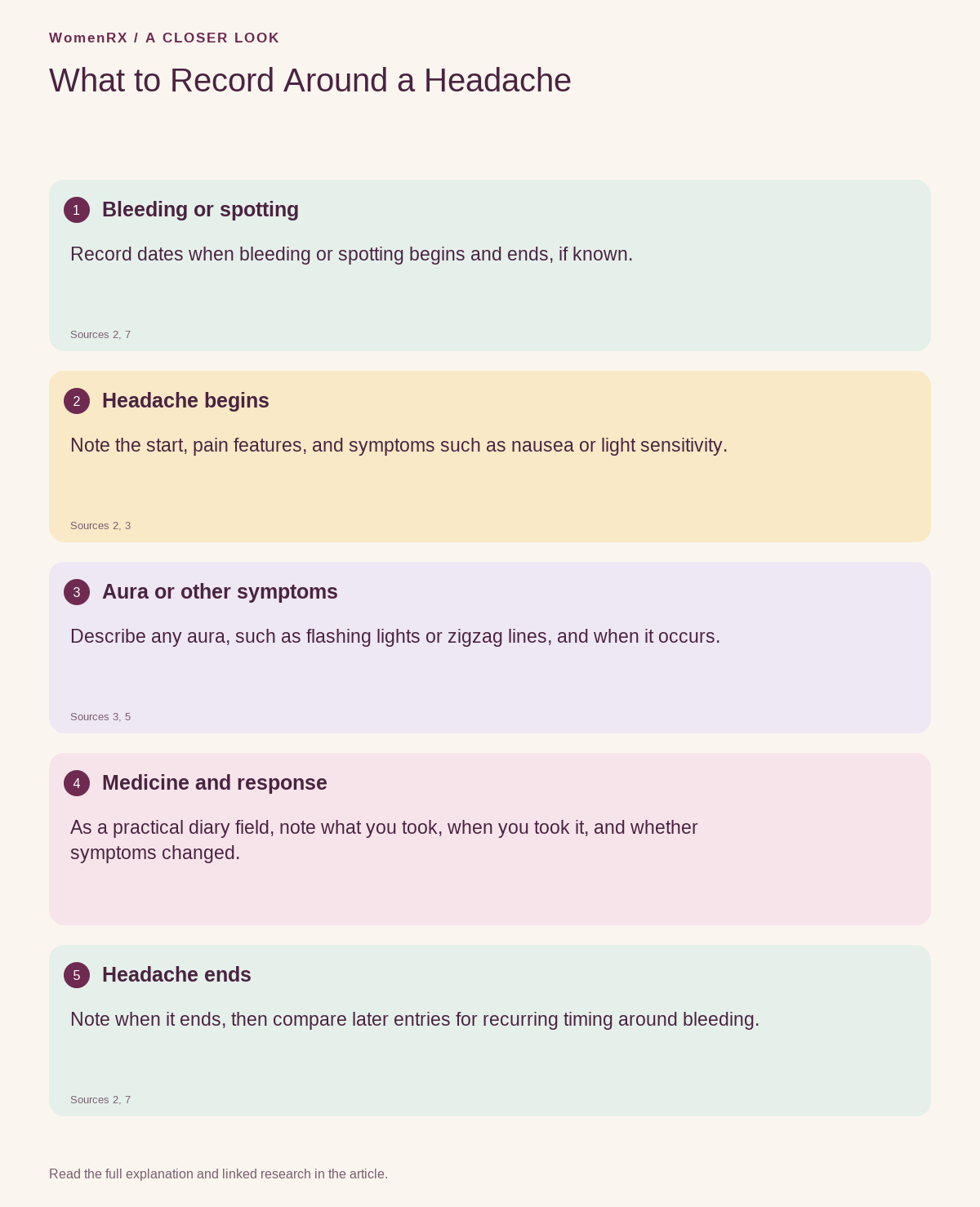
What to Record Around a Headache
Bleeding or spotting: Record dates when bleeding or spotting begins and ends, if known.27
Headache begins: Note the start, pain features, and symptoms such as nausea or light sensitivity.23
Aura or other symptoms: Describe any aura, such as flashing lights or zigzag lines, and when it occurs.35
Medicine and response: As a practical diary field, note what you took, when you took it, and whether symptoms changed.
Headache ends: Note when it ends, then compare later entries for recurring timing around bleeding.27
Read the figure as text
Use these points as a simple event-by-event diary template. They show what to compare, not a typical cycle or expected sequence.- Bleeding or spotting: Record dates when bleeding or spotting begins and ends, if known.27
- Headache begins: Note the start, pain features, and symptoms such as nausea or light sensitivity.23
- Aura or other symptoms: Describe any aura, such as flashing lights or zigzag lines, and when it occurs.35
- Medicine and response: As a practical diary field, note what you took, when you took it, and whether symptoms changed.
- Headache ends: Note when it ends, then compare later entries for recurring timing around bleeding.27
Sources you can check
- Headache | MedlinePlusAccessed 2026-09-25Return to first citation
- Headaches - NHSAccessed 2026-09-25Return to first citation
- Migraine | MedlinePlusAccessed 2026-09-25Return to first citation
- The 2022 hormone therapy position statement of The North American Menopause Society.“The 2022 Hormone Therapy Position Statement of The North American Menopause Society” Advisory Panel. · Menopause (New York, N.Y.) · 2022Return to first citation
- Perimenopausal migraine: a narrative review.Kamourieh S, MacGregor EA. · Climacteric : the journal of the International Menopause Society · 2026Return to first citation
- Migraine across the menopausal transition and beyond: A narrative review.Korn TF, Bernstein C. · Headache · 2026Return to first citation
- Menstrual and perimenopausal migraine: A narrative review.MacGregor EA. · Maturitas · 2020Return to first citation