Headaches Across Perimenopause: What Patterns Can Tell You
A changing cycle can offer clues about migraine timing, but it can’t explain every headache.
Migraine can change during perimenopause, when menstrual cycles and hormone levels fluctuate, but a headache near a period isn’t proof that hormones caused it. Record headache days alongside bleeding, symptoms and medication use to see what repeats. Get emergency help for a sudden, extremely painful headache or one with new weakness, numbness, confusion or trouble speaking. 5 2
When periods and headaches both change
If your periods are becoming less predictable and your headaches seem different, it’s reasonable to wonder whether the changes are connected. Hormonal fluctuations can affect migraine, particularly around menstruation, and perimenopause changes the hormonal environment. But timing is a clue, not a diagnosis. Stress and frequent use of migraine medicine can also play a role, while too little sleep or missed meals may contribute to other common headaches. 5 3 1
The kind of headache matters as much as the calendar. Migraine often causes moderate to severe pulsing pain, sometimes on one side, with nausea or sensitivity to light and sound. Some people see flashing lights or zigzag lines before or during an attack. Tension-type headache is another common possibility and can be associated with tight muscles in the neck, shoulders, scalp or jaw. Those descriptions can help you explain what you feel, but they aren’t a way to diagnose yourself. 3 1
In a cross-sectional survey of women ages 35 to 65 who had migraine, at least 10 headache days a month were reported by 12.2% of those classified as perimenopausal (154 of 1,266), compared with 8.0% of premenopausal participants (99 of 1,242). The association with perimenopause remained after the researchers accounted for several other factors. Because the survey compared groups at one point in time, it doesn’t show what caused the difference or predict how your headaches will change. 4
Keep a record that shows the whole pattern
A headache log is most useful when it puts several details side by side. For each headache, note the day, when it started, roughly how long it lasted and what it felt like. Add nausea, light or sound sensitivity, or visual symptoms if they occurred. If you’re still having periods, record bleeding dates and changes such as skipped periods. Also note sleep, missed meals, stress and which days you used headache medicine. A diary may help reveal possible triggers; medication use matters because taking migraine medicine too often can itself contribute to headaches. 2 3 1
Look for repetition rather than treating one coincidence as an answer. For example, headaches that repeatedly occur near bleeding are worth describing at an appointment. If the same headaches also follow poor sleep, that detail is worth bringing up too. Irregular periods may make a cycle link harder to judge. The log helps you describe the pattern clearly; it can’t prove its cause. 2 3 5
What the pattern means for care
If headaches are becoming frequent, severe or disruptive, bring the record to a medical visit. Include whether you’ve had migraine before and how often you use headache medicine. Migraine treatment can include approaches for individual attacks and, for frequent or severe attacks, medicines intended to prevent them. The first step is working out what kind of headache you’re having and whether anything else needs attention. 3
Don’t assume menopause hormone therapy will fix migraine. A review describes migraine as generally improving after menopause, but not for everyone; chronic migraine, menopause symptoms and hormone therapy can complicate the pattern. A treatment decision for menopause symptoms and a treatment decision for headache may need different conversations. 6
Don’t wait on these symptoms
Get emergency help if a headache starts suddenly and is extremely painful, or comes with numbness or weakness, trouble speaking or walking, confusion, a seizure or loss of vision. A headache with fever and a stiff neck, or after a head injury, also needs urgent assessment. These aren’t symptoms to watch for another cycle to see whether they repeat. 2 1
Seek prompt medical advice for a headache with vision or eye problems, vomiting, or pain triggered or worsened by coughing, bending down or exercise. 2
A headache log, with an urgent-care boundary
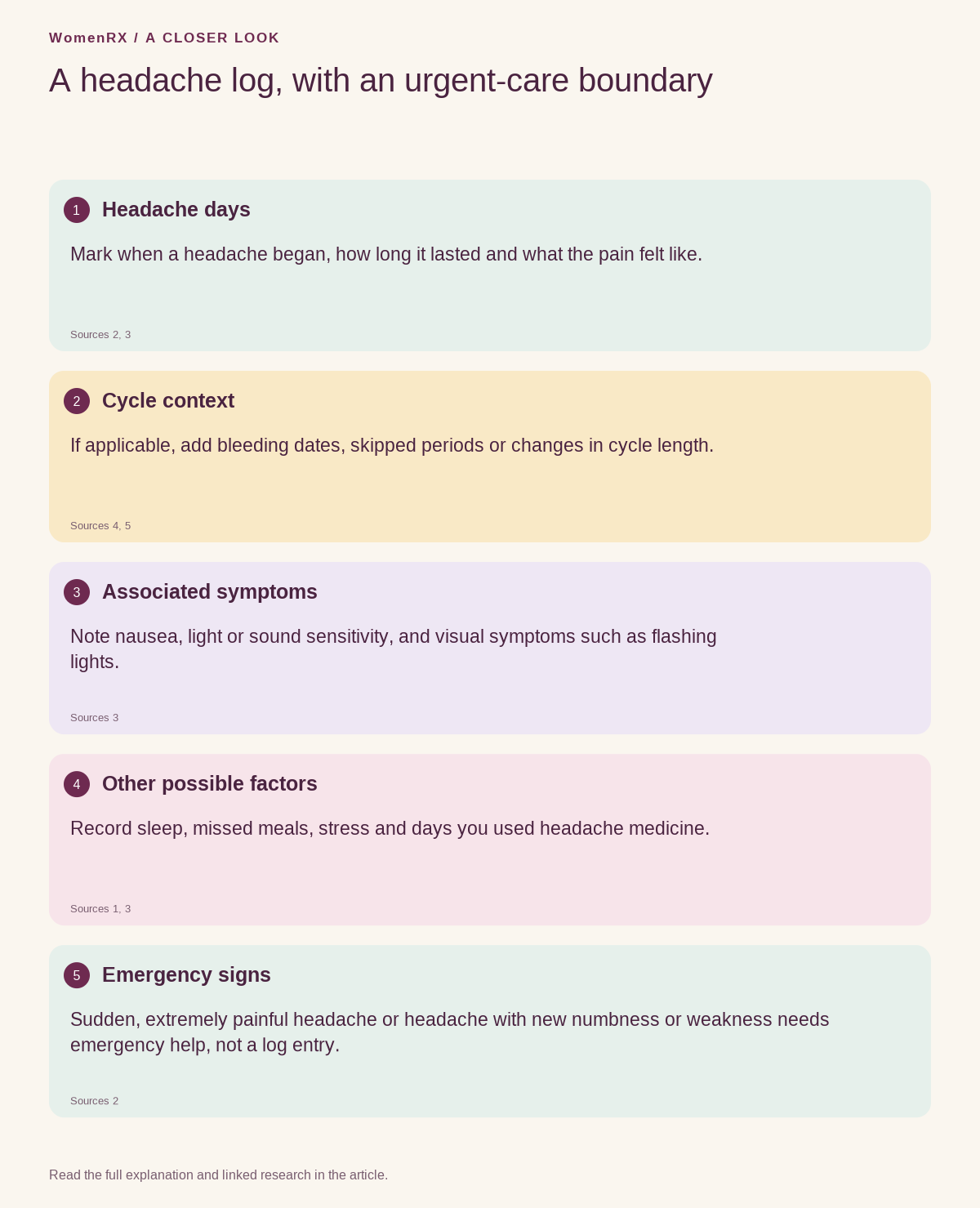
Headache days: Mark when a headache began, how long it lasted and what the pain felt like.23
Cycle context: If applicable, add bleeding dates, skipped periods or changes in cycle length.45
Associated symptoms: Note nausea, light or sound sensitivity, and visual symptoms such as flashing lights.3
Other possible factors: Record sleep, missed meals, stress and days you used headache medicine.13
Emergency signs: Sudden, extremely painful headache or headache with new numbness or weakness needs emergency help, not a log entry.2
Read the figure as text
Record these details together to see what repeats. Some symptoms call for help now, not another diary entry.- Headache days: Mark when a headache began, how long it lasted and what the pain felt like.23
- Cycle context: If applicable, add bleeding dates, skipped periods or changes in cycle length.45
- Associated symptoms: Note nausea, light or sound sensitivity, and visual symptoms such as flashing lights.3
- Other possible factors: Record sleep, missed meals, stress and days you used headache medicine.13
- Emergency signs: Sudden, extremely painful headache or headache with new numbness or weakness needs emergency help, not a log entry.2
Sources you can check
- Headache | MedlinePlusAccessed 2026-09-25Return to first citation
- Headaches - NHSAccessed 2026-09-25Return to first citation
- Migraine | MedlinePlusAccessed 2026-09-25Return to first citation
- Perimenopause and Menopause Are Associated With High Frequency Headache in Women With Migraine: Results of the American Migraine Prevalence and Prevention Study.Martin VT, Pavlovic J, Fanning KM, Buse DC, Reed ML, Lipton RB. · Headache · 2016Return to first citation
- Migraine headache in perimenopausal and menopausal women.MacGregor EA. · Current pain and headache reports · 2009Return to first citation
- Perimenopausal migraine: a narrative review.Kamourieh S, MacGregor EA. · Climacteric : the journal of the International Menopause Society · 2026Return to first citation