Perimenopause Headaches: What Cycle Tracking Can Tell You
A simple record of bleeding, headache features, sleep, and medicine use can reveal patterns without proving that hormones caused your pain.
If your headaches change as your periods become irregular, compare their actual timing with bleeding and note what the pain feels like, other symptoms, sleep, and medicines used. Migraine can be linked to menstrual timing, and one study found more frequent headaches among perimenopausal women who already had migraine. That association doesn’t explain every headache or diagnose its cause. 4 5
Look for a pattern, not a menopause label
Headaches can change during the menopause transition, but a headache during perimenopause isn’t automatically a hormone-related headache or migraine. Migraine often causes throbbing or pulsing pain, sometimes on one side, and may bring nausea or sensitivity to light and sound. Tension headaches can involve tight muscles in the neck, shoulders, scalp, or jaw. These features help describe an episode, but they don’t diagnose it on their own. 1 3
Hormonal changes can affect migraine, and attacks just before or during a period are recognized as menstrual migraine. Those attacks may be longer or more severe than migraine at other times. When cycles become irregular, however, the timing can be harder to interpret: a headache near one bleed doesn’t establish a repeatable cycle connection. 4 6
There is evidence of an association, not proof that perimenopause causes an individual’s headaches. In a cross-sectional survey of women who already had migraine, 12.2% of perimenopausal participants (154 of 1,266) had at least 10 headache days per month, compared with 8.0% of premenopausal participants (99 of 1,242). Because this was a survey, it can’t show that the transition caused the difference, and its findings don’t mean every headache in midlife is migraine. 5
Keep a record that works with irregular cycles
Use a calendar, paper, or notes app. Add headache details when an episode happens, and mark bleeding when it occurs. The point isn’t to create a perfect diary. It’s to make the timing and changes easier to describe.
For each headache, consider noting:
- Dates and duration: When did it start and stop? Did it happen before, during, or after bleeding? Mark the actual bleeding dates rather than relying on an expected period date.
- Pain features: Where did it hurt? Was it throbbing or more like tightness? How much did it interrupt your usual activities?
- Other symptoms: Record nausea, light or sound sensitivity, or visual changes. Migraine can include symptoms beyond head pain. 3
- Sleep and routine: Note unusually poor sleep or missed meals. These can be relevant context for headaches. 1
- Medicines: Write down what you took, on which days, and whether it helped. Frequent painkiller use can contribute to more headaches, so the number of days you use one is useful context too. 4
These are practical diary fields, not a validated test. A diary can help you notice possible triggers or timing patterns, but it can’t confirm that hormones caused a headache. 2 3
Compare episodes without overreading them
After you have several entries, look for questions rather than a verdict. Do headaches repeatedly occur just before or during bleeding? Do they also happen at other times? Are they becoming more frequent, lasting longer, or changing in character? If bleeding dates vary, compare each headache with what actually happened rather than with a predicted cycle date.
A short summary can be more useful than pages of notes: “Several headaches happened around bleeding and included nausea and light sensitivity,” or “They’ve become more frequent but don’t seem tied to bleeding.” That gives a clinician details to discuss without assuming there’s only one explanation.
Know when not to wait for a pattern
If headaches are recurring, worsening, or difficult to manage, seek medical care rather than writing them off as part of menopause. 2 4 MedlinePlus advises letting a health care provider know about sudden, severe headaches. It recommends getting medical help right away for a headache after a blow to the head or one accompanied by a stiff neck, fever, confusion, loss of consciousness, or pain in the eye or ear. 1
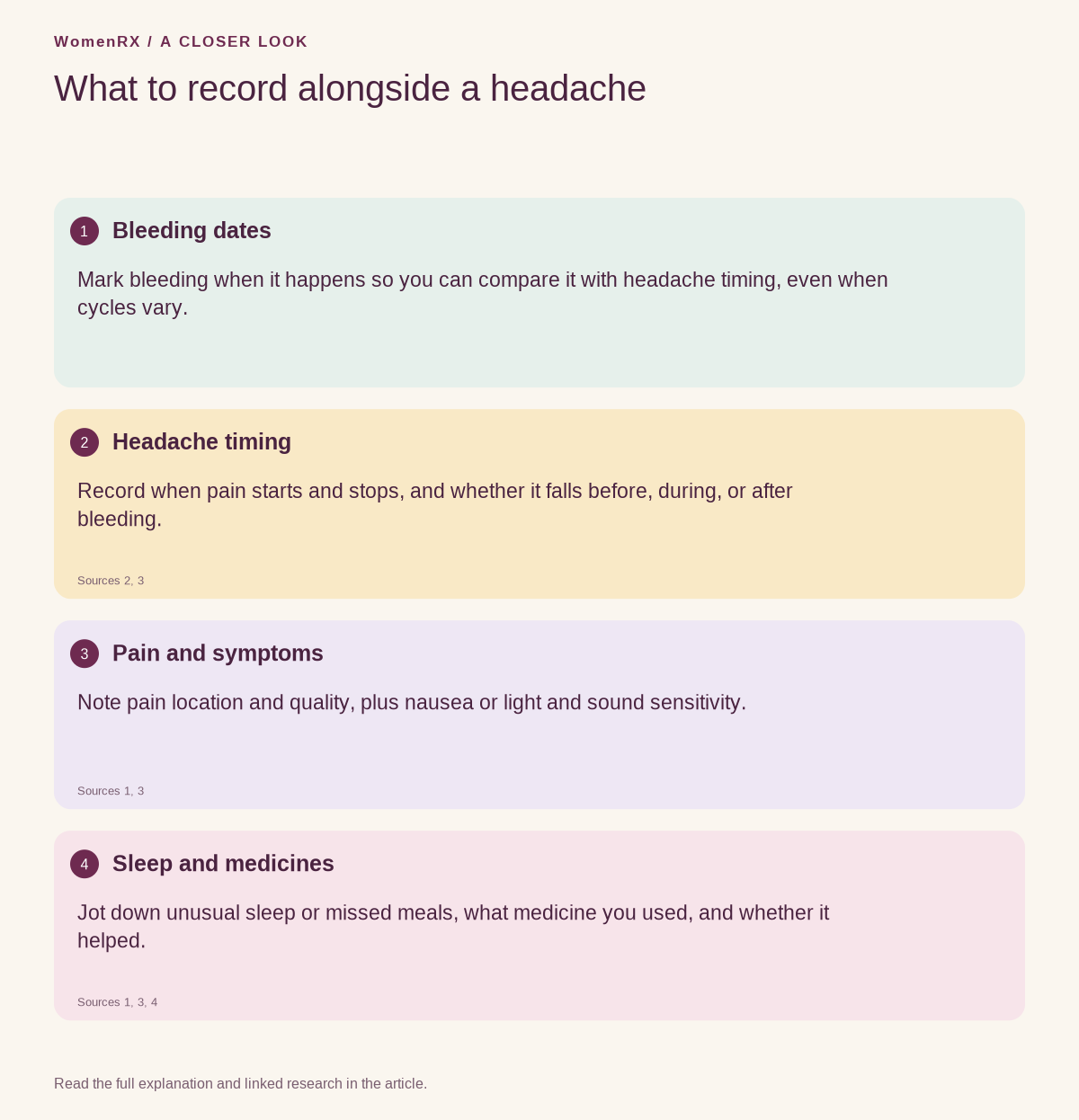
What to record alongside a headache
Bleeding dates: Mark bleeding when it happens so you can compare it with headache timing, even when cycles vary.
Headache timing: Record when pain starts and stops, and whether it falls before, during, or after bleeding.23
Pain and symptoms: Note pain location and quality, plus nausea or light and sound sensitivity.13
Sleep and medicines: Jot down unusual sleep or missed meals, what medicine you used, and whether it helped.134
Read the figure as text
Compare the dates and features that may help you describe a pattern, without treating the record as proof of a cause.- Bleeding dates: Mark bleeding when it happens so you can compare it with headache timing, even when cycles vary.
- Headache timing: Record when pain starts and stops, and whether it falls before, during, or after bleeding.23
- Pain and symptoms: Note pain location and quality, plus nausea or light and sound sensitivity.13
- Sleep and medicines: Jot down unusual sleep or missed meals, what medicine you used, and whether it helped.134
Sources you can check
- Headache | MedlinePlusAccessed 2026-09-25Return to first citation
- Headaches - NHSAccessed 2026-09-25Return to first citation
- Migraine | MedlinePlusAccessed 2026-09-25Return to first citation
- Migraine - NHSAccessed 2026-09-25Return to first citation
- Perimenopause and Menopause Are Associated With High Frequency Headache in Women With Migraine: Results of the American Migraine Prevalence and Prevention Study.Martin VT, Pavlovic J, Fanning KM, Buse DC, Reed ML, Lipton RB. · Headache · 2016Return to first citation
- Migraine headache in perimenopausal and menopausal women.MacGregor EA. · Current pain and headache reports · 2009Return to first citation