Anxiety, Your Cycle, and Menopause: What Timing Can Tell You
Anxiety can show up during perimenopause, but a timing pattern is a clue to explore, not proof that hormones are the cause.
Anxiety is reported during perimenopause, but it doesn’t follow one established pattern for everyone. If yours seems tied to your period, record anxiety alongside bleeding and other changes over several cycles. If it persists through the month or interferes with daily life, address the anxiety itself too. Hormone therapy for hot flashes isn’t automatically a treatment for anxiety. 1 2 3 4
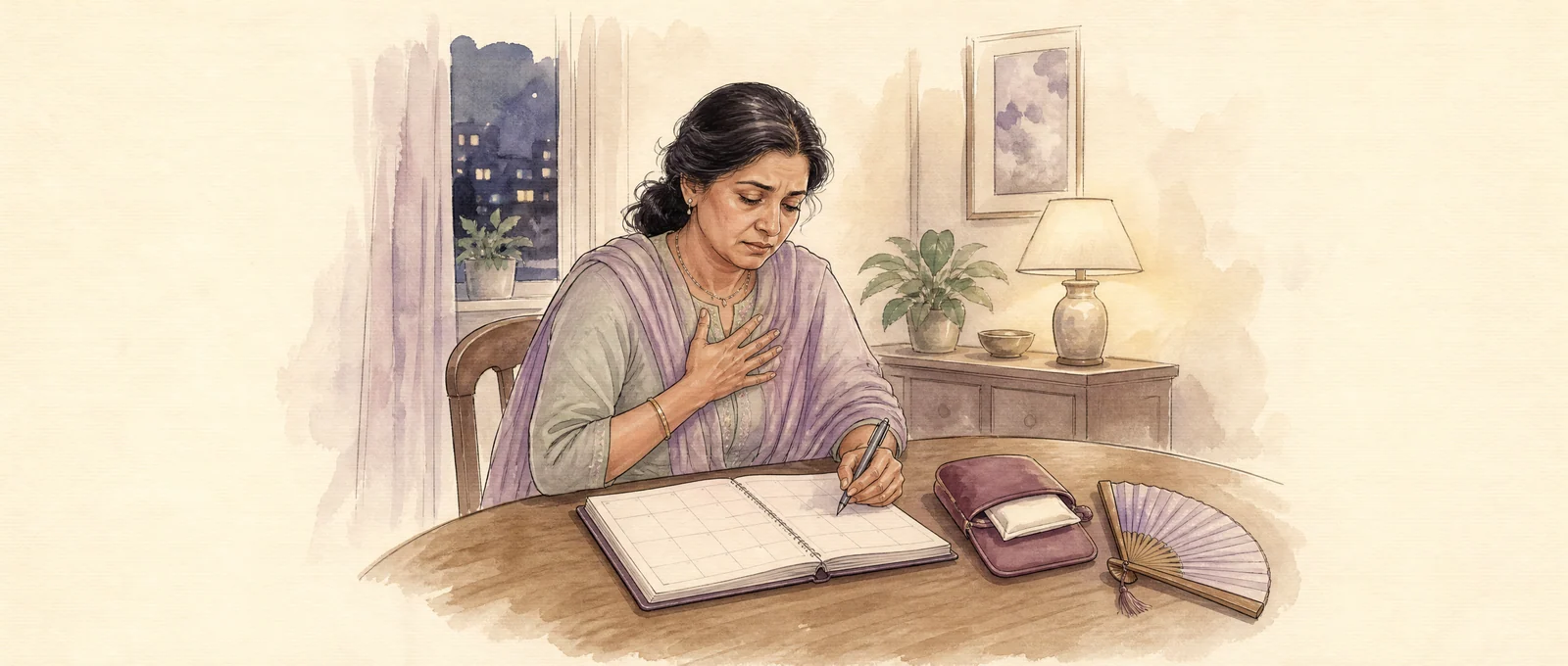
Timing is a clue, not a cause
You may notice anxiety before a period, at other points in your cycle, or without an obvious monthly rhythm. A repeating pattern is worth describing, but it can’t by itself show that hormones caused the anxiety. Anxiety can have more than one contributing factor, including stress, environment, brain biology, and some health conditions. 1
It also helps to separate a monthly cycle pattern from perimenopause. During the transition, menstrual cycles can become irregular, and anxiety is among the symptoms women report. An international app survey found that 75% of respondents aged 35 and older reported anxiety. Because the survey was cross-sectional and relied on self-report, that figure describes those respondents, not the rate for all women or proof that perimenopause caused their anxiety. 3 4
Menopause doesn’t guarantee that anxiety will appear or disappear. In one clinic study of 138 women referred for hot flashes, anxiety ratings didn’t differ significantly between the menopause-stage groups studied. That sample can’t represent everyone, but it cautions against assuming one path through the transition. 6
Keep a record that shows more than cycle day
If you want to see whether a pattern repeats, make a short daily note rather than relying on memory. Include:
- Date and bleeding: Note bleeding or spotting, or that there was none. If your periods have become irregular or stopped, record that too.
- Anxiety: Describe what you felt and whether it affected sleep, work, relationships, or other daily activities.
- Other changes: Note hot flashes, sleep disruption, and any major stressors. Keeping these separate can help you see whether anxiety seems to track with one of them.
Look for a pattern across several cycles if you still menstruate: does anxiety repeatedly rise and ease around a similar time, or is it present throughout the month? If your cycles are irregular or have stopped, note changes in symptoms without trying to force them into a monthly pattern. A midlife survey found anxiety and vigilance symptoms were associated with stress related to health, work, and difficulty paying for basics. Those associations don’t prove what caused anyone’s symptoms, but they’re a reminder to include life circumstances in the picture. 5
The record isn’t a diagnostic test. Its purpose is to help you explain what’s changing and what is staying steady.
Match care to the problem you’re having
If anxiety is persistent, worsening, or getting in the way of everyday life, it’s worth discussing even if it seems cycle-related. Anxiety disorders can involve fear or worry that doesn’t go away and interferes with daily activities. Psychotherapy, including cognitive behavioral therapy, and medication are among the main treatment options; the right approach depends on the person and the type of anxiety. 1
If anxiety is happening alongside bothersome hot flashes, mention both rather than assuming they have the same cause. Menopause hormone therapy is an effective treatment for vasomotor symptoms such as hot flashes, but that recommendation shouldn’t be treated as a general recommendation for anxiety. Hormone therapy’s benefits and risks depend on individual circumstances. 2
A useful summary to bring to a visit is simple: when the anxiety began, whether it repeats with bleeding or cycle changes, how often it occurs, what else changes at the same time, and how it affects your life. You don’t need to decide whether hormones are responsible before asking for help.
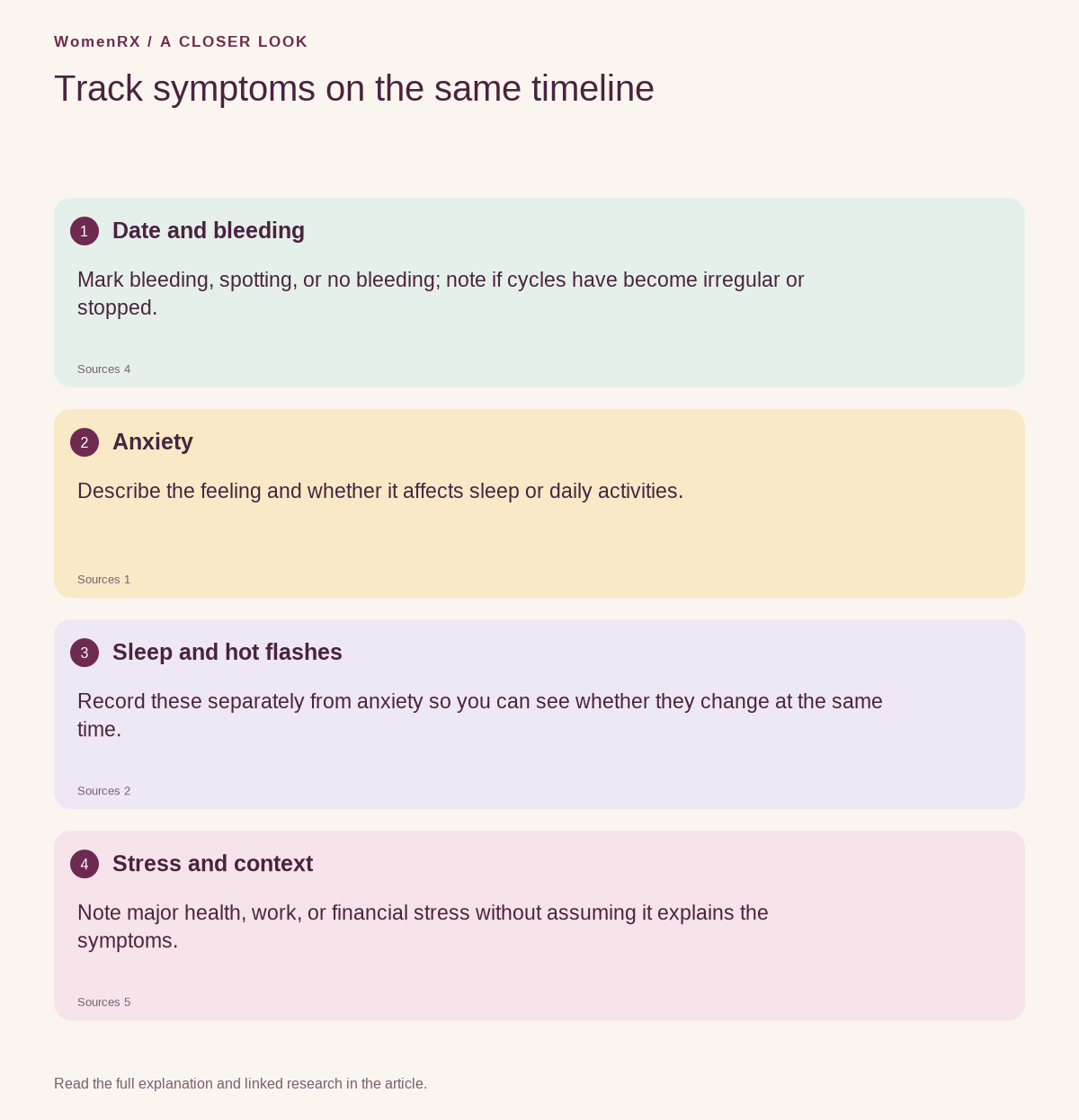
Track symptoms on the same timeline
Date and bleeding: Mark bleeding, spotting, or no bleeding; note if cycles have become irregular or stopped.4
Anxiety: Describe the feeling and whether it affects sleep or daily activities.1
Sleep and hot flashes: Record these separately from anxiety so you can see whether they change at the same time.2
Stress and context: Note major health, work, or financial stress without assuming it explains the symptoms.5
Read the figure as text
Record a few separate details each day. The timeline helps show what changes together without assuming a particular cycle or menopause pattern.- Date and bleeding: Mark bleeding, spotting, or no bleeding; note if cycles have become irregular or stopped.4
- Anxiety: Describe the feeling and whether it affects sleep or daily activities.1
- Sleep and hot flashes: Record these separately from anxiety so you can see whether they change at the same time.2
- Stress and context: Note major health, work, or financial stress without assuming it explains the symptoms.5
More questions, answered
Does anxiety around my period mean I have an anxiety disorder?
Not by itself. Anxiety can be temporary or connected to a particular situation; an anxiety disorder involves anxiety that persists and interferes with daily life. A repeating cycle pattern is useful context, but it doesn’t make the diagnosis. 1
Sources you can check
- Anxiety: MedlinePlusAccessed 2026-09-25Return to first citation
- The 2022 hormone therapy position statement of The North American Menopause Society.“The 2022 Hormone Therapy Position Statement of The North American Menopause Society” Advisory Panel. · Menopause (New York, N.Y.) · 2022Return to first citation
- Global perspectives on perimenopause: a digital survey of knowledge and symptoms using the Flo application.Hedges MS, Hewings-Martin Y, Karam J, Castaneda R, Cunningham AC, Xu Y, Zhaunova L, Faubion SS, Shufelt CL. · Menopause (New York, N.Y.) · 2026Return to first citation
- Hormonal Agents for the Treatment of Depression Associated with the Menopause.Herson M, Kulkarni J. · Drugs & aging · 2022Return to first citation
- Perimenopause meets life: observations from the Women Living Better Survey.Woods NF, Coslov N, Richardson MK. · Menopause (New York, N.Y.) · 2022Return to first citation
- Hormonal and psycho-relational aspects of sexual function during menopausal transition and at early menopause.Nappi RE, Albani F, Santamaria V, Tonani S, Magri F, Martini E, Chiovato L, Polatti F. · Maturitas · 2010Return to first citation