Why Anxiety Can Shift During Perimenopause
Anxiety may overlap with perimenopause, but sleep, hot flashes, stress, and other health conditions can also shape what you’re feeling.
Anxiety can change during perimenopause, a transition associated with anxiety symptoms and sleep disturbances, but that doesn’t show hormones are the cause for any one person. Hot flashes, disrupted sleep, life stress, and conditions such as thyroid problems can overlap. Looking at when anxiety occurs alongside these other changes can help you and a clinician decide what to assess and what support may help. 3 1
More than one thing can be true
You might notice a new edge of worry, a racing heart, or a sense of being on alert while your periods or sleep are changing. Perimenopause can be part of that picture: anxiety and sleep disturbances are among the symptoms associated with the transition. But an association isn’t proof that changing hormones caused your anxiety, and it can’t predict how your symptoms will unfold. 3
Anxiety also has many possible influences. Stress, brain biology, genetics, environment, and some physical conditions can play a role; thyroid problems and arrhythmia are among the health conditions that can contribute to anxiety symptoms. Anxiety can be a normal response to a challenge, but when it persists, worsens, or interferes with daily life, it deserves attention in its own right. 1
Follow the overlap, not just the calendar
A useful way to make sense of the pattern is to notice what changes together. For example, you could jot down when anxiety feels stronger, whether you woke during the night, whether you had a hot flash or night sweat, and whether a stressful event was happening. If your periods are changing, note that too. This isn’t a diagnostic test; it’s a way to distinguish a recurring pattern from a general feeling that everything changed at once.
Sleep can be one part of the connection. In a study of 101 perimenopausal participants followed weekly for 12 weeks, more bothersome vasomotor symptoms, such as hot flashes, and a history of depression, depressive symptoms, and higher baseline anxiety predicted worse sleep outcomes. The study did not establish that anxiety was caused by hormones or that poor sleep caused anxiety. It does show why sleep, hot flashes, and emotional health are worth considering together. 2
Stress belongs in that picture too. In the same study, stressful life events affected how poor sleep related to mood and attention. That doesn’t mean stress explains everything. It means current pressures are worth mentioning alongside physical symptoms rather than treating them as an unrelated issue. 2
Address the symptoms you’re actually having
If anxiety is new, worsening, or getting in the way of work, relationships, or everyday tasks, describe the pattern to a healthcare provider. Include sleep and hot flashes, but also mention other symptoms, health conditions, and major life stresses. A provider may ask about your symptoms and medical history, examine you, or order tests to check whether another health problem could be contributing. A psychological evaluation may help clarify whether an anxiety disorder is present. 1
Two distinct questions can help keep the conversation focused: “What might be contributing to the anxiety?” and “Do my hot flashes or sleep problems need attention too?” That leaves room to address overlapping problems without assuming they all have one cause.
For anxiety disorders, treatment approaches include psychotherapy, medication, or both. Cognitive behavioral therapy is one type of psychotherapy that can help change responses to troubling thoughts and situations. These options can address anxiety whether or not perimenopause is part of the picture. 1
Hormone therapy has evidence-based uses for particular menopausal symptoms, especially bothersome hot flashes, but the menopause guidance cited here does not establish it as a treatment for anxiety itself. If hot flashes are part of your experience, discussing their treatment is a separate, useful conversation from deciding how to address anxiety. 4
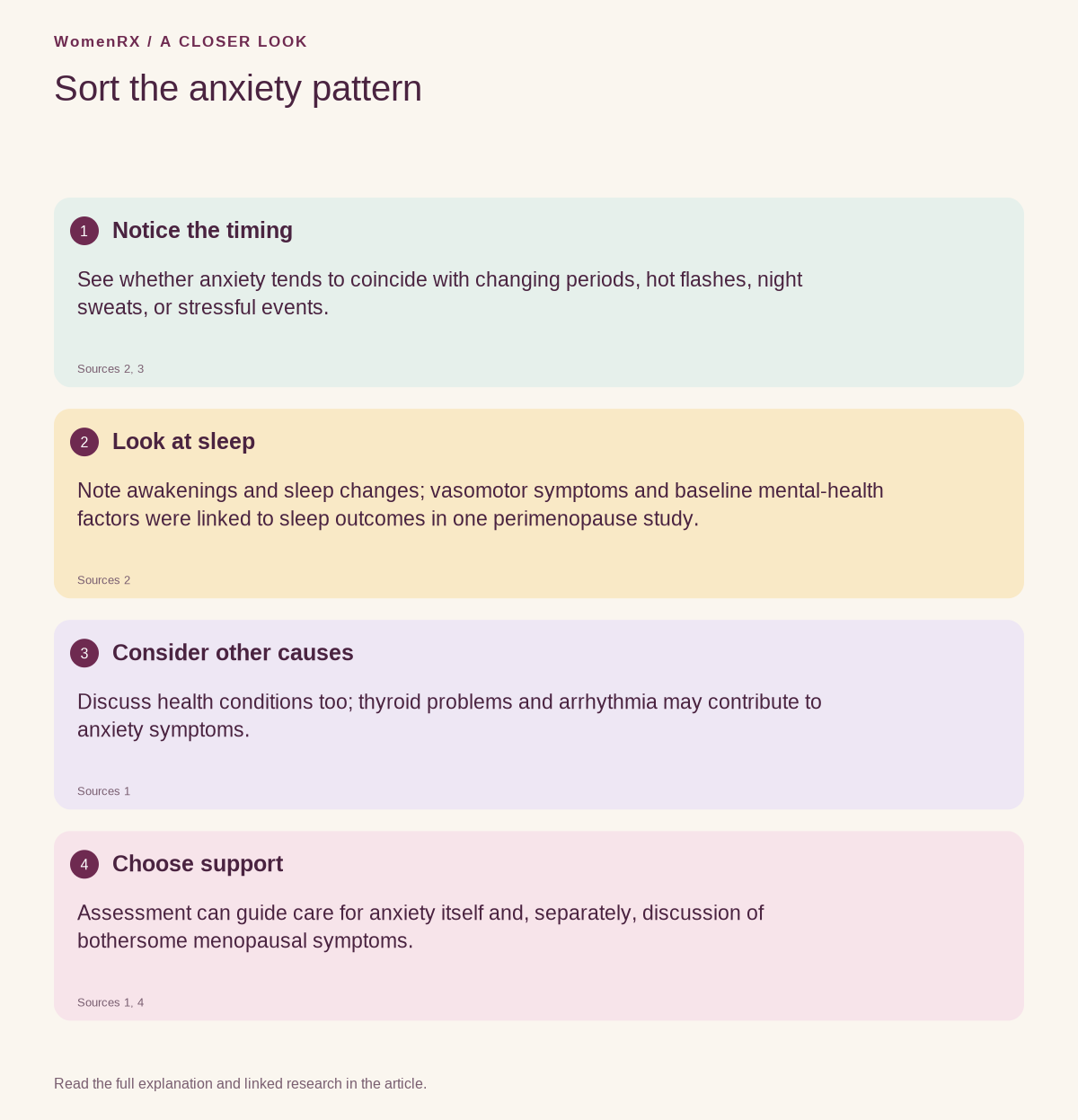
Sort the anxiety pattern
Notice the timing: See whether anxiety tends to coincide with changing periods, hot flashes, night sweats, or stressful events.23
Look at sleep: Note awakenings and sleep changes; vasomotor symptoms and baseline mental-health factors were linked to sleep outcomes in one perimenopause study.2
Consider other causes: Discuss health conditions too; thyroid problems and arrhythmia may contribute to anxiety symptoms.1
Choose support: Assessment can guide care for anxiety itself and, separately, discussion of bothersome menopausal symptoms.14
Read the figure as text
Use what happens alongside anxiety to shape a useful assessment without assuming a single cause.- Notice the timing: See whether anxiety tends to coincide with changing periods, hot flashes, night sweats, or stressful events.23
- Look at sleep: Note awakenings and sleep changes; vasomotor symptoms and baseline mental-health factors were linked to sleep outcomes in one perimenopause study.2
- Consider other causes: Discuss health conditions too; thyroid problems and arrhythmia may contribute to anxiety symptoms.1
- Choose support: Assessment can guide care for anxiety itself and, separately, discussion of bothersome menopausal symptoms.14
More questions, answered
Does anxiety during perimenopause mean I have an anxiety disorder?
No. Anxiety can be a response to stress. An anxiety disorder may be considered when anxiety doesn’t go away, worsens, or interferes with daily life. Assessment also considers your medical history and whether another health problem could be contributing. 1
Can hormone therapy be assumed to treat perimenopause anxiety?
No. Menopause guidance supports hormone therapy for certain symptoms, including bothersome hot flashes, but that doesn’t establish it as an anxiety treatment. Anxiety may need its own assessment and care. 4 1
Sources you can check
- Anxiety: MedlinePlusAccessed 2026-09-25Return to first citation
- Biopsychosocial factors intersecting with weekly sleep difficulties in the menopause transition.Chenji S, Sander B, Grummisch JA, Gordon JL. · Maturitas · 2024Return to first citation
- Intersection between gonadal function and vascular aging in women.Moreau KL. · Journal of applied physiology (Bethesda, Md. : 1985) · 2018Return to first citation
- The 2022 hormone therapy position statement of The North American Menopause Society.“The 2022 Hormone Therapy Position Statement of The North American Menopause Society” Advisory Panel. · Menopause (New York, N.Y.) · 2022Return to first citation