Perimenopause, Anxiety, and Mood: What to Consider
Mood changes can overlap with hot flashes and sleep problems, but the pattern alone can’t tell you what’s causing them.
Yes. Anxiety or low mood can arise during perimenopause, sometimes alongside hot flashes, night sweats, or sleep disruption. These symptoms can be related, but their overlap doesn’t prove that hormonal changes caused a particular mood problem. If symptoms persist or interfere with daily life, ask about assessment and discuss care for both mood and menopause symptoms, with each treatment matched to its intended target. 256

Symptoms can overlap without having one cause
Perimenopause may bring mood changes, anxiety, hot flashes, night sweats, and sleep difficulties. These can add to distress, but not every mood change is hormonal. Anxiety and depression can have different contributing factors, and some medicines or medical conditions can cause symptoms that resemble depression. 126
A small cross-sectional study offers one snapshot of the overlap. Among 89 perimenopausal women aged 45 to 55, researchers reported anxiety symptoms in 58%, depression symptoms in 62%, and vasomotor symptoms, such as hot flashes and night sweats, in 73%. Women reporting more negative affect also tended to rate their vasomotor symptoms as more bothersome. Because the study measured symptoms at one point in time, it can’t show which came first or establish that one caused another. Its percentages describe that study sample, not all women in perimenopause. 5
Sleep, mood, and hot flashes may be part of the same difficult stretch. It can help to explain what you notice: for example, whether worry seems worse after nights with repeated sweating, or whether low mood continues even when hot flashes are less noticeable. That pattern is useful context, not a diagnosis or proof of cause. 56
When mood symptoms merit assessment
Anxiety deserves attention when it doesn’t let up, feels overwhelming, or interferes with everyday activities such as work or relationships. Depression is more than a few days of sadness: symptoms can include ongoing low mood or loss of interest that affects daily life. For major depression, MedlinePlus describes symptoms occurring most of the day, nearly every day, for at least two weeks. 12
You don’t need to work out whether symptoms are “menopause” or “mental health” before raising them. Useful details include when the change began, how it affects your day, whether sleep or hot flashes are part of the pattern, and what medicines or other health changes may be relevant. A clinician can assess mood symptoms and consider other explanations, including medical conditions such as thyroid disorders. 2
Match treatment to the symptom you want to address
If hot flashes or night sweats are a major concern, ask about treatment for vasomotor symptoms. The North American Menopause Society identifies hormone therapy as the most effective treatment for these symptoms and says treatment should be individualized around benefits and risks. That guidance supports discussing hormone therapy for bothersome vasomotor symptoms; it does not make it a universal treatment for anxiety or depression. 3
There are nonhormonal options for vasomotor symptoms as well. The Society’s 2023 statement recommends cognitive behavioral therapy, clinical hypnosis, SSRIs or SNRIs, gabapentin, and fezolinetant, among other options. That recommendation concerns menopause-related vasomotor symptoms. Whether an option is also appropriate for a mood condition depends on the person and the treatment goal. 4
When depression and vasomotor symptoms occur together, FIGO guidance discusses escitalopram and venlafaxine for depressive symptoms and vasomotor instability in people with major depressive disorder. Psychological support, including cognitive behavioral therapy, may also be part of individualized care. Ask what symptom a proposed treatment is meant to help, and how you’ll know whether it is helping that symptom. 6
A useful distinction is the target: care for hot flashes may address one part of your experience, while persistent anxiety or depression deserves attention in its own right. It’s reasonable to discuss both, without assuming one explains the other.
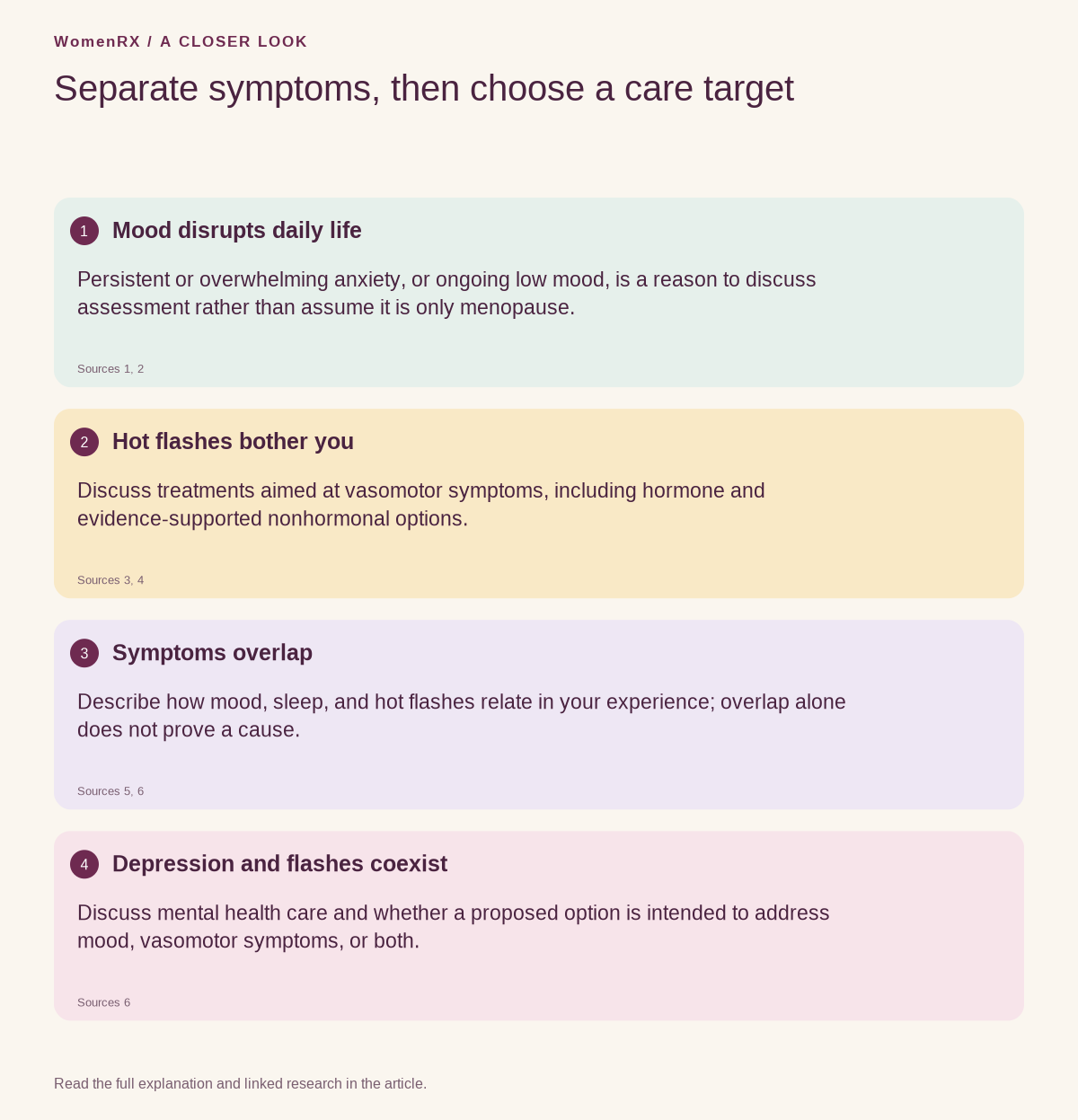
Separate symptoms, then choose a care target
Mood disrupts daily life: Persistent or overwhelming anxiety, or ongoing low mood, is a reason to discuss assessment rather than assume it is only menopause.12
Hot flashes bother you: Discuss treatments aimed at vasomotor symptoms, including hormone and evidence-supported nonhormonal options.34
Symptoms overlap: Describe how mood, sleep, and hot flashes relate in your experience; overlap alone does not prove a cause.56
Depression and flashes coexist: Discuss mental health care and whether a proposed option is intended to address mood, vasomotor symptoms, or both.6
Read the figure as text
Mood changes and vasomotor symptoms can overlap. This flow helps distinguish when to seek assessment from which symptoms a treatment is intended to address.- Mood disrupts daily life: Persistent or overwhelming anxiety, or ongoing low mood, is a reason to discuss assessment rather than assume it is only menopause.12
- Hot flashes bother you: Discuss treatments aimed at vasomotor symptoms, including hormone and evidence-supported nonhormonal options.34
- Symptoms overlap: Describe how mood, sleep, and hot flashes relate in your experience; overlap alone does not prove a cause.56
- Depression and flashes coexist: Discuss mental health care and whether a proposed option is intended to address mood, vasomotor symptoms, or both.6
More questions, answered
Does hormone therapy treat anxiety or depression?
The North American Menopause Society identifies hormone therapy as the most effective treatment for vasomotor symptoms such as hot flashes and night sweats. That supports discussing it for bothersome menopause symptoms, but doesn’t establish it as a universal treatment for an anxiety disorder or depression. Ask which symptoms a suggested treatment is intended to address. 3
Do hot flashes and anxiety mean one is causing the other?
No. They can occur together, and one small cross-sectional study found that negative affect was associated with how bothersome vasomotor symptoms felt. A study measured at one point in time can’t establish which came first or prove direct causation. 5
Sources you can check
- Anxiety: MedlinePlusAccessed 2026-09-25Return to first citation
- Depression: MedlinePlusAccessed 2026-09-25Return to first citation
- The 2022 hormone therapy position statement of The North American Menopause Society.“The 2022 Hormone Therapy Position Statement of The North American Menopause Society” Advisory Panel. · Menopause (New York, N.Y.) · 2022Return to first citation
- The 2023 nonhormone therapy position statement of The North American Menopause Society.Menopause (New York, N.Y.) · 2023Return to first citation
- Negative affect symptoms, anxiety sensitivity, and vasomotor symptoms during perimenopause.Jaeger MB, Miná CS, Alves S, Schuh GJ, Wender MC, Manfro GG. · Revista brasileira de psiquiatria (Sao Paulo, Brazil : 1999) · 2021Return to first citation
- FIGO best practice recommendations for the mental health of women at menopausal age.Khadilkar S, Divakar H, Benedetto C, Genazzani A, Ramos D, Argale E, Deshpande G, Hicky M, Filho ALDS, Herrera E, Balkrishnan M. · International journal of gynaecology and obstetrics: the official organ of the International Federation of Gynaecology and Obstetrics · 2026Return to first citation