Is Tirzepatide Linked to Depression or Anxiety?
The strongest direct trial analysis is reassuring for many adults, but it can’t explain every new mood symptom during treatment.
In a pooled analysis of three weight-loss trials, adults taking tirzepatide did not show more depressive symptoms than those taking placebo, and reported anxiety-related adverse events were generally similar. The trials largely excluded people with significant psychiatric illness, so they can’t settle what’s happening for every person. If your mood or anxiety changes during treatment, take it seriously without assuming the medicine is the cause. 6
What the tirzepatide trials can tell you
Researchers analyzed psychiatric measures from three placebo-controlled SURMOUNT trials involving 4,056 adults with overweight or obesity. Participants started with, on average, minimal depressive symptoms. At week 72, average depression-screening scores were slightly lower with tirzepatide than with placebo. Reports of depression-, stress-, and anxiety-related adverse events were generally similar between groups. This does not establish tirzepatide as a treatment for depression or anxiety; it means these trials did not find a signal of increased symptoms in the people they studied. 6
There’s an important boundary: the trials excluded people with a lifetime history of suicide attempt, clinically significant suicidal symptoms, or recent active or unstable major depression or another severe psychiatric illness. Someone with a history of significant mood symptoms shouldn’t read the trial average as a guarantee about her own experience. The analysis also did not establish a separate psychiatric effect in women. 6
Suicidal thoughts deserve their own distinction from depression or anxiety. On one structured assessment used in the trials, 0.6% of participants in each group reported suicidal ideation. That finding is reassuring within this study population, but uncommon events and the trial exclusions limit what it can rule out. 6
Why you may have seen conflicting headlines
Research on the wider GLP-1 medicine class does not all point in the same direction. A review of studies in adults with type 2 diabetes found no clear overall difference in new depression diagnoses between GLP-1 receptor agonists and other diabetes medicines, though results varied substantially across studies. Another review, focused on adults with overweight or obesity, found an association with more depression-related outcomes, but its studies were extremely inconsistent. Neither pooled result gives a reliable estimate of tirzepatide’s effect on an individual woman’s mood. 78
A personal account of a mood change after starting treatment raises a question worth discussing, but timing alone cannot show that the medicine caused it. The US tirzepatide weight-management label does not list depression or anxiety among its reported post-approval reactions. It also explains why voluntary reports, in general, cannot reliably establish how often a reaction occurs or whether a medicine caused it. The direct tirzepatide trial findings and a difficult personal experience can both be taken seriously without treating them as the same kind of evidence. 36
If anxiety or low mood starts during treatment
Tell the clinician managing your tirzepatide treatment what has changed, particularly if symptoms are new, worsening, or interfering with daily life. You don’t need to prove what caused them before asking for help. Depression may look like loss of interest, hopelessness, low energy, or trouble concentrating, not just sadness. Anxiety that is hard to control and disrupts daily life also deserves assessment. Talk therapy and medication are among the established treatments for anxiety; depression is treatable too. 42
One distinction is especially useful if you take tirzepatide with insulin or a sulfonylurea: low blood sugar can cause shakiness, a fast heartbeat, anxiety, irritability, or mood changes. Tirzepatide’s US weight-management prescribing information identifies a higher risk of low blood sugar with those medicines. Mention those physical symptoms and your diabetes medicines when you seek advice, rather than assuming a sudden anxious feeling is a psychiatric drug effect. 3
Your wider situation matters as well. Depression can emerge during pregnancy, after childbirth, or during perimenopause, whether or not you’re taking tirzepatide. After childbirth, persistent or severe sadness and anxiety should not be brushed off as ordinary ‘baby blues.’ These are possible contexts to consider, not reasons to dismiss a change that began during treatment. If you’re pregnant or become pregnant while using tirzepatide, tell your prescriber; that also calls for a separate discussion about the medicine. 453
If you’re thinking about harming yourself, call or text 988 now. If you’re in immediate danger, call 911. After childbirth, thoughts of harming your baby also need immediate help; confusion or seeing or hearing things that aren’t there is a medical emergency. You do not need to determine whether tirzepatide played a role before getting support. 15
What different kinds of evidence mean
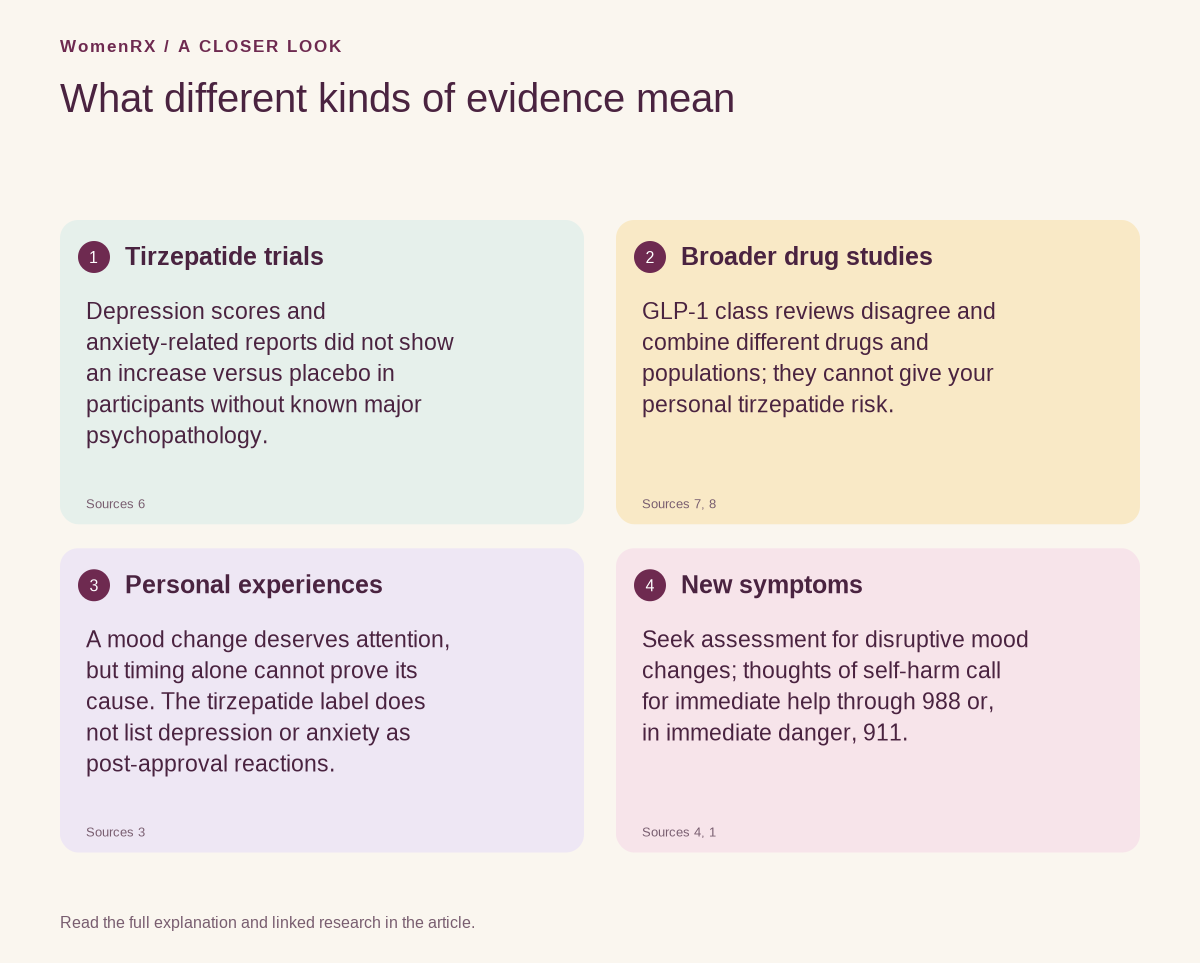
Tirzepatide trials: Depression scores and anxiety-related reports did not show an increase versus placebo in participants without known major psychopathology.6
Broader drug studies: GLP-1 class reviews disagree and combine different drugs and populations; they cannot give your personal tirzepatide risk.78
Personal experiences: A mood change deserves attention, but timing alone cannot prove its cause. The tirzepatide label does not list depression or anxiety as post-approval reactions.3
New symptoms: Seek assessment for disruptive mood changes; thoughts of self-harm call for immediate help through 988 or, in immediate danger, 911.41
Read the figure as text
These findings answer different questions. None can determine the cause of one person’s symptoms on its own.- Tirzepatide trials: Depression scores and anxiety-related reports did not show an increase versus placebo in participants without known major psychopathology.6
- Broader drug studies: GLP-1 class reviews disagree and combine different drugs and populations; they cannot give your personal tirzepatide risk.78
- Personal experiences: A mood change deserves attention, but timing alone cannot prove its cause. The tirzepatide label does not list depression or anxiety as post-approval reactions.3
- New symptoms: Seek assessment for disruptive mood changes; thoughts of self-harm call for immediate help through 988 or, in immediate danger, 911.41
More questions, answered
Should I wait two weeks to mention symptoms?
No. The two-week description helps identify a possible depressive episode; it is not a waiting period for asking for help. Bring up new or worsening symptoms sooner, especially if they affect daily life. Thoughts of self-harm call for immediate help. 41
Sources you can check
- Suicide: MedlinePlusAccessed 2026-09-25Return to first citation
- Anxiety: MedlinePlusAccessed 2026-09-25Return to first citation
- ZEPBOUND (TIRZEPATIDE) INJECTION, SOLUTION ZEPBOUND (TIRZEPATIDE) INJECTION, SOLUTION ZEPBOUND KWIKPEN (TIRZEPATIDE) INJECTION, SOLUTION [ELI LILLY AND COMPANY] | US prescribing information and patient instructionsAccessed 2026-09-25Return to first citation
- Depression in Women: 4 Things to Know - National Institute of Mental Health (NIMH)Accessed 2026-09-25Return to first citation
- Postpartum Depression: MedlinePlusAccessed 2026-09-25Return to first citation
- Psychiatric Safety of Tirzepatide in People With Obesity and No Known Major Psychopathology: A Post Hoc Analysis of SURMOUNT.Wadden TA, Oquendo MA, Kushner RF, Cao D, Karanikas CA, Kechter A, Murphy MA. · Obesity (Silver Spring, Md.) · 2026Return to first citation
- Risk of Depression With Glucagon-Like Peptide-1 (GLP-1) Receptor Agonists Compared to Other Antidiabetic Medications in Adults With Type 2 Diabetes: A Systematic Review and Meta-Analysis.Ferrer Zavala GM, Caro Rodriguez CF, Carrion Carrion P, Martinez Artiga L, Morales Del Cid ZY, Chia JE, Valladares C. · Cureus · 2026Return to first citation
- Glucagon-like peptide-1 receptor agonists and risk of depression: a systematic review and meta-analysis.Bi Z, Jiao Z, Li J, Fang Z. · BMC psychiatry · 2026Return to first citation