Burnout, Depression, or Anxiety? Finding Your Next Step
Work-centered exhaustion can point to burnout, but persistent low mood or worry may call for a broader assessment.
Burnout describes a pattern of work-related exhaustion, detachment, and feeling less effective. It can overlap with depression or anxiety, so you don’t have to settle on a label before seeking support. Notice whether the strain centers on work, extends across your life, or includes persistent low mood or worry. That distinction can help you choose a next step. 6 3 1 2
Start with where the strain shows up
You might feel depleted before work, distant from coworkers or the people you serve, or less able to do a job that once felt manageable. Burnout is commonly described through work-related exhaustion, detachment or negative reactions toward work, and a reduced sense of accomplishment. Those dimensions can help name a pattern, but they don’t diagnose you or rule out another condition. 6
Ask yourself where the difficulty shows up. If it centers on a particular job or work setting, the demands and conditions there deserve attention. If low mood, loss of interest, or worry is affecting home, relationships, and everyday tasks too, don’t assume work strain explains everything.
What else could be going on?
Depression can involve ongoing low mood or loss of interest that affects daily life. For major depression, symptoms occur most of the day, nearly every day, for at least two weeks, and include depressed mood or loss of interest. Depression doesn’t look the same in everyone. Some medical conditions and medicines can also cause similar symptoms, which is one reason an assessment may consider physical health as well as mood. 2
Anxiety can be a normal response to a stressful situation. An anxiety disorder involves fear or worry that doesn’t go away, may get worse, and interferes with daily activities. For example, worry that keeps spreading from a work problem to health, money, or family may be worth discussing if it feels overwhelming. Generalized anxiety disorder is one possible diagnosis, not a label for every stressful stretch. 1
These patterns aren’t mutually exclusive. Research in healthcare workers has examined burnout alongside anxiety and depression, and one healthcare-worker questionnaire study found that burnout and depression symptoms were positively correlated. That doesn’t tell us which came first or how often the same overlap occurs in other kinds of work. 3 5
Match the support to the pressure point
If the strain seems closely tied to work, think about what would change the conditions around you, not only what you could do to cope. For example, you might ask a manager to clarify priorities, discuss workload or schedule adjustments, or look into an employee support resource. Research in healthcare settings identifies workload and work conditions as relevant factors, though it doesn’t establish which adjustment will help in every workplace. 3 4
Caregiving can add demands whether or not you also have paid work. You don’t need to decide whether “burnout” is the right word to take that exhaustion seriously. As a practical starting point, consider whether a recurring task could be shared, delayed, or handled differently. For example, could someone else take a regular errand? If work and care responsibilities are both weighing on you, describe both when asking for support.
Consider a mental-health or medical assessment when symptoms are affecting daily functioning, extend well beyond work, or include persistent low mood, loss of interest, or overwhelming worry. A clinician can ask about your symptoms and health history and consider whether a medical condition or medicine might be contributing. 1 2
There’s no single pattern that describes women’s experience of burnout. A review of studies involving physicians and medical trainees reported higher rates of burnout, depression, and anxiety among women than men, but results varied widely. Those findings don’t establish what’s happening for women in other jobs or with unpaid care responsibilities. The review also describes barriers to seeking support in some physician and trainee settings, including limited time and concerns about confidentiality or careers. 4
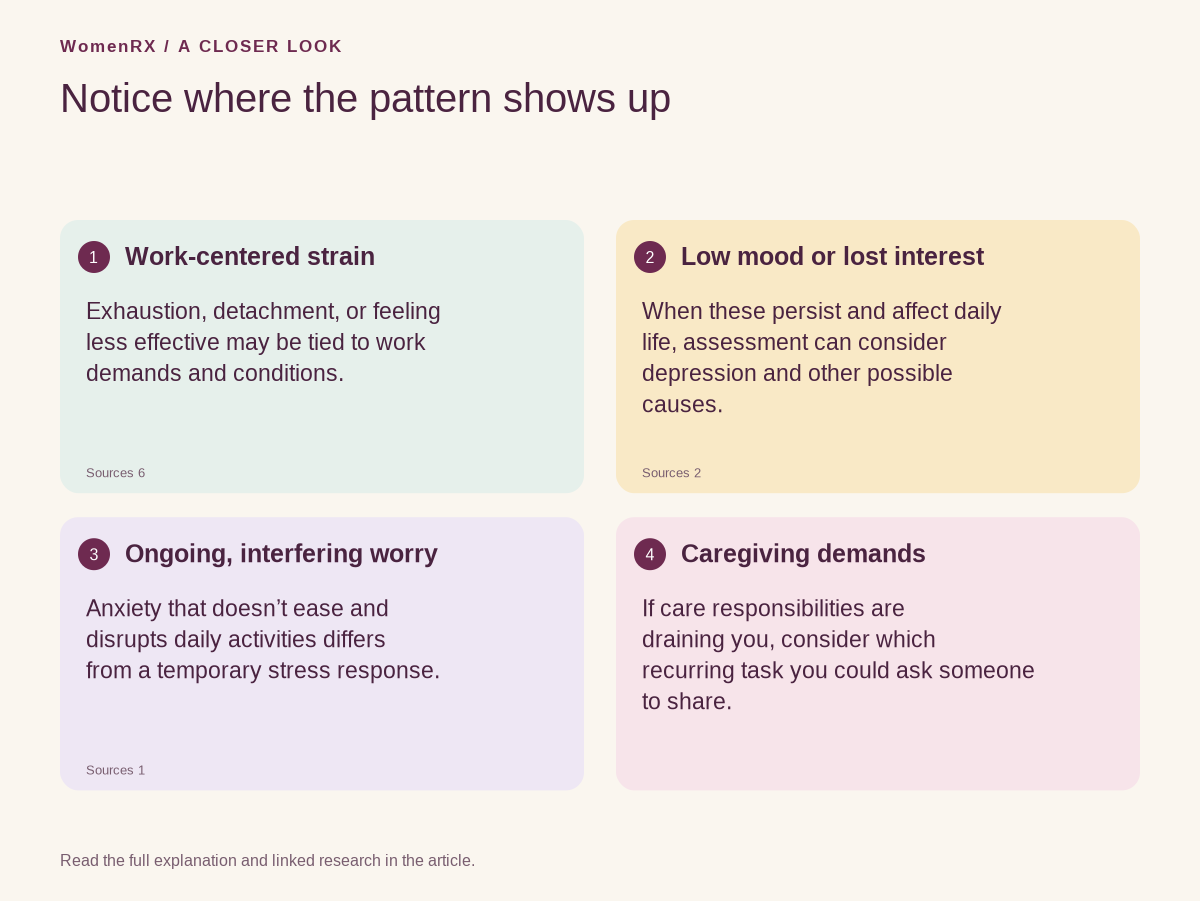
Notice where the pattern shows up
Work-centered strain: Exhaustion, detachment, or feeling less effective may be tied to work demands and conditions.6
Low mood or lost interest: When these persist and affect daily life, assessment can consider depression and other possible causes.2
Ongoing, interfering worry: Anxiety that doesn’t ease and disrupts daily activities differs from a temporary stress response.1
Caregiving demands: If care responsibilities are draining you, consider which recurring task you could ask someone to share.
Read the figure as text
These distinctions can guide your choice of support. They aren’t a diagnostic checklist, and more than one pattern can be present.- Work-centered strain: Exhaustion, detachment, or feeling less effective may be tied to work demands and conditions.6
- Low mood or lost interest: When these persist and affect daily life, assessment can consider depression and other possible causes.2
- Ongoing, interfering worry: Anxiety that doesn’t ease and disrupts daily activities differs from a temporary stress response.1
- Caregiving demands: If care responsibilities are draining you, consider which recurring task you could ask someone to share.
More questions, answered
Can burnout and depression happen at the same time?
Yes. Calling yourself burned out doesn’t rule out depression. If low mood or loss of interest persists and affects daily life, a broader assessment can help identify what support you need. 2 5
Sources you can check
- Anxiety: MedlinePlusAccessed 2026-09-25Return to first citation
- Depression: MedlinePlusAccessed 2026-09-25Return to first citation
- Predicting burnout, anxiety and depression among Canadian healthcare professionals during the COVID-19 pandemic: a cross-sectional secondary analysis study.Balakrishnar K, Long BS, Premji R, Choi C, Sathananthan A, Choppella M, Mazur M, Nowrouzi-Kia B. · BMJ open · 2026Return to first citation
- Prevalence and correlates of depression, anxiety, and burnout among physicians and postgraduate medical trainees: a scoping review of recent literature.Obeng Nkrumah S, Adu MK, Agyapong B, da Luz Dias R, Agyapong VIO. · Frontiers in public health · 2025Return to first citation
- [Hungarian version and adaptation of the BAT burnout questionnaire (BAT-H) and its correlation with depression in a sample of healthcare workers].Almássi Z, Debreceni D, Varga-Felföldi E, Kolozsvári L, Szemán-Nagy A, Hőgye-Nagy Á. · Psychiatria Hungarica : A Magyar Pszichiatriai Tarsasag tudomanyos folyoirata · 2026Return to first citation
- Burnout among medical doctors working in paediatric intensive care units in Bulgaria.Halilova M, Krumova D, Zlateva T, Teneva T, Pechilkov D, Mladenov B, Zdravkov B, Ivanov I, Avdjieva D, Yotov Y, Iotova V. · Frontiers in pediatrics · 2026Return to first citation