How to Choose Therapy for Anxiety or Depression
Start with what you want to change, then compare the approach, therapist, and practical details that would make care workable.
CBT is an established option for anxiety and depression, but the therapy label is only a starting point. For anxiety, CBT may include working gradually with situations you’ve been avoiding; other approaches may suit different needs. Ask a prospective therapist what sessions involve, how they’d address your concern, what care will cost, and how you’ll decide together whether it’s helping. 1 3
Begin with the problem, not a therapy label
You don’t need to know which therapy you want before making contact. Start with what’s getting harder. For example, you might be avoiding social plans because of anxiety, or finding that low mood makes ordinary tasks feel difficult. Anxiety disorders and depression can both interfere with daily life, and psychotherapy is a treatment option for each. 1 2
Put the change you’re hoping for into your own words: “I want to stop avoiding meetings,” or “I want to get back to activities I used to enjoy.” That gives you something more useful to discuss than a therapy acronym alone.
Find out what you would actually do
Cognitive behavioral therapy (CBT) works with ways of thinking and behaving. In anxiety treatment, it may include exposure therapy: working with feared situations so you can do things you’ve been avoiding. If that sounds relevant, ask what the therapist would suggest for your particular concern and how you’d work toward your goal. CBT is also a well-supported psychotherapy approach for depression. 1 3
Acceptance and commitment therapy (ACT) uses strategies such as mindfulness and goal-setting and may help with some anxiety disorders. You could ask how those strategies would apply to the situation that brought you to therapy. 1
For depression, psychotherapy can help you work with troubling emotions, thoughts, and behaviors. It can be individual or group-based and may offer skills, coping strategies, education, and support. Ask what a typical session would involve rather than assuming two therapists who say “talk therapy” work the same way. 2
None of these descriptions can tell you how a particular therapist will work with you. A useful follow-up is: “Why do you think this approach fits my concern, and what might we try if it isn’t helping?”
Compare what’s possible in your life
A promising approach is less useful if you can’t attend regularly or afford it. When contacting therapists, consider asking:
- Experience: “What training and experience do you have with the concern I’ve described?”
- Sessions: “What would we do in sessions, and would there be anything to practice between them?”
- Cost: “What would I pay, and how can I confirm any insurance coverage?”
- Format and schedule: “Do you offer in-person, video, or group sessions? When are appointments available?”
- Progress: “How would we agree on a goal and check whether therapy is helping?”
These questions don’t assume any particular therapist offers a certain format or takes your insurance. They help you compare real options instead of choosing on approach alone.
If an online CBT program appeals to you, ask whether it’s structured and whether a therapist guides it. A review found that guided, structured internet-delivered CBT had outcomes comparable to face-to-face therapy in some groups and settings. Digital options vary, though, and long-term evidence is limited. That finding doesn’t mean every app offers the same care as sessions with a therapist. 3
Leave room for the context that matters to you
You can ask how a therapist works with trauma-related concerns if that matters to you. If pregnancy or the postpartum period is part of what you’re experiencing, ask about their experience with that stage and how they would tailor care. A review of perinatal interventions reported different findings by pregnancy or postpartum stage and by the concern being addressed; it doesn’t establish one best approach for every person. 4
You might also care about whether you feel able to speak openly, whether the therapist answers questions clearly, or whether their style feels workable. Preferences about a therapist’s background or approach are yours to name. A therapist’s gender alone won’t tell you whether the fit is right.
For a first inquiry, try: “I’m looking for help with [main concern]. How would you approach it, what would sessions be like, and how would we review whether it’s helping?” You can compare the answer with the cost, format, and availability you need. You’re looking for a plan you understand and can realistically use.
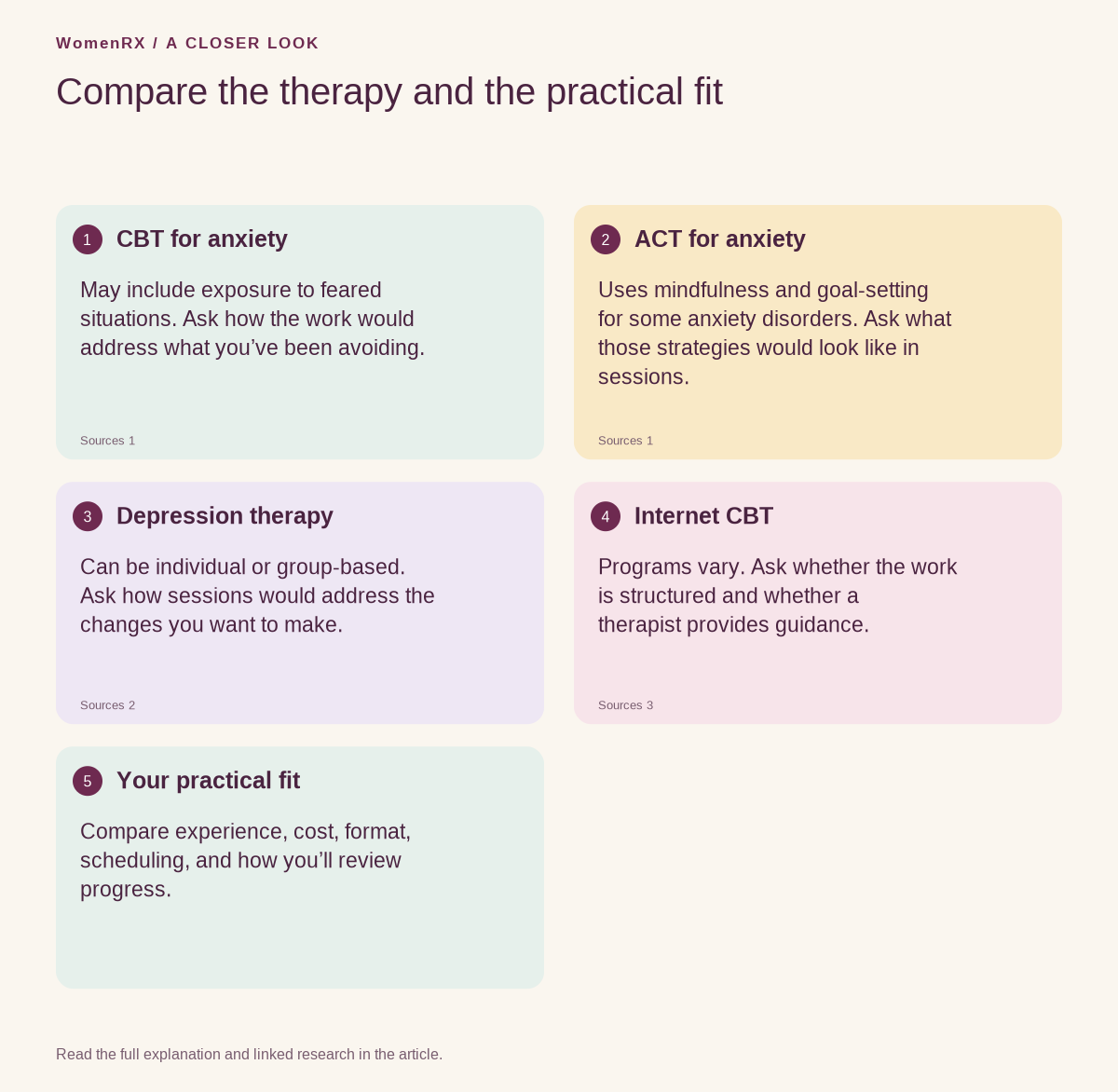
Compare the therapy and the practical fit
CBT for anxiety: May include exposure to feared situations. Ask how the work would address what you’ve been avoiding.1
ACT for anxiety: Uses mindfulness and goal-setting for some anxiety disorders. Ask what those strategies would look like in sessions.1
Depression therapy: Can be individual or group-based. Ask how sessions would address the changes you want to make.2
Internet CBT: Programs vary. Ask whether the work is structured and whether a therapist provides guidance.3
Your practical fit: Compare experience, cost, format, scheduling, and how you’ll review progress.
Read the figure as text
Each option raises a different question to ask before deciding whether it works for you.- CBT for anxiety: May include exposure to feared situations. Ask how the work would address what you’ve been avoiding.1
- ACT for anxiety: Uses mindfulness and goal-setting for some anxiety disorders. Ask what those strategies would look like in sessions.1
- Depression therapy: Can be individual or group-based. Ask how sessions would address the changes you want to make.2
- Internet CBT: Programs vary. Ask whether the work is structured and whether a therapist provides guidance.3
- Your practical fit: Compare experience, cost, format, scheduling, and how you’ll review progress.
More questions, answered
Is online CBT the same as video sessions with a therapist?
Not necessarily. Internet-delivered CBT can refer to a structured program, sometimes with therapist guidance, while video sessions are a way to meet with a therapist remotely. Ask who will provide support, what the work includes, and how you’ll receive feedback. Evidence of comparable outcomes for internet CBT applies to some groups and conditions, particularly when the program is guided and structured. 3
Sources you can check
- Anxiety: MedlinePlusAccessed 2026-09-25Return to first citation
- Depression: MedlinePlusAccessed 2026-09-25Return to first citation
- AI-Guided Cognitive Behavioral Therapy for Depression and Anxiety: Bridging the Mental Health Treatment Gap Through Digital Psychiatry.Stojanovic A, Stankovic M, Ristic A. · Healthcare (Basel, Switzerland) · 2026Return to first citation
- Optimizing Non-Pharmacological Support for Perinatal Mental Health: A Bayesian Network Meta-Analysis of Intervention Effects by Pregnancy/Postpartum Stage.Li Z, Nima L, Song Y, Li Y. · Current psychiatry reports · 2026Return to first citation