Therapy, Medication, or Both for Anxiety or Depression?
The best starting point depends on what you're experiencing, what treatment you can use consistently, and what you'll do if the first plan isn't helping.
Therapy, medication, and combined care are all treatment options for anxiety disorders and depression. How much symptoms disrupt daily life should be part of the discussion, alongside the type of anxiety or depression, your preferences, past response, and safety needs. For depression, more severe symptoms can make combined care especially worth discussing, but severity alone doesn't decide the treatment.615
Start with the problem you want treatment to change
Anxiety and depression can affect sleep, relationships, work, and the ordinary tasks that fill a day. Anxiety disorders can also look quite different from one another. If you avoid driving because you're afraid of a panic attack, that's a different treatment conversation from feeling worried across many parts of life. Therapy, medication, or both are established options for anxiety disorders; antidepressants are also used to treat depression.61
How much symptoms are interfering matters too. If you're struggling to manage daily tasks, say that at the start rather than describing symptoms alone. In a participant-level analysis summarized in a 2026 meta-analysis, people with more severe depression and episodes lasting over two years benefited more from antidepressants plus psychodynamic therapy than from antidepressants alone or with brief supportive therapy. That finding makes combined care a useful question for some people with depression, not a rule based on a severity label or a prediction for anxiety disorders.75
A useful first question isn't “Which treatment wins?” It's “What am I hoping will become easier, and what can I realistically start?” Your answer might be getting back to a place you've avoided, being able to concentrate at work, or having enough energy to manage daily life. Bring up anything you've tried before, including what helped and what made treatment hard to continue.
What therapy asks of you
For an anxiety disorder, psychotherapy should focus on the anxieties you're actually experiencing. Cognitive behavioral therapy (CBT) works on patterns of thinking and behavior. It may include exposure therapy, which helps you face feared situations rather than keep avoiding them. Acceptance and commitment therapy is another approach used for some anxiety disorders.6
That makes the type of therapy a practical question, not just whether a therapist has an opening. If avoidance is your main problem, for example, ask how a therapist works with it and what you'll practice between visits. Therapy also takes time and active participation. If appointments are difficult to fit around work or caregiving, say so while you're choosing a plan.
Psychotherapy is also a treatment for depression. In a review of adult depression trials with follow-up at least 12 months after treatment ended, psychotherapy and combined treatment had better results than medication alone on some longer-term relapse-related outcomes. The studies varied, and that finding doesn't mean therapy alone is the best choice for every person or for anxiety disorders.4
What medication asks of you
Antidepressants can treat depression, and certain antidepressants are also used for anxiety disorders. Different anxiety conditions may call for different medicines. Finding one that helps can take more than one try; antidepressants usually take 4 to 8 weeks to work, though sleep or appetite may improve before mood does.16
If you're considering medication, ask what change to watch for, when you'll review it, and which side effects should prompt a call. That matters whether medication is your first treatment or something you add later. Contact your prescriber promptly about new or worsening symptoms, unusual mood changes, or other changes that worry you. Don't stop or change an antidepressant on your own; stopping too quickly can make symptoms return or worsen.1
Sertraline and fluoxetine are examples of antidepressants used for depression, not a pair of default choices for every anxiety disorder or every woman. The discussion should be about a medicine's fit for your condition and circumstances, rather than a familiar name.236
When both belong in the conversation
Combined care isn't a verdict that either treatment has failed. For someone with depression, it may offer a way to address symptoms with medication while also working on thoughts and behaviors in therapy. A review of adult depression trials found better longer-term relapse-related outcomes for combined treatment than for medication alone, but did not find a clear difference between combined treatment and psychotherapy alone at follow-up. Those results don't establish the best option for an individual woman.4
For anxiety disorders, both psychotherapy and medicines are treatment options, and they can be used together. The choice depends partly on the anxiety disorder and the treatment you're able and willing to pursue. The depression comparison above shouldn't be used to predict whether adding medication to therapy, or therapy to medication, will work better for your particular anxiety condition.64
If you start with one approach, make the review part of the plan: What would count as meaningful improvement? When will you check in? If you're not improving, would it make more sense to adjust the current treatment, change it, or add the other approach? These questions keep a first choice from becoming an indefinite wait.
Bring your life stage into the decision
Pregnancy, plans for pregnancy, and breastfeeding belong in a medication discussion. They aren't automatic reasons to go without treatment or to choose therapy alone. A prescriber can weigh treatment benefits and risks with you; for example, fluoxetine and sertraline may be used during pregnancy when needed, and fluoxetine can sometimes be used while breastfeeding. Those facts don't make either medicine the right choice for everyone.123
After childbirth, mood changes deserve attention too. Brief “baby blues” often fade within days to a week, while postpartum depression is more intense and lasts longer. Treatment may include talk therapy or medication. If you're postpartum and thinking of harming yourself or your baby, get help right away. Confusion, seeing or hearing things that aren't there, or dangerous behavior after childbirth calls for 911 or the nearest emergency room.7
If symptoms seem to change around your period or during the menopause transition, describe that pattern when discussing treatment. It gives the person helping you a clearer picture of what you want treated, but timing alone doesn't settle the therapy-versus-medication choice.
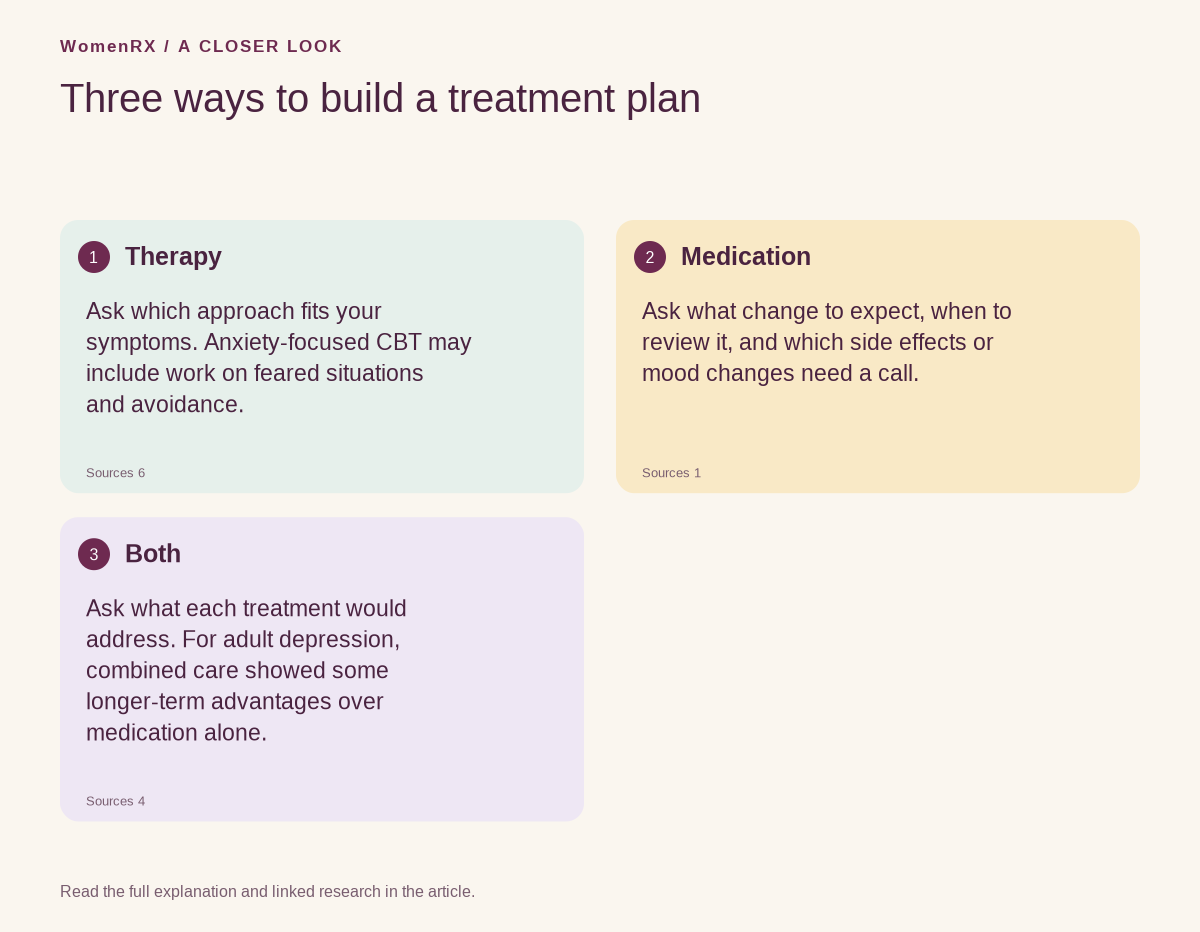
Three ways to build a treatment plan
Therapy: Ask which approach fits your symptoms. Anxiety-focused CBT may include work on feared situations and avoidance.6
Medication: Ask what change to expect, when to review it, and which side effects or mood changes need a call.1
Both: Ask what each treatment would address. For adult depression, combined care showed some longer-term advantages over medication alone.4
Read the figure as text
Compare what each option involves, then ask how you'll know whether it's helping.- Therapy: Ask which approach fits your symptoms. Anxiety-focused CBT may include work on feared situations and avoidance.6
- Medication: Ask what change to expect, when to review it, and which side effects or mood changes need a call.1
- Both: Ask what each treatment would address. For adult depression, combined care showed some longer-term advantages over medication alone.4
More questions, answered
If an antidepressant helps, will I need it forever?
Not necessarily. MedlinePlus describes 6 to 12 months as a typical treatment length, while some people continue longer. You and your prescriber can revisit the decision once it's helping. Don't stop it on your own, because stopping too quickly can cause problems or bring symptoms back.1
Sources you can check
- Antidepressants | Depression Medicines | MedlinePlusAccessed 2026-09-25Return to first citation
- Fluoxetine: an antidepressant medicine - NHSAccessed 2026-09-25Return to first citation
- Sertraline: an antidepressant medicine - NHSAccessed 2026-09-25Return to first citation
- Enduring effects of psychotherapy, antidepressants and their combination for depression: a systematic review and meta-analysis.Voderholzer U, Barton BB, Favreau M, Zisler EM, Rief W, Wilhelm M, Schramm E. · Frontiers in psychiatry · 2024Return to first citation
- Modifiers in Effects of Combined Pharmacotherapy and Psychotherapy versus Pharmacotherapy Alone for Adult Depression: An Individual Participant Data Meta-Analysis.Ciharova M, Karyotaki E, Harrer M, Weitz E, Miguel C, Amarnath A, Furukawa TA, Plessen CY, Driessen E, Buntrock C, Tong L, Hellerstein D, Samstag LW, Chen Y, Rentala S, Hemanny C, ... · Psychotherapy and psychosomatics · 2026Return to first citation
- Anxiety: MedlinePlusAccessed 2026-09-25Return to first citation
- Postpartum Depression: MedlinePlusAccessed 2026-09-25Return to first citation