When Anxiety Medication May Be Worth Discussing
If anxiety is disrupting daily life, you can discuss medication before you’ve tried every other option.
A medication conversation may be useful when anxiety keeps getting in the way of work, relationships, or daily activities; when therapy hasn’t helped enough; or when you’d prefer to consider more than one kind of care. There’s no single symptom score that decides. Therapy, medication, or both are options to weigh around your diagnosis, preferences, and circumstances. 1

Look at what anxiety is taking from your day
Anxiety can be a normal response to stress. The question isn’t whether you ever feel anxious; it’s whether the worry or fear persists, becomes hard to control, or interferes with things you need or want to do. Anxiety disorders can affect work, school, relationships, and other daily activities. That impact is a reasonable reason to start a treatment conversation, even if you’re unsure about medication. 1
You don’t have to wait until anxiety feels unbearable, or until you’ve tried therapy first. A conversation is a way to understand your options, not a commitment to take medication.
Compare the kinds of support available
Psychotherapy can help you recognize and change patterns in thoughts, feelings, and behavior. Cognitive behavioral therapy (CBT) is one approach; it may include exposure work that helps you face situations you’ve been avoiding. Medication is another treatment option, and some people consider medication and psychotherapy together. Which options make sense depends in part on the kind of anxiety you’re experiencing and what matters to you. 1
The comparison isn’t simply “therapy or medication.” For social anxiety disorder, for example, a Brazilian clinical guideline supports both CBT and selective serotonin reuptake inhibitors (SSRIs) as first-line options. It also notes evidence that psychological treatment may have longer-lasting benefits than medication in some comparisons. Studies of combined treatment for social anxiety have not produced one uniform answer: results differed across treatment combinations and follow-up. Those findings apply to social anxiety, not automatically to every anxiety disorder, but they show why a combined plan shouldn’t be assumed to be best for everyone. 3
If therapy has helped somewhat but anxiety still limits your life, say what has and hasn’t changed. If therapy isn’t accessible or appealing to you, you can still ask about medication and other available forms of support. You can also ask what a reasonable trial of a proposed approach would look like and how you and your prescriber would decide whether it’s helping. The right plan can be revisited; you don’t need to predict the perfect choice at the first appointment.
Make the conversation fit your life
Your preferences count. You might be open to medication but concerned about side effects, or prefer to start with therapy. You might want symptom relief while also building skills for situations that trigger anxiety. Bring up those priorities directly, and ask about the likely benefits and trade-offs of the specific options being considered rather than assuming all medications have the same effects.
Mention other health conditions, medicines or substances you use, and any previous treatment response. Some medicines and substances, including caffeine, can worsen anxiety symptoms, and physical health conditions can sometimes contribute to symptoms. A clinician may ask about your health history and consider whether another cause needs attention. 1
If you’re pregnant, breastfeeding, recently postpartum, trying to conceive, or noticing changes around perimenopause or menopause, include that context in the discussion. These details are worth raising as part of an individual conversation about options. They don’t automatically determine whether medication is right for you.
Questions that help you leave with a plan
- What kind of anxiety might be contributing to what I’m experiencing, and could a health condition or substance be making it worse?
- What could therapy, medication, or a combination realistically help with in my situation?
- What trade-offs or side effects should I know about for the specific medication you’re suggesting?
- What changes in the daily-life problems that prompted care, and any unwanted effects, should we review? How will we decide together whether to revisit the plan?
- How do my other medicines, health history, pregnancy plans, breastfeeding, postpartum status, or menopause-related concerns affect the options?
You can ask these questions even if you aren’t ready to choose a treatment. The useful next step may simply be getting a clearer comparison and agreeing on how you’ll decide what to try.
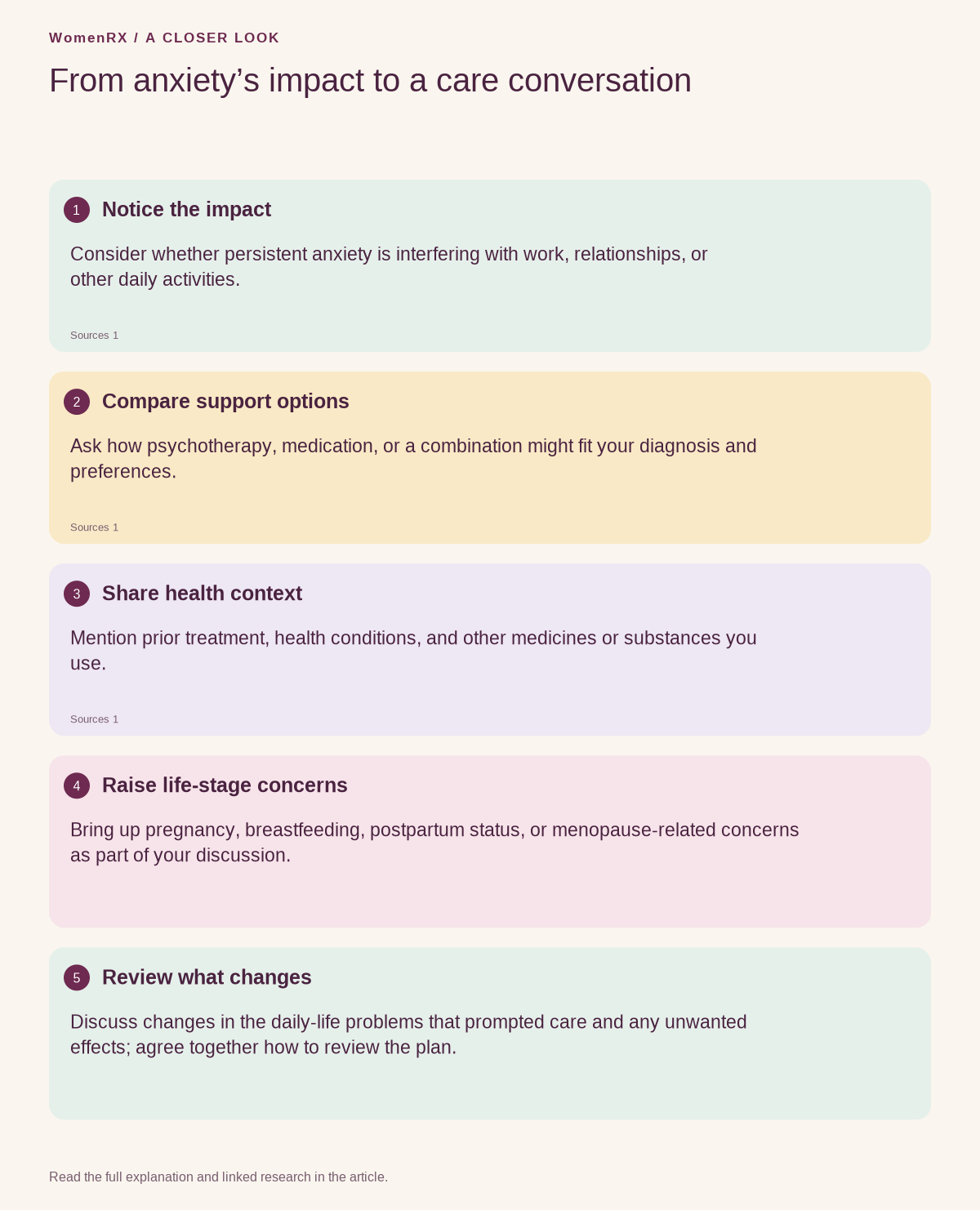
From anxiety’s impact to a care conversation
Notice the impact: Consider whether persistent anxiety is interfering with work, relationships, or other daily activities.1
Compare support options: Ask how psychotherapy, medication, or a combination might fit your diagnosis and preferences.1
Share health context: Mention prior treatment, health conditions, and other medicines or substances you use.1
Raise life-stage concerns: Bring up pregnancy, breastfeeding, postpartum status, or menopause-related concerns as part of your discussion.
Review what changes: Discuss changes in the daily-life problems that prompted care and any unwanted effects; agree together how to review the plan.
Read the figure as text
Use these prompts to organize a discussion, not to decide on a treatment path by yourself.- Notice the impact: Consider whether persistent anxiety is interfering with work, relationships, or other daily activities.1
- Compare support options: Ask how psychotherapy, medication, or a combination might fit your diagnosis and preferences.1
- Share health context: Mention prior treatment, health conditions, and other medicines or substances you use.1
- Raise life-stage concerns: Bring up pregnancy, breastfeeding, postpartum status, or menopause-related concerns as part of your discussion.
- Review what changes: Discuss changes in the daily-life problems that prompted care and any unwanted effects; agree together how to review the plan.
More questions, answered
Do I need to try therapy before asking about medication?
No. Psychotherapy and medication are both recognized anxiety treatments, and you can ask about either or both. For social anxiety specifically, a guideline supports CBT and SSRIs as first-line options; that finding shouldn’t be treated as a rule for every anxiety disorder. 1 3
What if I’ve already tried treatment and still feel anxious?
Tell the clinician what you tried and what changed, including whether treatment helped partly or not at all. A review of treatment-resistant anxiety describes multiple possible approaches, but it also reports small studies and methodological limitations, so the next step depends on the specific diagnosis and prior treatment. 2
Sources you can check
- Anxiety: MedlinePlusAccessed 2026-09-25Return to first citation
- Integrative Systematic Review on Pharmacological, Psychotherapeutic, and Neurostimulatory Treatment Options in Treatment-Resistant Anxiety Disorders.Schiele MA, Fagan HA, Baldwin DS, Domschke K. · Psychotherapy and psychosomatics · 2026Return to first citation
- Brazilian Psychiatric Association guidelines for the treatment of social anxiety disorder.Baldaçara L, Almeida TM, Dos Santos DC, Paschoal AB, Pinto AF, Gaiotto LAV, Veiga DL, Loureiro FF, Malloy-Diniz LF, de Oliveira RL, Cordeiro Q, Sanches M, Nardi AE, da Silva AG, Uc... · Revista brasileira de psiquiatria (Sao Paulo, Brazil : 1999) · 2025Return to first citation