When to Talk About Medication for Anxiety or Depression
You don’t need to meet a severity cutoff to bring up medication; ongoing symptoms, their effect on daily life, what you’ve already tried, and your preferences all belong in the conversation.
Consider raising medication when anxiety or depression keeps affecting sleep, work, relationships, or daily tasks, or when the support you’re using isn’t helping enough. That doesn’t mean medication is required: therapy and medication can be options on their own or together. Your history, side-effect concerns, reproductive plans, and goals can help shape the choice. 1 5
A conversation can start before things feel unbearable
There isn’t one symptom score or point in time that makes medication the “right” choice for everyone. A useful reason to discuss it is that symptoms are sticking around, getting harder to manage, or interfering with parts of life that matter to you. You can also bring it up if you’re already in therapy or using other support and still aren’t getting enough relief. The conversation is about whether medication fits your situation, not a test you have to pass.
Depression and anxiety can both be reasons a prescriber considers an antidepressant, though the best-supported treatment choice depends on the specific condition and your circumstances. For depression, medication and some forms of psychological therapy are both treatment options; medication may also be combined with talk therapy. 1 5
Weigh four things, not just symptom severity
How symptoms affect your life. Describe what has changed in concrete terms: perhaps you’re missing work, withdrawing from people, struggling to sleep, or finding everyday tasks unusually difficult. These details help explain the burden even if you’re unsure how to label what you’re feeling.
What you’ve tried and what happened. Mention therapy, other supports, and any medication you’ve taken before. If a medication helped, caused effects you couldn’t live with, or didn’t seem to help, that’s useful information. For adults with major depressive disorder, one review found no single antidepressant was superior to the others overall and argued for matching treatment to a person’s preferences. That finding is specific to depression; it shouldn’t be assumed to settle medication choices for anxiety. 4
The tradeoffs you care about. Ask what improvement the medication is meant to help with, what side effects to watch for, and how you’ll decide whether it’s helping. Antidepressants can cause side effects, including sleepiness or sexual problems, though not everyone experiences them. 1 If a prescriber mentions a medicine such as fluoxetine or sertraline, ask why it may fit your particular symptoms and history rather than treating the drug name as the answer. 2 3
Your preference and circumstances. It’s reasonable to want to try therapy first, to consider medication, or to ask about combining approaches. Say what feels acceptable to you and what worries you. If you’re pregnant, planning a pregnancy, breastfeeding, or recently postpartum, bring that up early so treatment choices can account for your circumstances. If symptoms changed around perimenopause or menopause, mention that timing too; fluoxetine is sometimes used for menopause symptoms, which is a different treatment question from treating depression or anxiety. 1 2
If you’re already taking medication
If symptoms haven’t improved enough, or have returned, tell the prescriber what you notice and how long you’ve been taking the medication. Antidepressants for depression can take several weeks to work; MedlinePlus gives a usual range of four to eight weeks, and notes that sleep or appetite may change before mood does. That timing is not a reason to wait silently if symptoms are worsening or side effects are difficult. 1
Ask what the next step could be: continuing with monitoring, addressing side effects, considering another medication, or adding talk therapy. Don’t change your dose or stop an antidepressant on your own; stopping too quickly can make symptoms return or worsen. 1
A few questions that make the discussion clearer
You might ask:
- What symptoms are we trying to improve, and how will we tell if things are changing?
- What are the reasonable options for me, including therapy or combining treatments?
- Which side effects should I let you know about, and what should I do if they bother me?
- How do my past treatment, other health conditions, pregnancy plans, or breastfeeding affect the choice?
- If this option doesn’t help enough, what would we reconsider?
These are starting points, not a checklist you have to complete. You can begin with the simplest version: “I’m still struggling, and I’d like to talk through whether medication makes sense for me.”
When it shouldn’t wait for a routine discussion
If you might act on thoughts of suicide or feel in immediate danger, seek urgent help now rather than waiting for a scheduled medication conversation. Also contact your prescriber promptly about new or worsening symptoms or unusual changes in mood or behavior after starting or changing an antidepressant. 1
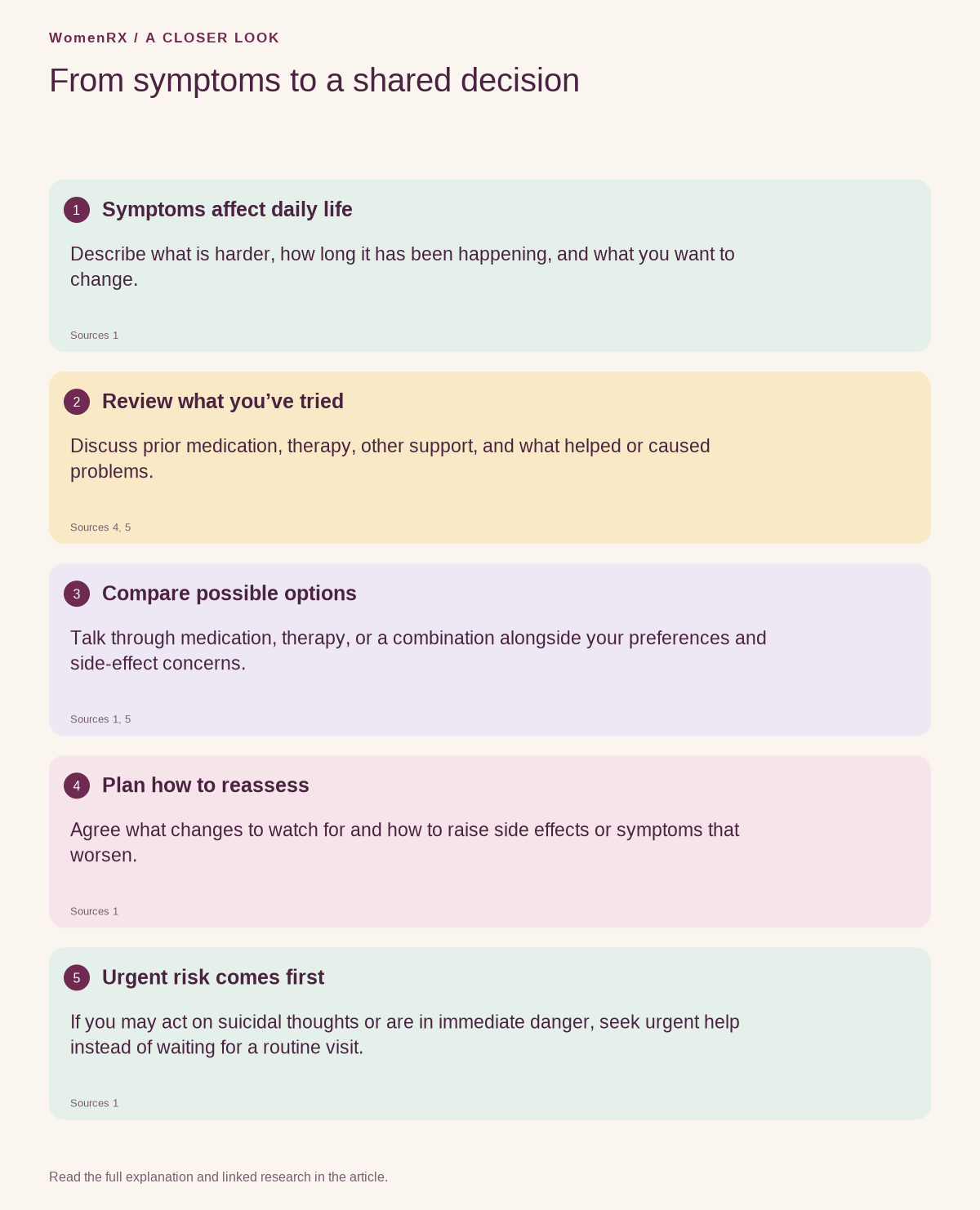
From symptoms to a shared decision
Symptoms affect daily life: Describe what is harder, how long it has been happening, and what you want to change.1
Review what you’ve tried: Discuss prior medication, therapy, other support, and what helped or caused problems.45
Compare possible options: Talk through medication, therapy, or a combination alongside your preferences and side-effect concerns.15
Plan how to reassess: Agree what changes to watch for and how to raise side effects or symptoms that worsen.1
Urgent risk comes first: If you may act on suicidal thoughts or are in immediate danger, seek urgent help instead of waiting for a routine visit.1
Read the figure as text
A medication discussion can follow several useful questions without relying on a fixed severity cutoff.- Symptoms affect daily life: Describe what is harder, how long it has been happening, and what you want to change.1
- Review what you’ve tried: Discuss prior medication, therapy, other support, and what helped or caused problems.45
- Compare possible options: Talk through medication, therapy, or a combination alongside your preferences and side-effect concerns.15
- Plan how to reassess: Agree what changes to watch for and how to raise side effects or symptoms that worsen.1
- Urgent risk comes first: If you may act on suicidal thoughts or are in immediate danger, seek urgent help instead of waiting for a routine visit.1
More questions, answered
Does discussing medication mean I have to take it?
No. The purpose is to compare options and decide together what fits your symptoms, past experience, and preferences. Medication, psychological therapy, and a combination can all be part of depression treatment. 4 5
What if I’m worried about side effects?
Bring up the specific effects you’re concerned about, including sexual side effects or sleepiness. If side effects become troubling, talk with the prescriber about next steps rather than changing the dose or stopping on your own. 1
Sources you can check
- Antidepressants | Depression Medicines | MedlinePlusAccessed 2026-09-25Return to first citation
- Fluoxetine: an antidepressant medicine - NHSAccessed 2026-09-25Return to first citation
- Sertraline: an antidepressant medicine - NHSAccessed 2026-09-25Return to first citation
- Individualized antidepressant therapy in patients with major depressive disorder: Novel evidence-informed decision support tool.Chin T, Huyghebaert T, Svrcek C, Oluboka O. · Canadian family physician Medecin de famille canadien · 2022Return to first citation
- The efficacy of antidepressant medication and interpersonal psychotherapy for adult acute-phase depression: study protocol of a systematic review and meta-analysis of individual participant data.Driessen E, Cohen ZD, Weissman MM, Markowitz JC, Weitz ES, Hollon SD, Browne DT, Rucci P, Corda C, Menchetti M, Bagby RM, Quilty LC, O'Hara MW, Zlotnick C, Pearlstein T, Blom MBJ, ... · BJPsych open · 2021Return to first citation