Postpartum Depression and Anxiety: What to Notice and How to Get Help
Depression and anxiety can begin during pregnancy or after birth, and you don’t have to sort out the diagnosis before asking for help.
Mood swings, crying, or anxiety after birth are often called the baby blues and usually ease within days to a week. Symptoms that last longer, feel overwhelming, or make daily care difficult deserve attention, whether they began during pregnancy or after birth. Talk therapy, medication, or both may help. Seek help right away for thoughts of harming yourself or your baby, or for confusion or hallucinations after birth. 1 6
When adjustment feels like more than adjustment
A new baby can bring broken sleep, physical recovery, and a lot to learn. You may also feel sad or have the “baby blues,” which usually ease within a few days to a week. Symptoms that are more severe and last longer than two weeks may be postpartum depression. Extreme sadness or difficulty caring for yourself or your baby also deserves attention. Depression that starts during pregnancy and continues after birth is part of the same perinatal picture. It isn’t caused by something you did wrong. 1 2 6
Look at the pattern, not just one hard moment. Depression can affect your mood, thinking, sleep, appetite, and ability to enjoy things. Perinatal depression may also bring pronounced anxiety and fatigue that make everyday tasks difficult. The National Institute of Mental Health advises talking with a care provider about depressive symptoms that occur most of the day, nearly every day, for at least two weeks. You don’t need to wait two weeks if you’re struggling to care for yourself or your baby. 6 2
Anxiety can be part of the picture, too
Anxiety may feel like fear or dread, restlessness, tension, sweating, or a racing heart. Some worry under stress is expected. Anxiety that doesn’t ease, grows worse, or interferes with daily life deserves its own attention, even if you don’t feel especially sad. 3
Depression and anxiety aren’t always separate problems. In an analysis of Canadian birthing parents seeking treatment for postpartum depression, 66% of those who met the study’s depression-screening threshold also scored in the moderate-to-severe range on an anxiety questionnaire. That number describes a treatment-seeking group, not all new parents. Its practical lesson is to mention both low mood and worry when you ask for help, so neither gets overlooked. 4
A screening score starts a conversation
A care team may ask you to complete a questionnaire about mood or anxiety. The Edinburgh Postnatal Depression Scale measures perinatal depressive symptoms; other questionnaires can assess anxiety. A score helps identify symptoms worth discussing, but it doesn’t, by itself, explain what’s causing them or establish a diagnosis. In the Canadian study, researchers used screening thresholds and a separate diagnostic interview for different analyses. 5 4
You can raise concerns without waiting for a scheduled screening or finding the right label. For example, “I’m anxious much of the day and it’s affecting what I can do” gives a clinician more to work with than trying to decide on your own whether you have postpartum anxiety or depression. If someone close to you has noticed a change, they can help by describing what they’ve seen and supporting you in reaching out.
What help can look like
Treatment isn’t one-size-fits-all. Talk therapy, antidepressant medication, or a combination are common approaches to depression; psychotherapy and medication are also main treatments for anxiety disorders. Therapy can focus on the thoughts, feelings, behaviors, or specific fears that are making daily life harder. A clinician can help work out which approach fits your symptoms and circumstances. 6 3
Pregnancy and breastfeeding belong in that conversation, not outside it. If medication is being considered, tell the prescriber whether you’re pregnant, planning a pregnancy, or breastfeeding so you can weigh treatment choices for you and your baby. The decision includes the risks of leaving depression untreated, as well as a medicine’s possible side effects. If you already take an antidepressant, don’t change the dose or stop it on your own; discuss concerns with the prescriber. 7 1
Practical support matters alongside treatment. If you can, tell a trusted person plainly what would help today, such as taking a turn with baby care while you rest or helping you make a call. Rest and help from others may ease the load, but they aren’t a reason to put off care when symptoms persist or daily life is becoming hard. 1 2
When to get help immediately
Postpartum psychosis is rare, but confusion, hallucinations, or dangerous behavior after birth can signal a medical emergency. Call 911 or go to the nearest emergency room right away. If you’re a support person, help the parent get emergency care rather than waiting to see whether the symptoms pass. 1
If you have thoughts of suicide or of harming yourself or your baby, get help right away. In the United States, you can call or text 988, call 911, or go to the nearest emergency room. You don’t have to determine whether the experience fits a particular diagnosis before seeking help. 1 8
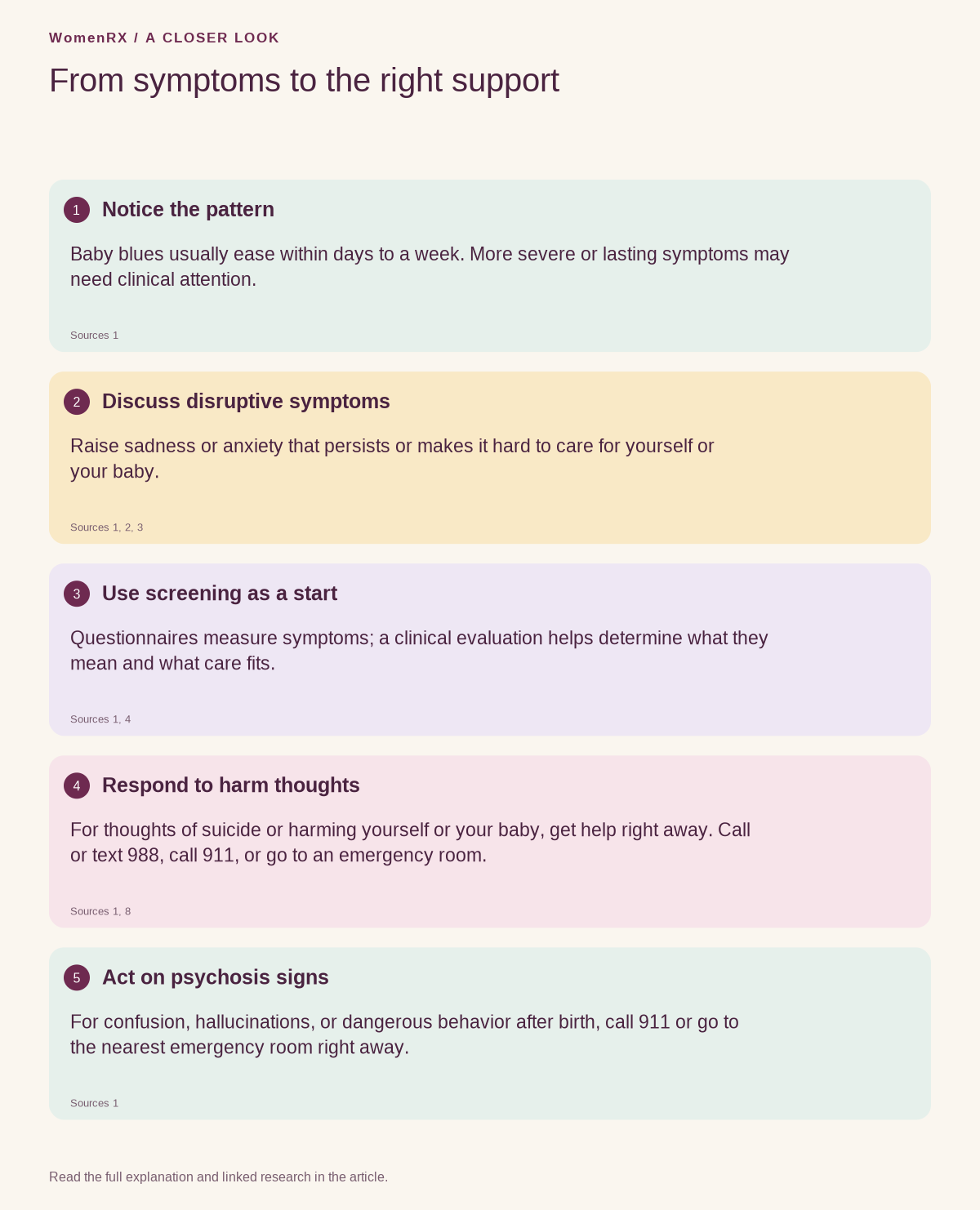
From symptoms to the right support
Notice the pattern: Baby blues usually ease within days to a week. More severe or lasting symptoms may need clinical attention.1
Discuss disruptive symptoms: Raise sadness or anxiety that persists or makes it hard to care for yourself or your baby.123
Use screening as a start: Questionnaires measure symptoms; a clinical evaluation helps determine what they mean and what care fits.14
Respond to harm thoughts: For thoughts of suicide or harming yourself or your baby, get help right away. Call or text 988, call 911, or go to an emergency room.18
Act on psychosis signs: For confusion, hallucinations, or dangerous behavior after birth, call 911 or go to the nearest emergency room right away.1
Read the figure as text
A route from noticing a change to seeking clinical or immediate help, without treating symptoms as a self-diagnosis.- Notice the pattern: Baby blues usually ease within days to a week. More severe or lasting symptoms may need clinical attention.1
- Discuss disruptive symptoms: Raise sadness or anxiety that persists or makes it hard to care for yourself or your baby.123
- Use screening as a start: Questionnaires measure symptoms; a clinical evaluation helps determine what they mean and what care fits.14
- Respond to harm thoughts: For thoughts of suicide or harming yourself or your baby, get help right away. Call or text 988, call 911, or go to an emergency room.18
- Act on psychosis signs: For confusion, hallucinations, or dangerous behavior after birth, call 911 or go to the nearest emergency room right away.1
Sources you can check
- Postpartum Depression: MedlinePlusAccessed 2026-09-25Return to first citation
- Postpartum Care: MedlinePlusAccessed 2026-09-25Return to first citation
- Anxiety: MedlinePlusAccessed 2026-09-25Return to first citation
- Prevalence of Comorbid Postpartum Depression and Anxiety in Birthing Parents Seeking Treatment for Postpartum Depression: Prévalence de la présence comorbide de la dépression et de l'anxiété post-partum chez les parents ayant accouché qui ont consulté en raison de la dépression post-partum.George KV, Savoy CD, Layton H, Bieling PJ, Van Lieshout RJ. · Canadian journal of psychiatry. Revue canadienne de psychiatrie · 2026Return to first citation
- The Antenatal Origins of Postpartum Distress: A Retrospective Longitudinal Analysis of Depression and Anxiety Trajectories.Holbanel LM, Turcu-Stiolica A, Toma SC, Pirlog MC, Gheorman V. · Medical sciences (Basel, Switzerland) · 2026Return to first citation
- Depression in Women: 4 Things to Know - National Institute of Mental Health (NIMH)Accessed 2026-09-25Return to first citation
- Antidepressants | Depression Medicines | MedlinePlusAccessed 2026-09-25Return to first citation
- Suicide: MedlinePlusAccessed 2026-09-25Return to first citation