Depression: Signs, Assessment, and Finding Support
When low mood or loss of interest starts disrupting everyday life, you don’t have to wait until you can explain why to ask for help.
Depression can involve persistent low mood or losing interest in things, along with changes that make everyday tasks harder. A screening questionnaire can identify a reason to look more closely, but it doesn’t diagnose depression by itself. A clinician can ask about symptoms, how long they’ve lasted, daily functioning, health and medications, then discuss treatment options. 1 3

When a change in mood deserves attention
Depression is more than feeling sad or irritable for a few days. It can affect how you think, feel, and manage everyday life. Low mood and losing interest in most activities are two central signs. You might also notice that basic routines, such as sleeping, eating, working, or getting through daily responsibilities, have become difficult. Depression doesn’t look identical for everyone, and it doesn’t always feel like sadness. 1
For major depression, symptoms affect daily activities and last at least two weeks. That timeframe can help explain why a passing difficult spell and a more persistent change may call for different kinds of attention. You don’t need to wait until the two weeks have passed to bring up a concern or ask what support is available. 1
Screening is a starting point, not a diagnosis
A questionnaire may help identify symptoms that deserve follow-up. For example, the Edinburgh Postnatal Depression Scale is used to screen for depressive symptoms during the perinatal period. A positive result indicates a need for further assessment; it does not, on its own, establish a diagnosis. Screening tools can also miss symptoms, so how you’re functioning and what you describe matter too. 3
Assessment is a conversation, not just a score. A provider may ask what has changed, how long it has been going on, how it affects daily life, and whether you’ve experienced depression before or have a family history. They may also review medical conditions and medicines, since some can cause symptoms that resemble depression. Sometimes medical tests are used to check for other explanations, such as a thyroid disorder. 1
It can help to describe concrete changes rather than trying to choose a label: for example, “I’ve stopped enjoying activities I usually look forward to,” or “Getting through work and meals has become difficult.” Those are examples of ways to describe a change, not a diagnostic checklist.
Pregnancy and postpartum are relevant assessment contexts
Depression can occur during pregnancy or after birth, and it may not present as sadness alone. A perinatal study describes anxiety, restlessness or agitation, and difficulty concentrating or making decisions among possible features. Those experiences can be useful to mention when you talk with a provider, but no single symptom proves that you have depression. 3
If you’re pregnant or recently gave birth, say so when arranging support. That context can help shape the assessment. The same is true at other life stages, including menstruation and menopause: these are relevant contexts to discuss, not proof that hormones are the cause of a mood change. Depression symptoms can also be affected by medical conditions or medicines. 1
Finding support that fits the problem
Psychotherapy, also called talk therapy, and medicines are common treatment options; some people receive one or both. Therapy can help you work with troubling emotions, thoughts, and behaviors and build coping strategies. The right plan depends on the assessment and your circumstances. If symptoms are severe or aren’t improving with treatment, other options may be considered. 1
A practical first move is to contact a primary care provider or a mental health provider and say what has changed and how it is affecting daily life. You can ask what the assessment involves and which treatment options might fit. If getting to an appointment feels hard, consider asking someone you trust to help you make contact or go with you. These are ways to make reaching out more manageable, not requirements for getting care.
If you’re thinking about suicide or are worried you may not be able to keep yourself safe, tell someone nearby and seek urgent, in-person help now. Immediate safety is a central part of assessing suicidal thoughts and deciding what support is needed. 2
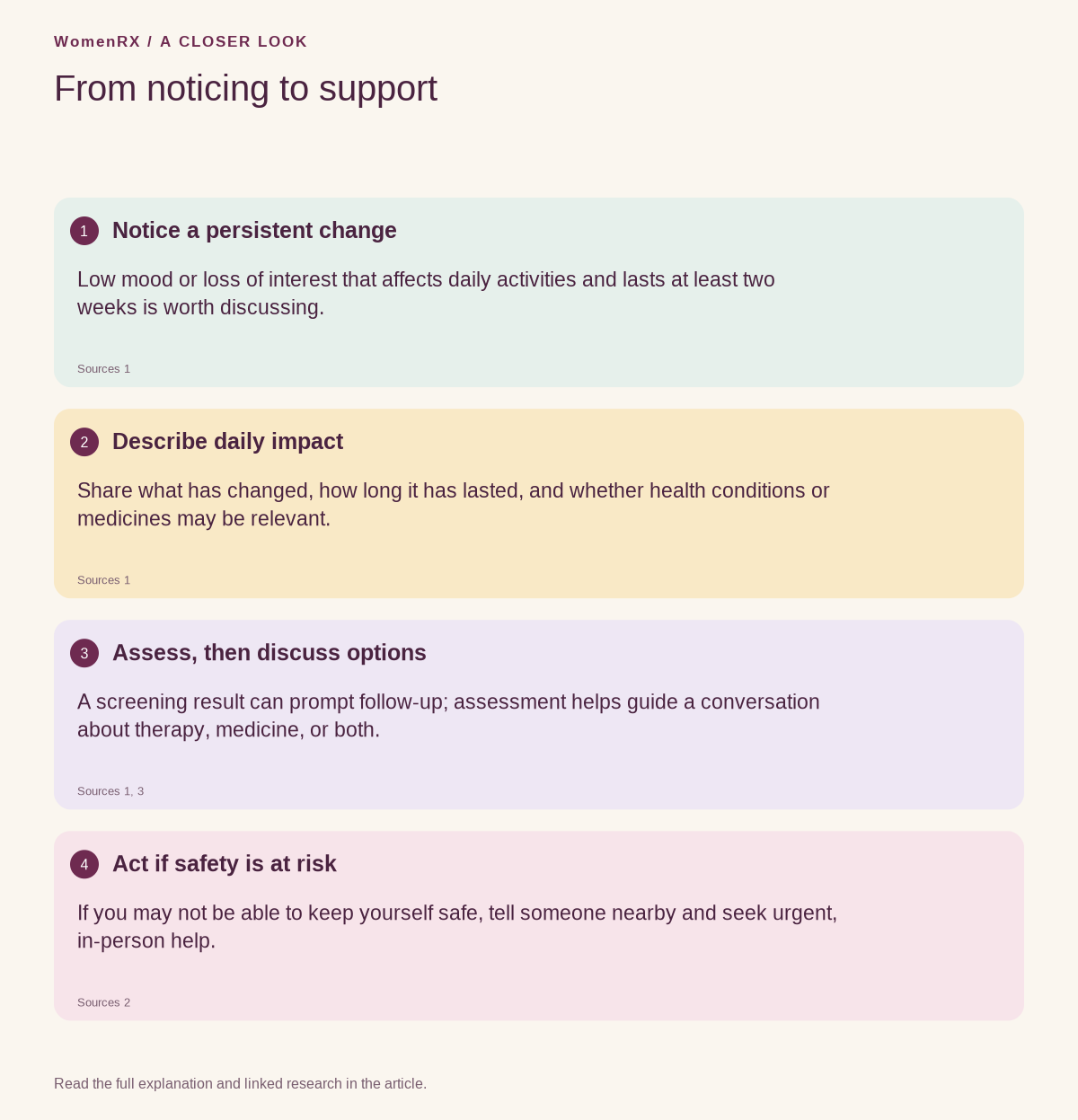
From noticing to support
Notice a persistent change: Low mood or loss of interest that affects daily activities and lasts at least two weeks is worth discussing.1
Describe daily impact: Share what has changed, how long it has lasted, and whether health conditions or medicines may be relevant.1
Assess, then discuss options: A screening result can prompt follow-up; assessment helps guide a conversation about therapy, medicine, or both.13
Act if safety is at risk: If you may not be able to keep yourself safe, tell someone nearby and seek urgent, in-person help.2
Read the figure as text
A simple route from a persistent change in mood or functioning to assessment, treatment discussion, or urgent help if safety is at risk.- Notice a persistent change: Low mood or loss of interest that affects daily activities and lasts at least two weeks is worth discussing.1
- Describe daily impact: Share what has changed, how long it has lasted, and whether health conditions or medicines may be relevant.1
- Assess, then discuss options: A screening result can prompt follow-up; assessment helps guide a conversation about therapy, medicine, or both.13
- Act if safety is at risk: If you may not be able to keep yourself safe, tell someone nearby and seek urgent, in-person help.2
More questions, answered
Can depression be present without feeling sad?
Yes. Depression doesn’t look the same for everyone, and loss of interest or difficulty managing daily activities may be more noticeable than sadness. A provider can assess the full pattern rather than relying on one symptom. 1
Does a screening result mean I have depression?
No. A screening tool can flag symptoms for further assessment, but it does not establish a diagnosis by itself. For example, the Edinburgh Postnatal Depression Scale screens for perinatal depressive symptoms rather than diagnosing depression. 3
Sources you can check
- Depression: MedlinePlusAccessed 2026-09-25Return to first citation
- Clinical practice guideline for assessment and management of depression in India.Tripathi A, Shukla R, Kar SK, Gupta S, Saran P, Pattojoshi A, Rao T. · Indian journal of psychiatry · 2026Return to first citation
- Time-varying restless legs syndrome and risk of incident perinatal depression.Tezuka K, Ito Y, Sasaki N, Nishi D. · Journal of clinical sleep medicine : JCSM : official publication of the American Academy of Sleep Medicine · 2026Return to first citation