ADHD in Adult Women: What Assessment and Support Involve
An ADHD assessment looks at a lasting pattern and its effects on daily life, not whether you recognize yourself in a symptom list.
An adult ADHD assessment considers current symptoms, earlier history, their effects across daily life, and other possible explanations. Recognizing yourself in a symptom list isn’t enough. If ADHD is diagnosed, support discussions can cover skills-based help, psychological counseling, and medication, guided by the difficulties you most want to address. 1 5
The difference between a hard stretch and an ADHD pattern
Losing your keys or struggling to focus during a stressful week doesn’t, by itself, point to ADHD. The pattern associated with ADHD is persistent and pervasive inattention and/or hyperactivity-impulsivity that causes functional impairment. 1
The effect matters as much as the symptom. For example, “I forget things” gives less detail than “I regularly miss work deadlines despite using a calendar, and I lose track of household bills.” These are examples of how to describe an impact, not signs that establish a diagnosis. 1
What an assessment puts together
An adult assessment is more than a questionnaire. A clinical review describes an interview about current symptoms, childhood and developmental history, and how difficulties affect work, school, relationships, or home life. It also describes considering mental health conditions and other possible explanations. Information from someone who knows you may be useful, but the interview with you remains central. This is a general description of adult assessment, not a women-specific protocol. 5
There isn’t one account of what assessment feels like for every woman. In two virtual focus groups with 14 women diagnosed as adults, participants described varied assessment experiences; many said they hadn’t recognized their own symptoms, and some described diagnostic complexity or having to advocate for an evaluation. These accounts offer insight into possible experiences, not a template for every assessment. 3
To make the conversation concrete, you might organize examples of the recurring pattern, what you remember from earlier in life, and how the difficulties affect you now. If you remember school reports or comments about unfinished work, those may give you examples to discuss, even without a childhood diagnosis. Assessment considers developmental history, but it also looks at what is happening in your life now. 5
Why the question may come up in adulthood
Some women reach adulthood without having recognized their difficulties as possible ADHD. The focus-group participants also described barriers and different paths to diagnosis. Their accounts illuminate possible experiences, but they can’t tell us how common any one experience is among women generally. 3
Anxiety about unfinished tasks or strong emotional reactions may be part of what prompts you to seek help. In a questionnaire study of 176 women ages 20 to 30, all of whom were undergraduates or recent graduates, greater ADHD symptom severity was associated with greater emotional dysregulation. That finding doesn’t make emotional difficulty a stand-alone ADHD test, and it doesn’t show that ADHD caused those feelings. 4
If you’ve noticed changes around your menstrual cycle or a life transition, you can describe when they happen alongside the longer-term pattern. Treat that timing as part of your own account, rather than as proof of ADHD or an explanation for why your difficulties changed.
Match support to the problem you want to solve
Support is more useful when it addresses a specific difficulty rather than an abstract goal of being “more organized.” If unfinished tasks are the main problem, ask what help is intended to change about starting, planning, or completing them. If conflict at home is taking the biggest toll, say that.
An adult ADHD review describes education about the condition, skills training, psychological counseling, and medication as possible parts of treatment. They address different needs: education can help you understand the pattern being assessed; skills work or counseling may focus on day-to-day difficulties; medication is a separate discussion about symptom treatment. The review focuses on adult men, so it does not establish which combination works best for women. 5
Medication is a discussion, not an automatic next step or a one-size-fits-all choice. A 2012 systematic review reported quality-of-life benefits in studies of atomoxetine and mixed amphetamine salts, sometimes even when measured symptoms didn’t improve. The studies used different quality-of-life measures, which limited direct comparisons between medication classes; the review doesn’t establish which option would work best for an individual woman. 2
Digital tools can sound appealing when planning and follow-through are already hard. A 2026 scoping review found adult ADHD programs using approaches such as cognitive behavioral therapy and psychoeducation, often delivered with guidance. Many studies emphasized whether a tool was usable or acceptable rather than establishing how well it improves everyday functioning. Consider what a tool actually helps you do and how it would fit with the rest of your support, rather than treating an app as an assessment or a complete care plan. 1
A useful next move is to bring a few concrete examples of the recurring problem, what you recall about its earlier history, and the part of life you most want to improve. That gives an assessment something more useful to work with than a label you’re trying to prove.
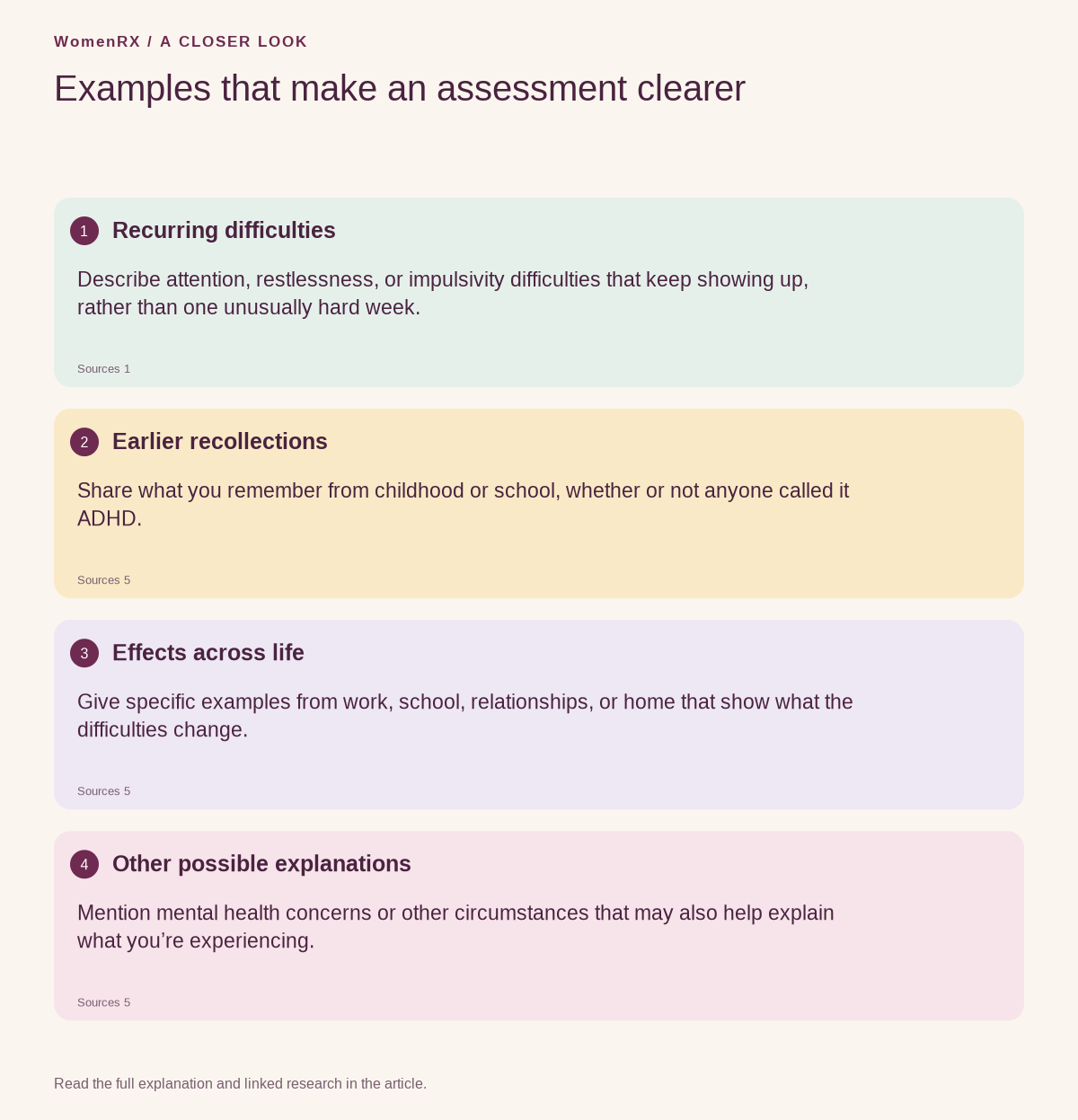
Examples that make an assessment clearer
Recurring difficulties: Describe attention, restlessness, or impulsivity difficulties that keep showing up, rather than one unusually hard week.1
Earlier recollections: Share what you remember from childhood or school, whether or not anyone called it ADHD.5
Effects across life: Give specific examples from work, school, relationships, or home that show what the difficulties change.5
Other possible explanations: Mention mental health concerns or other circumstances that may also help explain what you’re experiencing.5
Read the figure as text
Use these prompts to explain a pattern, not to score yourself for ADHD.- Recurring difficulties: Describe attention, restlessness, or impulsivity difficulties that keep showing up, rather than one unusually hard week.1
- Earlier recollections: Share what you remember from childhood or school, whether or not anyone called it ADHD.5
- Effects across life: Give specific examples from work, school, relationships, or home that show what the difficulties change.5
- Other possible explanations: Mention mental health concerns or other circumstances that may also help explain what you’re experiencing.5
More questions, answered
Can an online ADHD questionnaire tell me if I have it?
A questionnaire or symptom list by itself can’t establish ADHD. An assessment also considers the persistence and impact of symptoms, earlier history, and other possible explanations. 1 5
Do I need to have been diagnosed as a child?
No. A childhood diagnosis and childhood difficulties are not the same thing. An adult assessment considers developmental history, and women diagnosed as adults have reported that they hadn’t recognized their own symptoms earlier. 5 3
Sources you can check
- Digital health technologies for adults with ADHD: a scoping review.Schofield FJ, Wilkie S, Nielsen EE, Brigden A, Jones MW, Isotalus HK. · Frontiers in digital health · 2026Return to first citation
- The quality of life of adults with attention deficit hyperactivity disorder: a systematic review.Agarwal R, Goldenberg M, Perry R, IsHak WW. · Innovations in clinical neuroscience · 2012Return to first citation
- Adult Diagnosis of ADHD in Women: A Mixed Methods Investigation.Babinski DE, Libsack EJ. · Journal of attention disorders · 2025Return to first citation
- A controlled study of emotional dysfunction in adult women with ADHD.Slobodin O, Har Sinay M, Zohar AH. · PloS one · 2025Return to first citation
- Attention Deficit Hyperactivity Disorder (ADHD) Causes and Diagnosis in Adults: A Review.Sapkale B, Sawal A. · Cureus · 2023Return to first citation