Why ADHD May Be Overlooked in Some Women
Masking, expectations, and overlapping symptoms can affect recognition, while an assessment looks at your history and how difficulties affect daily life.
ADHD may be overlooked when difficulties are less visible, coping strategies hide their cost, or attention problems are attributed to anxiety or depression. None of these factors proves ADHD, and women don’t all present alike. For an assessment, describe patterns you remember from childhood, current examples and their impact, and any other explanations you’ve considered. Ask whether earlier records or someone who knew you then could add context. 234
When the effort is less visible than the outcome
For example, you might meet deadlines and appear organized while spending hours catching up at night. Or your difficulties may be obvious to people around you. Neither pattern, by itself, tells you whether you have ADHD. An assessment needs to consider the broader history and how difficulties affect your life. 2
A review of ADHD in girls and women describes masking, social expectations, and referral patterns as factors that may influence which difficulties are noticed and how they’re interpreted. These are possible recognition barriers, not diagnostic signs. They don’t mean every woman masks symptoms or has the same experience. The review cites a girl-to-boy diagnosis ratio of 1:4.8 among children under 12. That childhood finding is not an estimate of adult women’s diagnosis rates. 3
A collaborative account by academic mothers diagnosed as adults describes seeking a diagnosis and feeling unheard. It offers a window into those authors’ experiences, not a picture of all women with ADHD. 1
Describe the pattern, not just the label
Instead of saying only “I’m disorganized,” try to describe what happens. Examples might include starting several work tasks but struggling to finish them, missing appointments despite reminders, or needing a late-night catch-up to manage routine responsibilities. These examples aren’t a checklist or proof of ADHD. Their value is in helping someone understand your experience.
For each difficulty, consider when you remember it beginning, where it happens, and what it affects. Include the workarounds too: calendars, extra checking, reminders from someone else, or spending much longer than expected on a task. Those details can help explain why a difficulty is less visible from the outside, though effort alone doesn’t establish a diagnosis.
Adult ADHD is associated with impairment in major areas of life. Assessment also needs to guard against both overlooking ADHD and attributing difficulties to it when another explanation fits better. 2 Childhood experiences are worth discussing, particularly since some girls may have been overlooked earlier. A late diagnosis alone, though, doesn’t establish what was happening when you were young. 3
If you don’t have childhood records, describe the patterns you remember. If you do have records, or someone who knew you then might help fill in details, ask how that information could be used alongside your own account.
Anxiety and depression complicate the picture
Attention difficulties can occur alongside anxiety or depression, and ADHD may be overlooked when those concerns take center stage. Symptoms can also overlap, so anxiety or depression neither confirms nor rules out ADHD. A careful assessment considers the wider pattern and whether more than one explanation may be involved. 23
One study assessed 170 women receiving outpatient psychiatric care for depression or anxiety. ADHD was identified in 33, and 15 of those 33 had not previously been diagnosed. Because participants came from selected clinics, those numbers can’t tell you how common ADHD is among women generally. They do illustrate why ADHD may be worth considering when attention difficulties persist alongside mood or anxiety concerns. 4
In that study, attention-deficit scores were associated with depression scores among participants who did not have ADHD. The researchers also concluded that hyperfocus alone is not diagnostic. A familiar trait or a screening score cannot settle the question; the wider history matters. 4
Bring up changes in timing, too
If your difficulties seem to change across your menstrual cycle, after childbirth, or around perimenopause, describe when you notice the changes and what else changes at the same time, such as sleep or mood. A review discusses possible symptom fluctuations across these periods, while calling for more research. Timing can add context, but it isn’t proof of ADHD. 3
The useful question for an assessment is how your earlier history, present-day difficulties, and possible overlapping or alternative explanations fit together. That leaves room to take your concerns seriously without deciding the answer from one experience.
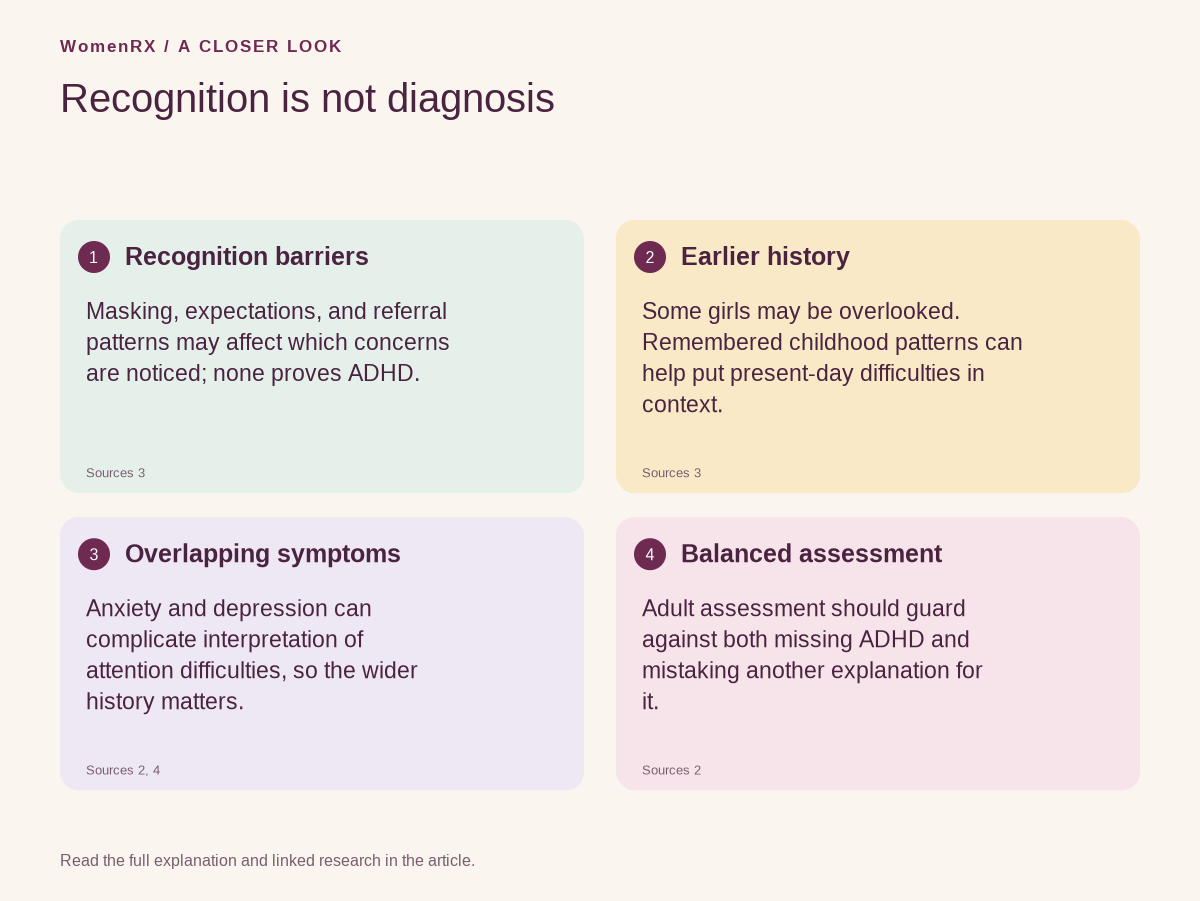
Recognition is not diagnosis
Recognition barriers: Masking, expectations, and referral patterns may affect which concerns are noticed; none proves ADHD.3
Earlier history: Some girls may be overlooked. Remembered childhood patterns can help put present-day difficulties in context.3
Overlapping symptoms: Anxiety and depression can complicate interpretation of attention difficulties, so the wider history matters.24
Balanced assessment: Adult assessment should guard against both missing ADHD and mistaking another explanation for it.2
Read the figure as text
These distinctions show how concerns may be missed without treating any recognition barrier as proof of ADHD.- Recognition barriers: Masking, expectations, and referral patterns may affect which concerns are noticed; none proves ADHD.3
- Earlier history: Some girls may be overlooked. Remembered childhood patterns can help put present-day difficulties in context.3
- Overlapping symptoms: Anxiety and depression can complicate interpretation of attention difficulties, so the wider history matters.24
- Balanced assessment: Adult assessment should guard against both missing ADHD and mistaking another explanation for it.2
More questions, answered
Does anxiety or depression rule out ADHD?
No. Attention and mood symptoms can overlap, and ADHD can be considered in someone receiving care for anxiety or depression. An assessment should look at the broader history rather than treating one diagnosis as proof against another. 24
What if I don’t have childhood records?
Describe the patterns you remember from childhood and how they affected you. You can ask whether records, if any exist, or someone who knew you then could add useful context. Your current difficulties and other possible explanations belong in that conversation too. 23
Sources you can check
- Coming to Terms with Our Racecar Brains: Academic Mothers Experiencing Adult Diagnosis of ADHD.Cripe ET, LeBlanc SS, Eilert M, Bernhardt K. · Health communication · 2025Return to first citation
- [Screening and diagnostic assessment of ADHD in adults - risks associated with both underdiagnosis and overdiagnosis].Hirvikoski T, Billstedt E, Lundström S, Brar A. · Lakartidningen · 2022Return to first citation
- Practical tools for female-specific ADHD: The impact of hormonal fluctuations in clinical practice and from the literature.Wynchank D, de Jong M, Kooij SJJS. · European psychiatry : the journal of the Association of European Psychiatrists · 2025Return to first citation
- ADHD Comorbidity in Women with Depression and Anxiety: Prevalence, Clinical Features and Hyperfocus Dynamics.Yavuzlar Civan H, Berkol TD. · International journal of psychiatry in medicine · 2026Return to first citation