Why Your Waist May Change in Your 40s
A changing waist can be part of midlife, but weight, activity, sleep, and perimenopause each tell a different part of the story.
A larger waist in your 40s doesn’t, by itself, mean perimenopause is the cause. Studies associate the menopausal transition with a shift toward abdominal fat, but aging and changes in activity can be hard to separate from it. Track waist and weight as two different measures, and note changes in sleep, activity, and medications that happened around the same time. 1 2 3
Start with what changed
A tighter waistband and a higher number on the scale aren’t quite the same finding. Weight includes muscle, bone, fat, and water. Waist circumference adds information about abdominal size, but neither measure can tell you what caused a change. 1
For example, if your waist measurement increases while your weight stays fairly steady, the scale alone would miss that change. It still wouldn’t tell you whether the difference reflects body composition or something else. If both measurements rise, you know more about what changed, not necessarily why. 1 2
Waist size is worth understanding because carrying more fat around the abdomen, rather than the hips, is associated with higher risk of heart disease and type 2 diabetes. A measurement is a piece of health information, not a verdict about your body. 1
Could perimenopause be involved?
Yes, it could. Research describes a shift toward more abdominal fat and less lean mass across menopausal stages. In a study comparing 325 premenopausal, perimenopausal, and postmenopausal women, the postmenopausal group had lower lean mass and more central adiposity. But the researchers looked at different women at one point in time. Their findings can’t establish that menopause caused a particular woman’s waist to change. 2
Age complicates the picture. A review found that average weight gain during the menopausal transition was similar to weight gain in premenopausal women of the same age, even as abdominal fat tended to increase. That’s why a changing waist and a changing weight shouldn’t be treated as interchangeable signs of a hormone change. A waist measurement alone also can’t tell you whether you’re in perimenopause. 4
Look at what else changed at the same time
Activity, sleep, stress, and eating patterns can affect body weight. Physical activity may decline during perimenopause and the years after it, while exercise remains beneficial for midlife physical and cardiometabolic health. These factors can overlap rather than compete as explanations. 1 3
Think in terms of timing, not blame. Did your routine become more sedentary? Has sleep changed? Did your waist measurement begin changing around a new medication? Writing down a medication’s name and when you started it gives you a specific question to raise about that medicine; the timing alone doesn’t show that it caused weight gain. You don’t need to assume every midlife change is hormonal, or that every change is something you did.
Use measurements to spot a pattern
If tracking feels useful, record waist circumference and weight separately under reasonably similar conditions each time. Alongside them, make brief notes about meaningful changes in activity, sleep, eating patterns, stress, and medications. The goal is to see a pattern, not to assign significance to every reading.
BMI may come up in a health assessment, but it doesn’t distinguish fat from muscle or bone. Waist circumference offers another perspective; health history and other risk factors matter when interpreting either number. 1
There’s no need to jump from a changing waist to a special menopause diet or an exercise meant to target belly fat. Physical activity has broader health benefits in midlife, but a waist measurement doesn’t identify a quick fix. 3 If you’re gaining or losing weight without trying, especially if the change is sudden, bring it up with a health care provider rather than attributing it to perimenopause. 1
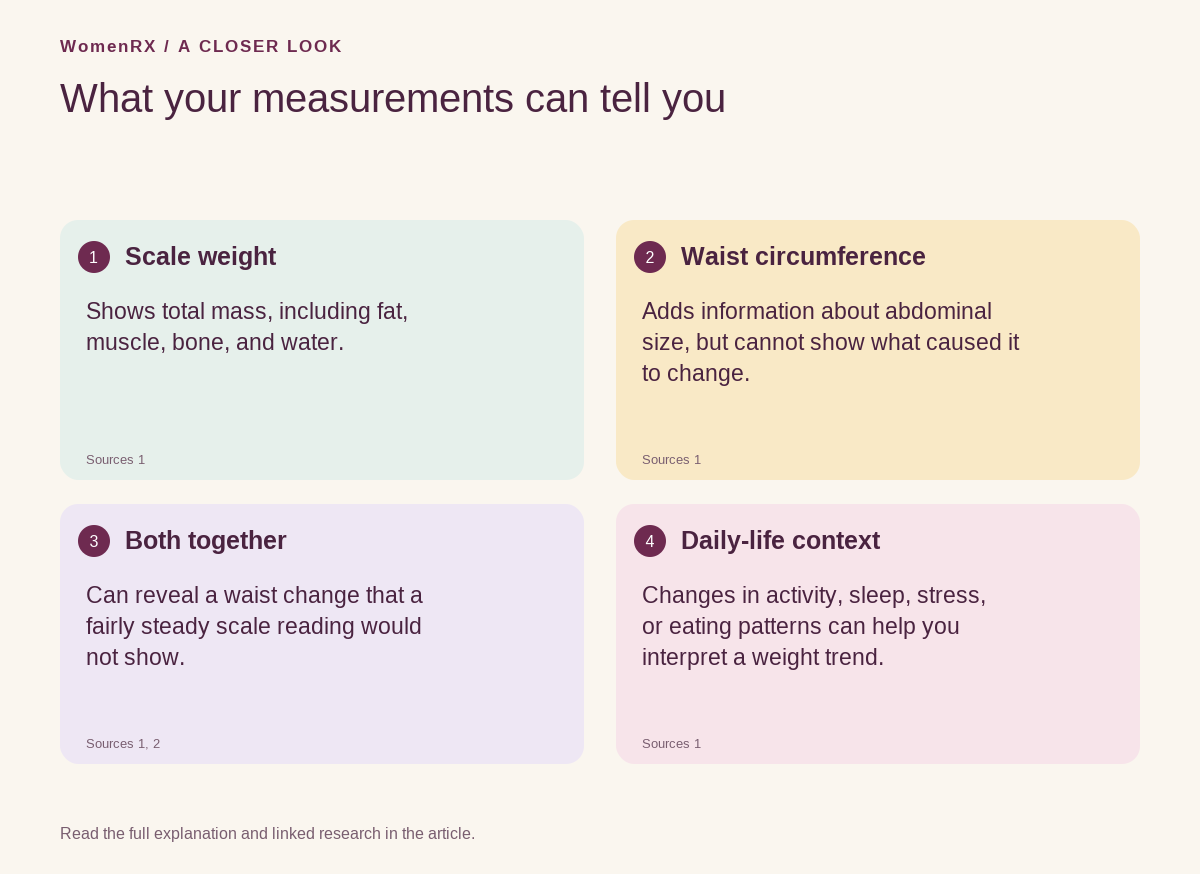
What your measurements can tell you
Scale weight: Shows total mass, including fat, muscle, bone, and water.1
Waist circumference: Adds information about abdominal size, but cannot show what caused it to change.1
Both together: Can reveal a waist change that a fairly steady scale reading would not show.12
Daily-life context: Changes in activity, sleep, stress, or eating patterns can help you interpret a weight trend.1
Read the figure as text
Weight and waist size describe different changes. Neither identifies the cause by itself.- Scale weight: Shows total mass, including fat, muscle, bone, and water.1
- Waist circumference: Adds information about abdominal size, but cannot show what caused it to change.1
- Both together: Can reveal a waist change that a fairly steady scale reading would not show.12
- Daily-life context: Changes in activity, sleep, stress, or eating patterns can help you interpret a weight trend.1
More questions, answered
Can my waist change if my weight stays about the same?
Yes. Weight combines fat, muscle, bone, and water, so a steady scale reading doesn’t show whether body composition has changed. Waist circumference adds another measure, though it can’t identify the cause on its own. 1 2
Sources you can check
- Body Weight: MedlinePlusAccessed 2026-09-25Return to first citation
- The Impact of the Menopausal Transition on Body Composition and Abdominal Fat Redistribution.Szeliga A, Chedraui P, Meczekalski B. · Journal of clinical medicine · 2026Return to first citation
- Detrimental Changes in Health during Menopause: The Role of Physical Activity.Hulteen RM, Marlatt KL, Allerton TD, Lovre D. · International journal of sports medicine · 2023Return to first citation
- Metabolic implications of menopause.Polotsky HN, Polotsky AJ. · Seminars in reproductive medicine · 2010Return to first citation