Spironolactone and Weight: What a Change May Mean
Spironolactone can affect fluid balance, but a change on the scale doesn’t show what changed.
Spironolactone can help remove excess fluid when it’s prescribed for fluid-related swelling, so weight may change as swelling improves. A scale reading alone can’t distinguish water from body tissue or tell you whether the medicine caused a change. Note when the change began, whether swelling changed too, and any treatment changes. Contact your prescriber about unexpected weight gain or loss. 2 3 1
What the scale can and can’t tell you
If your weight changed after you started spironolactone, the timing is worth noticing. It isn’t proof that the medicine caused the change. Body weight includes water as well as muscle, bone, and fat, and everyday factors can affect the number. The scale can show a change without showing what changed. 1
Spironolactone is a diuretic. It can help the body get rid of excess fluid and is prescribed for swelling associated with certain conditions. If you take it for fluid buildup, a lower weight alongside less ankle or foot swelling may reflect a change in fluid, not body fat. If your weight rises and swelling is new or worsening, tell your prescriber about both rather than trying to interpret the number alone. 2 3 1
Why you take spironolactone matters. A weight change during treatment for swelling or heart failure has a different context from a weight change while taking it for a skin concern. Neither a drop nor a gain on the scale, by itself, establishes a medication effect.
What weight studies actually show
In a three-week observational study in India, people with heart failure and signs of congestion started a pill containing both torsemide and spironolactone. Average weight fell and edema improved. The study did not compare that combination with spironolactone alone, so it can’t tell you how much of the change was due to spironolactone or predict what will happen when it’s used for another reason. About 61% of participants were men, and the reported weight result wasn’t broken down for women. 5
A different study looked at spironolactone added to usual treatment for acute heart failure. In that short-term setting, it did not show a clear additional improvement in net fluid loss, urine output, or other measures of congestion. That finding doesn’t rule out fluid-related changes in other settings, but it’s another reason not to promise a particular weight change after starting the medicine. 4
Make the change easier to describe
A short record is more useful than a single weigh-in. Write down when you started spironolactone or when your treatment changed, when you first noticed the weight change, and whether it has continued. If you weigh yourself again, use similar conditions so the readings are easier to compare. Note any swelling and where it appears, along with changes to other medicines or supplements.
If you menstruate, you can add your cycle dates to that record. They provide another piece of timing context, but they won’t tell you whether spironolactone caused the change. The heart-failure weight findings above do not establish a predictable body-weight effect for women taking spironolactone for skin concerns. 5 4
Contact your prescriber about weight gain or loss you weren’t trying for, particularly if it’s sudden or continuing. If you take spironolactone for fluid-related swelling, mention new or worsening swelling when you call. A useful way to frame the question is: “Given why I take this medicine and what else has changed, could this be a fluid change?” MedlinePlus advises discussing unexpected weight changes with a health care provider; the scale alone can’t identify their cause. 1 2 3
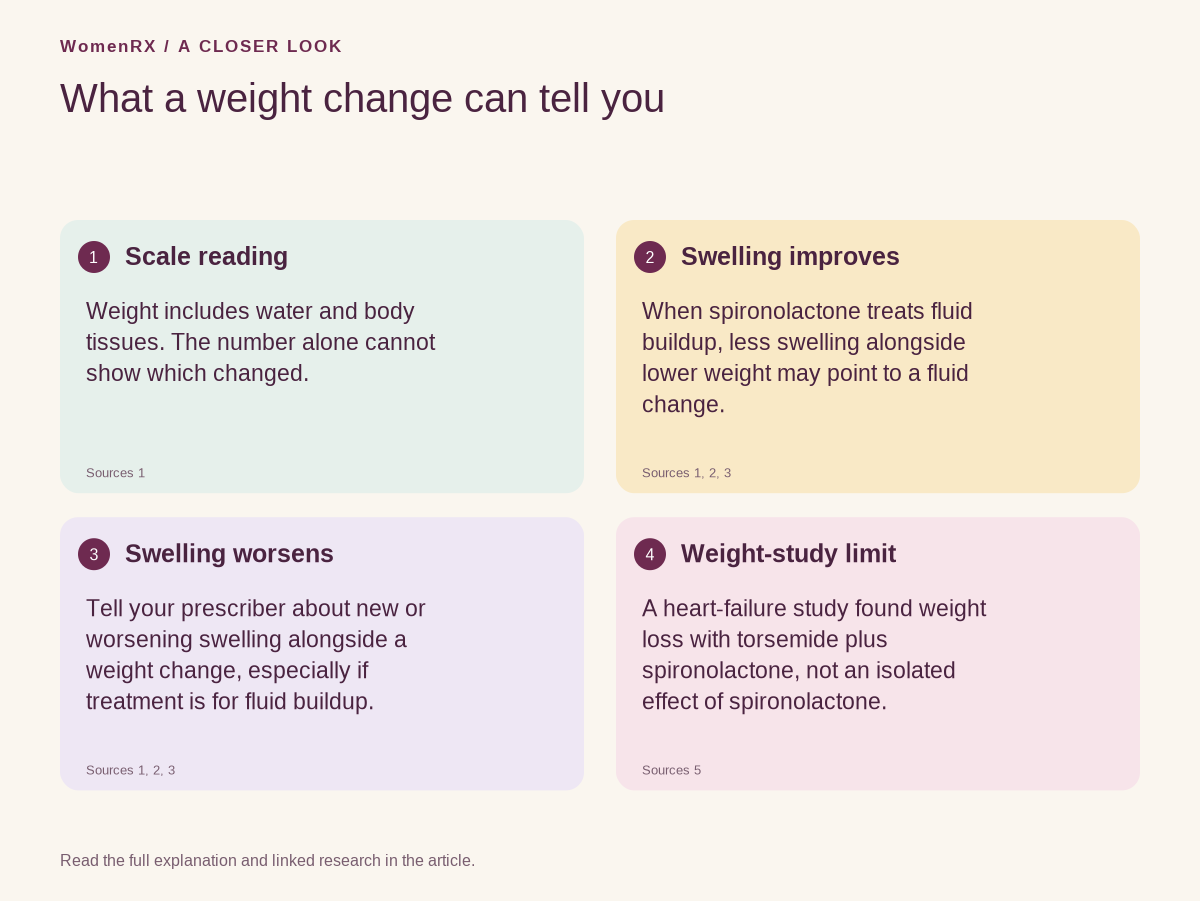
What a weight change can tell you
Scale reading: Weight includes water and body tissues. The number alone cannot show which changed.1
Swelling improves: When spironolactone treats fluid buildup, less swelling alongside lower weight may point to a fluid change.123
Swelling worsens: Tell your prescriber about new or worsening swelling alongside a weight change, especially if treatment is for fluid buildup.123
Weight-study limit: A heart-failure study found weight loss with torsemide plus spironolactone, not an isolated effect of spironolactone.5
Read the figure as text
Use the scale alongside symptoms and treatment context, not as a stand-alone explanation.- Scale reading: Weight includes water and body tissues. The number alone cannot show which changed.1
- Swelling improves: When spironolactone treats fluid buildup, less swelling alongside lower weight may point to a fluid change.123
- Swelling worsens: Tell your prescriber about new or worsening swelling alongside a weight change, especially if treatment is for fluid buildup.123
- Weight-study limit: A heart-failure study found weight loss with torsemide plus spironolactone, not an isolated effect of spironolactone.5
More questions, answered
Does spironolactone cause weight loss?
It can help remove excess fluid in certain conditions, which may affect weight, but that isn’t the same as losing body fat. A study reporting weight loss used spironolactone together with torsemide in people with heart failure, so it doesn’t establish what spironolactone alone will do to your weight. 2 3 5
Sources you can check
- Body Weight: MedlinePlusAccessed 2026-09-25Return to first citation
- Spironolactone - NHSAccessed 2026-09-25Return to first citation
- SPIRONOLACTONE TABLET, FILM COATED [REMEDYREPACK INC.] | US prescribing information and patient instructionsAccessed 2026-09-25Return to first citation
- Increased Spironolactone Dosing in Acute Heart Failure Alters Potassium Homeostasis but Does not Enhance Decongestion.Natov PS, Ivey-Miranda JB, Cox ZL, Rao VS, Butler J, Konstam MA, Kiernan MS, Kapur NK, Testani JM. · Journal of cardiac failure · 2024Return to first citation
- Real-world effectiveness and safety of torsemide and spironolactone fixed dose combination in Indian heart failure patients (RESTORE-HF study): a prospective, multicenter, observational study.Ponde CK, Ghosh Roy D, Jadav U, Mohanty A, Dang K, Francis F, Zalte N, Sugumaran A, Sawant S, Mohanasundaram S. · Therapeutic advances in cardiovascular disease · 2026Return to first citation