Can Spironolactone Change Your Weight?
A scale change may reflect fluid, not body fat, and the reason you take spironolactone matters.
Spironolactone helps the body remove excess fluid, so weight can fall when fluid buildup is being treated. But a scale number includes water as well as fat, muscle, and bone, and it can’t show what changed. A weight change after starting the medicine doesn’t, by itself, show that spironolactone caused body-fat gain. Note when it began and review it with your prescriber before changing treatment. 1 2
A change on the scale after starting spironolactone can feel like a clear answer: the medicine must be responsible. But the number alone can’t tell you whether you’ve gained body fat, retained fluid, or had an ordinary fluctuation. Spironolactone is a diuretic that helps the body get rid of excess fluid, so the reason you’re taking it is part of the story. 1 2
What a scale change can, and can’t, tell you
Body weight includes water, fat, muscle, and bone. A scale can track the total, but it doesn’t identify which part changed. 1
If spironolactone was prescribed for swelling caused by fluid buildup, removing some of that fluid may lower your weight. That is different from losing body fat. If you take it for acne or androgen-related symptoms, don’t assume that a result seen while treating fluid retention applies to your situation. Results in people treated for fluid buildup don’t establish a predictable weight or body-fat effect when spironolactone is used for acne or androgen-related symptoms. 2
Weight changes can also have causes unrelated to the medicine. Food, genetics, and other health factors can affect body weight, and the scale can’t explain the cause on its own. 1
What the evidence can tell you
The official medicine information describes spironolactone as a diuretic used for fluid buildup and lists dizziness, breast pain, and breast enlargement among common side effects. That information doesn’t establish that spironolactone causes body-fat gain. A list of common effects also can’t rule out every possible individual response. 2
Studies in people with cirrhosis and fluid buildup illustrate why context matters: changes in weight can be studied as part of managing ascites, alongside other treatments. Those results don’t show that spironolactone causes weight gain or loss in people taking it for acne, nor do they separate its effects from the other medicines used in those studies. 4 5
Pregnancy and breastfeeding are separate questions
If you’re pregnant or might be pregnant, raise that with your prescriber separately from the weight change. US prescribing information advises avoiding spironolactone during pregnancy or advising a pregnant woman about a potential risk to a male fetus. That concern is based on the medicine’s anti-androgen effects and animal findings; limited human case reports and series have not shown an association with major malformations or other adverse pregnancy outcomes. 3
If you’re postpartum and breastfeeding, the information is different. Limited data found a spironolactone metabolite in breast milk in low amounts, with no adverse effects reported in the breastfed infant after short-term exposure in that case. Long-term effects are unknown, and there are no data on effects on milk production. Neither the pregnancy nor breastfeeding information explains a change on your scale. 3
Make the change easier to interpret
Before changing your treatment, write down when you started spironolactone, when the scale change began, and whether it was gradual or sudden. If you already weigh yourself, use a consistent routine so individual readings are easier to compare. Note any new swelling or change in fluid-related symptoms, and list other medicines or supplements started or changed around the same time.
Share the pattern with your prescriber, especially if the change is sudden or unexpected. 1 If you take spironolactone with potassium supplements, salt substitutes containing potassium, certain blood-pressure medicines, or NSAIDs such as ibuprofen, mention that too. These combinations can raise potassium; they don’t prove a cause of weight change, but they matter in a medicine review. 3
Discuss the change with your prescriber before making treatment changes. The right interpretation depends on why spironolactone was prescribed and what else is changing.
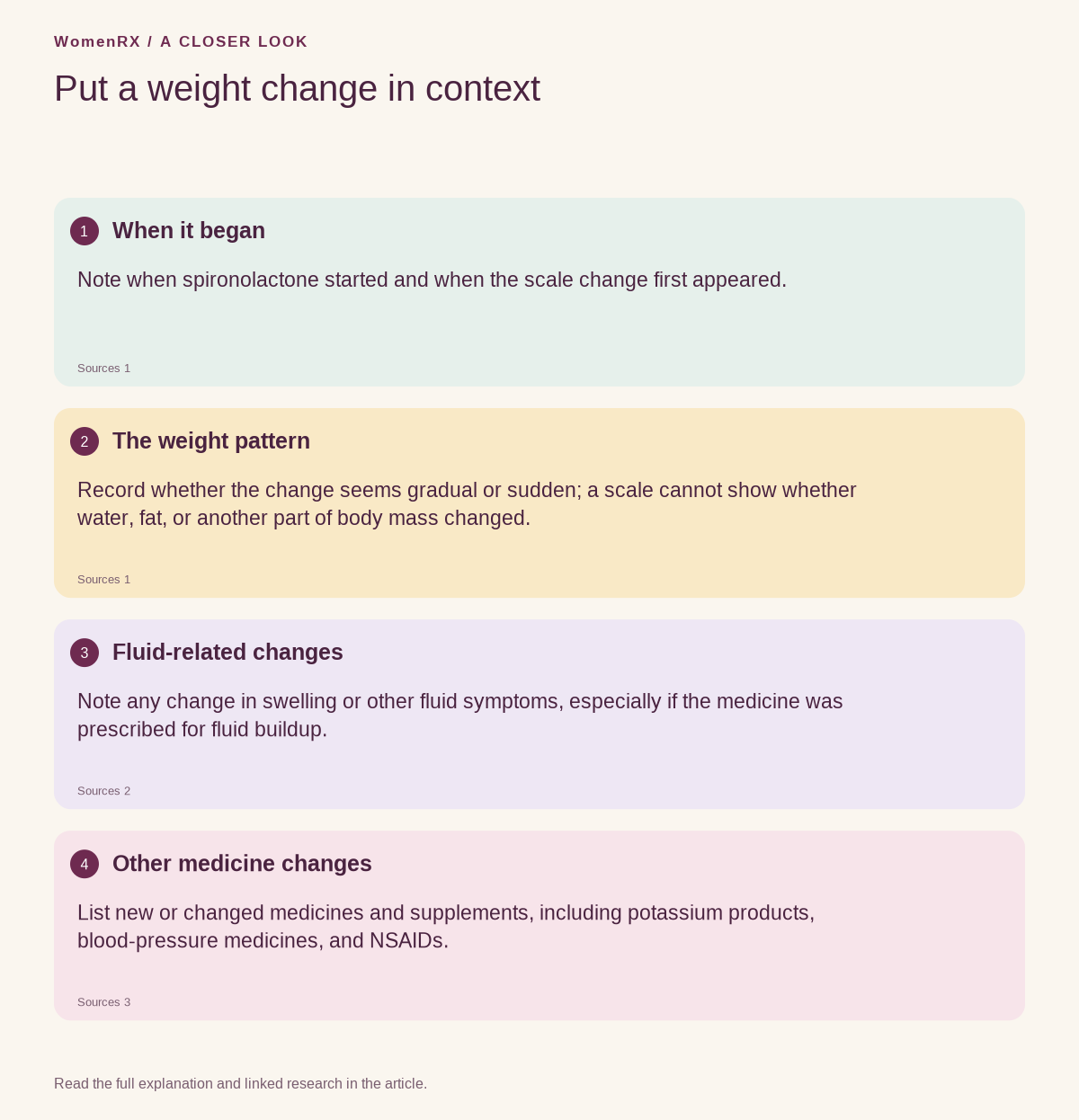
Put a weight change in context
When it began: Note when spironolactone started and when the scale change first appeared.1
The weight pattern: Record whether the change seems gradual or sudden; a scale cannot show whether water, fat, or another part of body mass changed.1
Fluid-related changes: Note any change in swelling or other fluid symptoms, especially if the medicine was prescribed for fluid buildup.2
Other medicine changes: List new or changed medicines and supplements, including potassium products, blood-pressure medicines, and NSAIDs.3
Read the figure as text
These notes can help distinguish a scale trend from a fluid-related change and give your prescriber useful context.- When it began: Note when spironolactone started and when the scale change first appeared.1
- The weight pattern: Record whether the change seems gradual or sudden; a scale cannot show whether water, fat, or another part of body mass changed.1
- Fluid-related changes: Note any change in swelling or other fluid symptoms, especially if the medicine was prescribed for fluid buildup.2
- Other medicine changes: List new or changed medicines and supplements, including potassium products, blood-pressure medicines, and NSAIDs.3
More questions, answered
Does spironolactone-related weight loss mean I’ve lost body fat?
Not necessarily. Because spironolactone helps remove excess fluid, a lower scale reading during treatment for fluid buildup may reflect less water rather than less body fat. A scale can’t tell you which part of body weight changed. 1 2
Should I stop taking spironolactone if my weight changes?
A scale reading alone can’t explain the change. Record when it started and review it with your prescriber before changing treatment. Why you take spironolactone, fluid symptoms, and other medication changes all provide useful context. 1 2
Sources you can check
- Body Weight: MedlinePlusAccessed 2026-09-25Return to first citation
- Spironolactone - NHSAccessed 2026-09-25Return to first citation
- SPIRONOLACTONE TABLET, FILM COATED [REMEDYREPACK INC.] | US prescribing information and patient instructionsAccessed 2026-09-25Return to first citation
- Clinical trial: short-term effects of combination of satavaptan, a selective vasopressin V2 receptor antagonist, and diuretics on ascites in patients with cirrhosis without hyponatraemia--a randomized, double-blind, placebo-controlled study.Ginès P, Wong F, Watson H, Terg R, Bruha R, Zarski JP, Dudley F, NormoCAT Study Investigators. · Alimentary pharmacology & therapeutics · 2010Return to first citation
- Effects of satavaptan, a selective vasopressin V(2) receptor antagonist, on ascites and serum sodium in cirrhosis with hyponatremia: a randomized trial.Ginès P, Wong F, Watson H, Milutinovic S, del Arbol LR, Olteanu D, HypoCAT Study Investigators. · Hepatology (Baltimore, Md.) · 2008Return to first citation