Set-Point Theory and What It Means for Weight Change
Your body can respond to weight loss, but that doesn’t prove it has one fixed weight it will always return to.
“Set point” is a useful shorthand for the idea that biological systems influence appetite and energy use around a person’s weight. But researchers haven’t established that every person has one fixed, predictable target. Other models allow for a range of weights or emphasize how environment and biology interact. After weight loss, some studies find changes that may resist further loss, but those changes vary and don’t predict one person’s future. 2 4 5
What people mean by a “set point”
The phrase usually describes the idea that the body actively regulates weight, rather than weight being only the result of moment-to-moment choices. In a strict set-point model, the body is thought to defend a particular level of body fat, with biological responses pushing weight back toward that level when it shifts.
That’s one model, not a proven personal setting. Other models describe weight as settling where biological feedback meets the conditions around a person, or propose a range in which weight can vary before stronger responses kick in. These models differ in how much active defense they predict and what they say happens when weight changes. Researchers still need experiments that can distinguish which model best explains human weight regulation. 4 5
So “set point” can help explain why weight change isn’t always a simple, steady process. It shouldn’t be treated as a number your body has chosen, a ceiling on what change is possible, or a forecast of what will happen to you.
What biological adaptation after weight loss can show
Weight loss can be accompanied by changes in appetite and energy expenditure. A systematic review of 33 adult studies, including 2,528 participants, found evidence of adaptive thermogenesis in many studies. Adaptive thermogenesis is a proposed compensatory response that may resist weight loss and promote weight regain. But the studies used varied methods, and the review found that well-designed studies tended to report smaller or statistically nonsignificant effects. The adaptation also appeared smaller or absent after periods of weight stabilization in some studies. 2
This is evidence that the body can respond to weight loss. It isn’t proof of one fixed set point, and it doesn’t show that weight regain is inevitable. Nor does it give a precise prediction for an individual: the review reported considerable variation between people and studies. 2
A small human study illustrates one possible appetite-related response without settling the bigger theory. In 13 people with obesity, losing 17% of initial body weight during a six-month diet program was associated with a 24% increase in the area under the curve for 24-hour ghrelin, a hormone studied for its role in appetite and weight regulation. That finding is specific to this small study; it can’t tell us what will happen to everyone, or establish a universal weight target. 3
Why the scale doesn’t reveal a hidden target
Body weight reflects more than fat: it includes muscle, bone, and water, and everyday factors can change the number on the scale. 1 A plateau, fluctuation, or regain therefore doesn’t identify a set point by itself. And a change in weight doesn’t demonstrate that the body is defending a particular number.
Models also give the environment a role. One recent review describes body weight regulation as an interaction between a person’s biological sensitivity and the environment, rather than biology operating in isolation. 4 This helps explain why a single theory shouldn’t be used to blame someone for their weight or to declare that change is impossible.
What this evidence tells us about women
The adult weight-loss review and small ghrelin study discussed here support the idea that biological responses can follow weight loss. But the findings summarized here don’t establish whether those responses differ between women and men, or how they vary through pregnancy, postpartum, perimenopause, or postmenopause. 2 3
That distinction matters: evidence about adults overall doesn’t answer every life-stage question. It also doesn’t justify assuming that women have a unique, fixed set point. The most grounded takeaway is broader: biological responses to weight change exist, their size and persistence vary, and current models don’t let us calculate an individual’s defended weight.
A practical way to use the idea
If someone tells you that your body has a set point, you can hear that as shorthand for possible biological feedback, not a verdict. Weight change may involve appetite and energy-use responses, while environmental conditions also matter. The theory can make the process less moralistic, but it can’t tell you what your weight must be, what change is possible, or what your individual trajectory will look like. 2 4 5
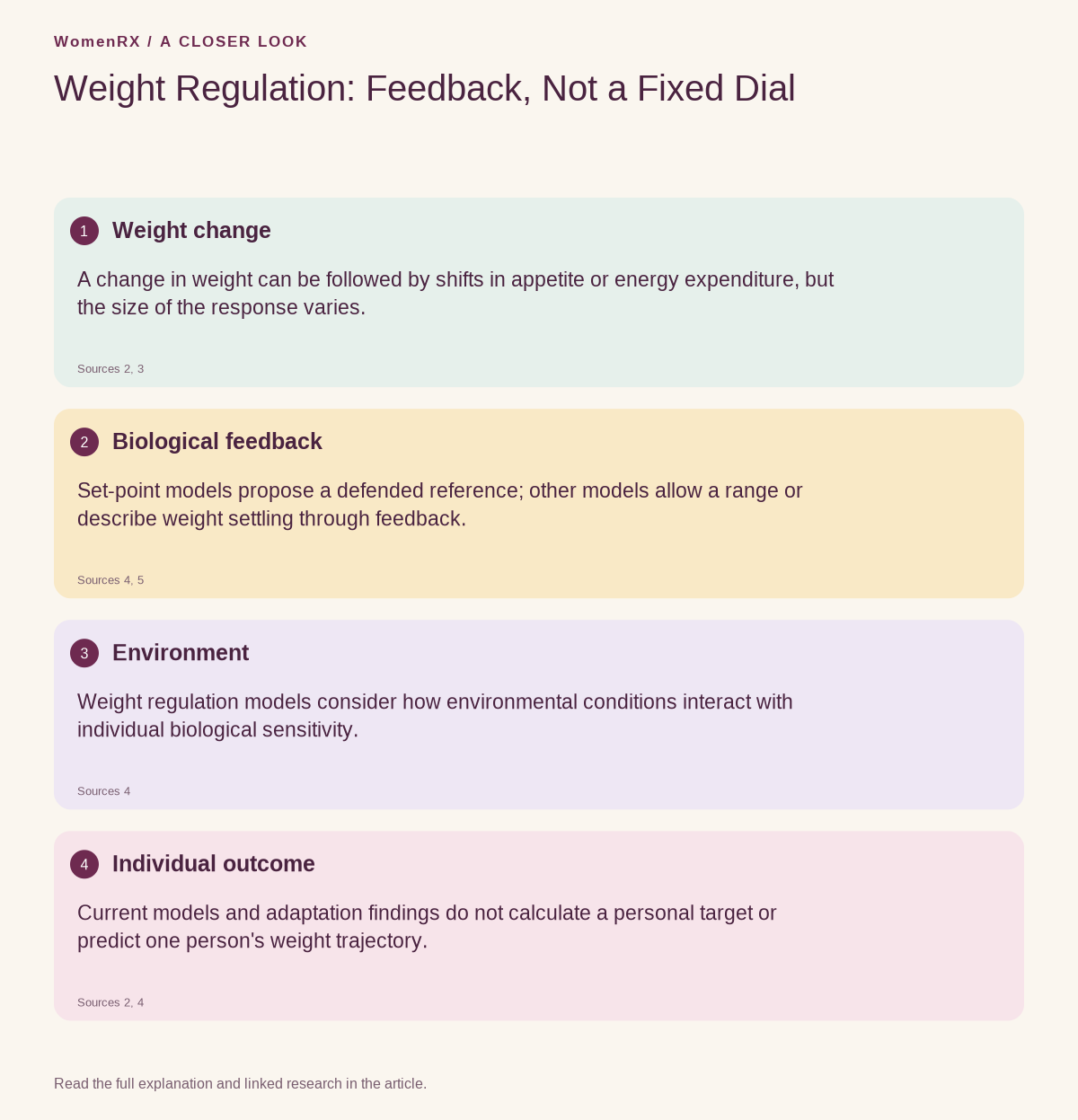
Weight Regulation: Feedback, Not a Fixed Dial
Weight change: A change in weight can be followed by shifts in appetite or energy expenditure, but the size of the response varies.23
Biological feedback: Set-point models propose a defended reference; other models allow a range or describe weight settling through feedback.45
Environment: Weight regulation models consider how environmental conditions interact with individual biological sensitivity.4
Individual outcome: Current models and adaptation findings do not calculate a personal target or predict one person's weight trajectory.24
Read the figure as text
The figure separates proposed biological feedback from the environment and shows why these mechanisms do not specify one inevitable weight.- Weight change: A change in weight can be followed by shifts in appetite or energy expenditure, but the size of the response varies.23
- Biological feedback: Set-point models propose a defended reference; other models allow a range or describe weight settling through feedback.45
- Environment: Weight regulation models consider how environmental conditions interact with individual biological sensitivity.4
- Individual outcome: Current models and adaptation findings do not calculate a personal target or predict one person's weight trajectory.24
More questions, answered
Does a weight plateau mean I’ve reached my set point?
Not by itself. A plateau doesn’t show that your body is defending one specific weight. Current models make different predictions about weight regulation, and researchers still need human experiments to distinguish between them. 4 5
Does set-point theory mean weight loss is impossible?
No. The theory proposes that biological responses may influence weight regulation; it doesn’t establish that change can’t happen or predict one person’s limits. Studies of adaptation after weight loss also report variation in the size and persistence of those responses. 2 4
Sources you can check
- Body Weight: MedlinePlusAccessed 2026-09-25Return to first citation
- Does adaptive thermogenesis occur after weight loss in adults? A systematic review.Nunes CL, Casanova N, Francisco R, Bosy-Westphal A, Hopkins M, Sardinha LB, Silva AM. · The British journal of nutrition · 2022Return to first citation
- Plasma ghrelin levels after diet-induced weight loss or gastric bypass surgery.Cummings DE, Weigle DS, Frayo RS, Breen PA, Ma MK, Dellinger EP, Purnell JQ. · The New England journal of medicine · 2002Return to first citation
- Body weight regulation models in humans: insights for testing their validity.Fernández-Verdejo R, Ravussin E, Galgani JE. · Nature reviews. Endocrinology · 2025Return to first citation
- Models of body weight and fatness regulation.Speakman JR, Hall KD. · Philosophical transactions of the Royal Society of London. Series B, Biological sciences · 2023Return to first citation