Why Weight Returns, and What Can Support Maintenance
Weight regain can reflect biology as well as changing routines, so maintenance support may need to continue after initial weight loss.
After weight loss, appetite and energy use can shift in ways that make maintaining the loss harder. Regain can also reflect changing routines, health factors, or treatment changes; it isn’t proof of personal failure. Ongoing activity, behavioral follow-up, and, for some people, medication treatment may help, though results vary and the best long-term approach isn’t settled. 3 4 6
Regain isn’t a verdict on effort
It’s common for weight to rise after a period of weight loss, and biology is part of the explanation. Reviews describe changes after weight loss that can increase appetite and reduce energy expenditure, creating pressure toward regain. That pressure interacts with behavior and circumstances over time. Calling regain a failure of willpower leaves out much of what shapes a person’s weight trajectory. 3 6
Your weight can also change for reasons that don’t represent fat regain. It includes water, muscle, bone, and fat, and everyday factors can move the scale. A pattern over time is more informative than one reading. A sudden, unexplained change is different from gradual regain and is worth discussing with a healthcare provider. 2
Four places maintenance support can help
Biological pressure. Increased appetite and lower energy expenditure after weight loss can make the same routines less effective than they were before. This doesn’t mean a person has stopped trying; the body’s response can change the effort needed to maintain a loss. 3 6
Routines and circumstances. Sustained changes in eating patterns, activity, and self-regulation are part of long-term weight trajectories. Health conditions and some medicines can also affect weight, so a maintenance review may include more than food and exercise. 1 6
Treatment changes. Weight-loss medicines are treatments to review over time, not a one-size-fits-all short course. A systematic review of 12 randomized trials involving 4,915 adults found that anti-obesity medications used during weight maintenance helped prevent regain on average compared with placebo, while gastrointestinal side effects were more common. The review does not settle the best duration or plan for each person. 4
Support over time. In a review of 11 exercise trials involving 568 participants, exercise interventions were associated with 2.81 kg less weight regain than control at the last reported follow-up. Follow-up periods and programs varied, so this is an average across studies, not a promised result or a specific exercise prescription. 3
Match the next step to the pressure point
| If this is the main challenge | Support to consider | What the evidence suggests |
|---|---|---|
| Hunger or effort has increased after losing weight | Review the maintenance plan, including whether medication treatment is appropriate | Body responses after weight loss can promote regain; medication trials suggest average benefit during maintenance, with gastrointestinal side effects more common. 3 4 |
| Activity has become harder to sustain | Look for an activity approach that fits your health and circumstances | Exercise trials found a modest average reduction in regain, but they don’t establish one best program for everyone. 3 |
| Eating patterns or self-management routines have shifted | Consider ongoing nutrition or behavioral support | Long-term outcomes appear to involve sustained changes over time, not just baseline habits. 6 |
| Weight changed after a health or treatment change | Review health conditions and medicines as part of the discussion | Some medical conditions and medicines can affect weight. 1 |
This is a planning aid, not a score or a ranking of treatments. More than one factor can be active at once. For example, a change in work schedule could disrupt activity and meal routines while appetite is also stronger after weight loss. It may help to identify which pressure is most noticeable before choosing what kind of follow-up to seek.
What women’s evidence can and can’t tell us
The pooled exercise and medication findings give overall averages, not a women-specific comparison, so they can’t tell you whether benefits differ by sex. A study of postmenopausal women examined genetic susceptibility and weight trajectories. In a subgroup of European American women who had lost at least 5% of their initial weight, higher genetic risk was associated with faster regain. A separate analysis found no interaction between genetic risk, study assignment, and time among African American participants overall; it was not the same weight-loss subgroup comparison. Neither finding establishes that menopause itself causes regain or predicts what will happen to an individual woman. 3 4 5
Menopause, postpartum changes, or other life circumstances may matter to your own experience, but these cited studies do not establish a postpartum- or menopause-specific cause of regain or a distinct maintenance plan for either life stage. A useful review starts with what changed for you, including your health, treatment, appetite, schedule, and access to support. 3 4 5
Think in terms of continued care
Maintenance isn’t a single finish line. If weight is rising, the practical question is not simply how to repeat the original weight-loss plan. It’s whether your body’s response, routines, health, or treatment needs have changed, and what support could address that change. For some people, that may mean activity support; for others, it may mean renewed behavioral care or a discussion about ongoing medication treatment. The evidence supports considering continued care, while leaving the right mix and duration to individual circumstances. 4 6
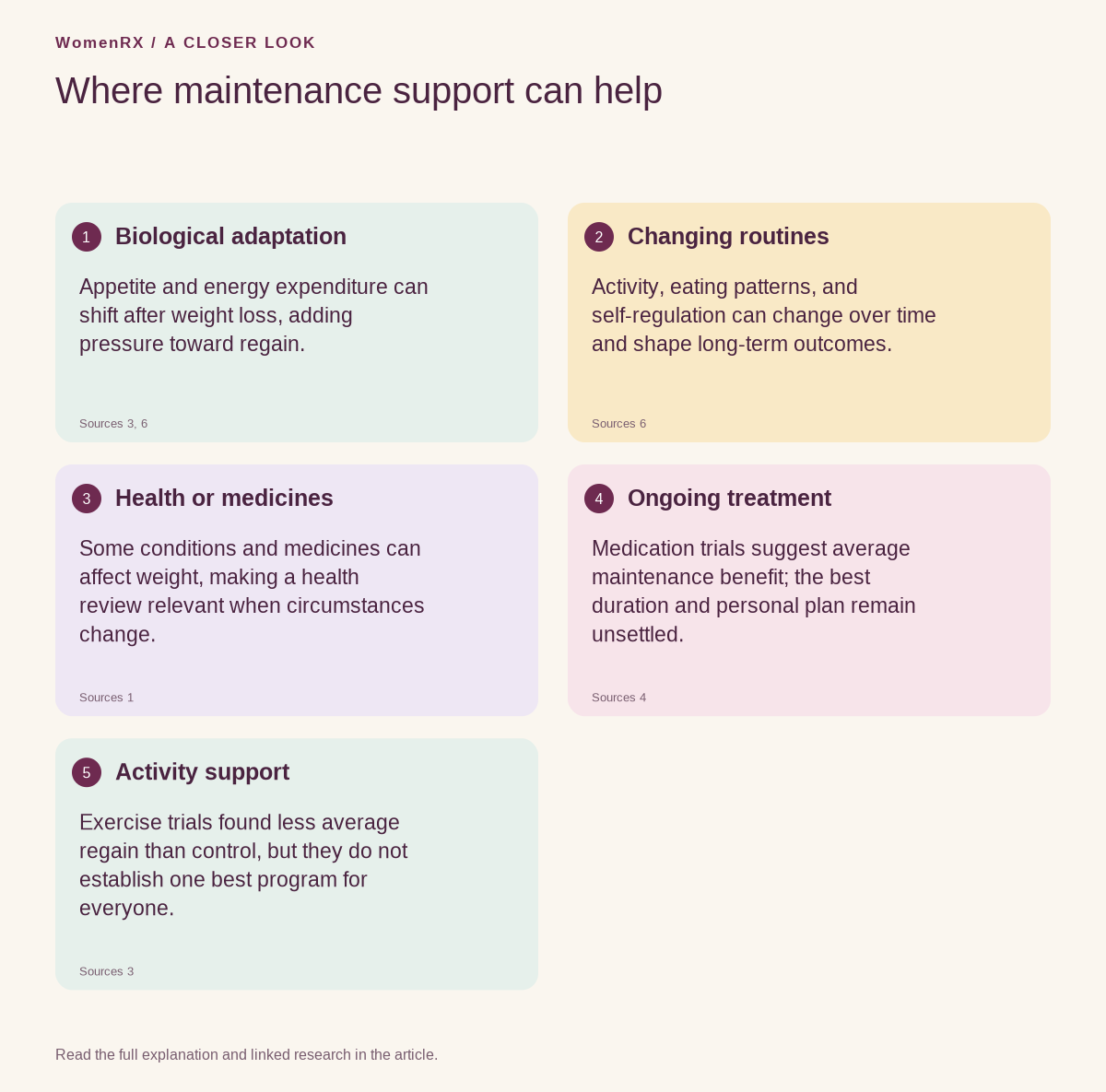
Where maintenance support can help
Biological adaptation: Appetite and energy expenditure can shift after weight loss, adding pressure toward regain.36
Changing routines: Activity, eating patterns, and self-regulation can change over time and shape long-term outcomes.6
Health or medicines: Some conditions and medicines can affect weight, making a health review relevant when circumstances change.1
Ongoing treatment: Medication trials suggest average maintenance benefit; the best duration and personal plan remain unsettled.4
Activity support: Exercise trials found less average regain than control, but they do not establish one best program for everyone.3
Read the figure as text
Weight regain can reflect several pressures at once. This map links each pressure to a kind of support and the limits of what studies show.- Biological adaptation: Appetite and energy expenditure can shift after weight loss, adding pressure toward regain.36
- Changing routines: Activity, eating patterns, and self-regulation can change over time and shape long-term outcomes.6
- Health or medicines: Some conditions and medicines can affect weight, making a health review relevant when circumstances change.1
- Ongoing treatment: Medication trials suggest average maintenance benefit; the best duration and personal plan remain unsettled.4
- Activity support: Exercise trials found less average regain than control, but they do not establish one best program for everyone.3
Sources you can check
- Obesity: MedlinePlusAccessed 2026-09-25Return to first citation
- Body Weight: MedlinePlusAccessed 2026-09-25Return to first citation
- The effects of exercise interventions on weight regain after weight loss: a systematic review and meta-analysis.Wang J, Chen Y, Xu K, Dai J. · Scientific reports · 2026Return to first citation
- Efficacy and Safety of Anti-Obesity Medications for Weight Loss Maintenance in Adults With Overweight or Obesity: A Systematic Review and Meta-Analysis of Randomised Controlled Trials.Chen Z, Cheng R, Wang H, Hu F. · Diabetes, obesity & metabolism · 2026Return to first citation
- Impact of Genetic Predisposition to Obesity on Long-Term Maintenance of Modest Weight Loss in Postmenopausal Women.Lee HH, Avery CL, Graff M, Kim D, Arias J, Van Horn L, Kooperberg C, North KE. · Obesity (Silver Spring, Md.) · 2026Return to first citation
- Weight regain after obesity treatment: mechanisms, predictors, and real-world evidence from the IGOBE program.Tejera C, Torrente L, Porca C, Bellido D, Crujeiras AB. · Reviews in endocrine & metabolic disorders · 2026Return to first citation