Weight Management: General Options and Life-Stage Considerations
Weight loss isn’t automatically the right goal. Compare general options, with considerations for pregnancy, postpartum recovery, and goals around menopause.
Weight management can mean losing weight, preventing further gain, or focusing on health without making the scale the main target. If weight loss is appropriate for you, options include nutrition and activity changes, behavioral support, medication, and sometimes surgery. You don’t have to try every option in sequence. Your health conditions, life stage, preferences, and the burdens of each approach can help determine what fits. Around menopause, start with your goals and health conditions rather than assuming a separate treatment pathway. 3 4 5
Start with the reason, not the number
A weight goal makes more sense when it connects to something you care about: improving a health condition, making movement easier, or changing a pattern that concerns you. It’s also reasonable to decide that weight loss isn’t your priority right now. A clinician can consider your weight history, health conditions, activity, and physical exam rather than relying on a scale reading alone. BMI is one measure used in care, but it isn’t a complete description of your health. 3 4
Progress can include changes in health and daily wellbeing, not only pounds. If you do pursue weight loss, a modest change may still matter: MedlinePlus notes that, for people with obesity, losing 5-10% of body weight can delay or prevent some diseases. That isn’t a promise that a particular amount will produce the same result for everyone. 3
Choose the kind of help that fits the problem
Nutrition and activity changes give you room to shape a routine around your abilities and your day. Treatment plans may include eating-pattern changes and physical-activity goals aimed at long-term weight management. If you already know a manageable change you want to make, you can start there. For example, you might work on an eating pattern that fits your schedule alongside an activity goal that fits your current abilities, rather than take on a restrictive plan all at once. The test is whether those changes remain workable after the initial push. A nutrition professional can help if deciding what to change is the sticking point. 3
Behavioral or peer support addresses a different problem: knowing what you want to do but struggling to make it work in daily life. For example, if a plan repeatedly falls apart around your work schedule, another set of food rules may be less useful than help identifying the barrier and adjusting the plan. MedlinePlus describes counseling and support groups as options that may offer encouragement and help you understand what’s behind weight changes. Support can complement nutrition and activity changes; it isn’t a test you must pass before considering other care. 3
Prescription medication can be discussed alongside lifestyle modifications, not only after those changes have failed. A 2026 American College of Physicians guideline conditionally suggests certain medications for nonpregnant adults with obesity. It also makes a separate recommendation for nonpregnant adults with overweight who have type 2 diabetes, dyslipidemia, hypertension, obstructive sleep apnea, or cardiovascular disease. Semaglutide and tirzepatide are among its first-line options for both groups. These recommendations establish who might have a medication conversation, not whether a particular medicine fits you. 5
Before starting or changing medication, the guideline recommends discussing likely benefits and harms, cost and access, other health conditions, goals, preferences, and warnings or contraindications. That trade-off matters: a medication may be a reasonable option on paper but not suit your health, circumstances, or priorities. Pregnancy changes the decision; this guideline addresses nonpregnant adults and specifically calls out pregnancy in medication discussions. 5
Weight-loss procedures or surgery are another option for some people with severe obesity or serious weight-related health problems, particularly when other efforts haven’t led to enough weight loss. Unlike a change to a daily routine, this calls for a discussion of the procedure itself and the follow-up it would involve for you. 3
Be cautious about treating supplements as an easier substitute. NIH’s Office of Dietary Supplements describes the evidence for weight-loss supplements as inconclusive and unconvincing overall; products can combine ingredients in ways that make their effects and safety hard to judge. 1
Consider pregnancy, postpartum recovery, and menopause
During pregnancy, weight-loss goals aren’t interchangeable with adult obesity treatment. The medication guideline is for nonpregnant adults, and pregnancy involves a separate question of appropriate weight gain. A study of women with pre-existing type 2 diabetes found that weight-gain patterns were associated with different pregnancy and newborn outcomes, but its results are specific to that high-risk group and don’t set a target for all pregnancies. 5 7
After birth, recovery comes first. In the weeks after delivery, your body is recovering and your activity may need to follow your clinician’s instructions. MedlinePlus notes that rest and care for yourself and your baby may take priority, and recommends following instructions about activity in the weeks after birth. Postpartum weight-management guidance also needs to account for eating, activity, breastfeeding, and behavioral support, though the guideline summarized here was developed for Indian healthcare settings. 2 6
Around menopause, start with your own health goals. Consider your weight history, health conditions, and activity rather than a scale reading alone. If you’re considering medication, the ACP recommendations above apply to eligible nonpregnant adults; they do not identify menopause as a separate eligibility category. 3 4 5
Judge the approach against your goal
Decide what you want to improve before choosing a method, then check whether that method is doing its job. If you chose a nutrition or activity change, can you still make it work within your ordinary week? If the change makes sense but keeps running into the same practical barrier, that’s a reason to consider added support. If a health condition is part of your reason for considering weight loss, discuss whether that condition is changing, too; a scale reading alone won’t answer that question. With medication, revisit whether the benefits still justify the harms, cost, and access demands for you. If an approach isn’t working or its burden is too high, reconsider the approach rather than treating it as a verdict on your effort. 3 4 5
If weight changes unexpectedly or without trying, that’s a different situation from planned weight management and merits discussion with a clinician. 4
There isn’t one correct rung on the treatment ladder. It’s reasonable to start with supported lifestyle changes, to ask about medication, or to discuss whether a procedure belongs in the conversation. The right choice is the one that fits your health and circumstances, with room to reassess as either changes.
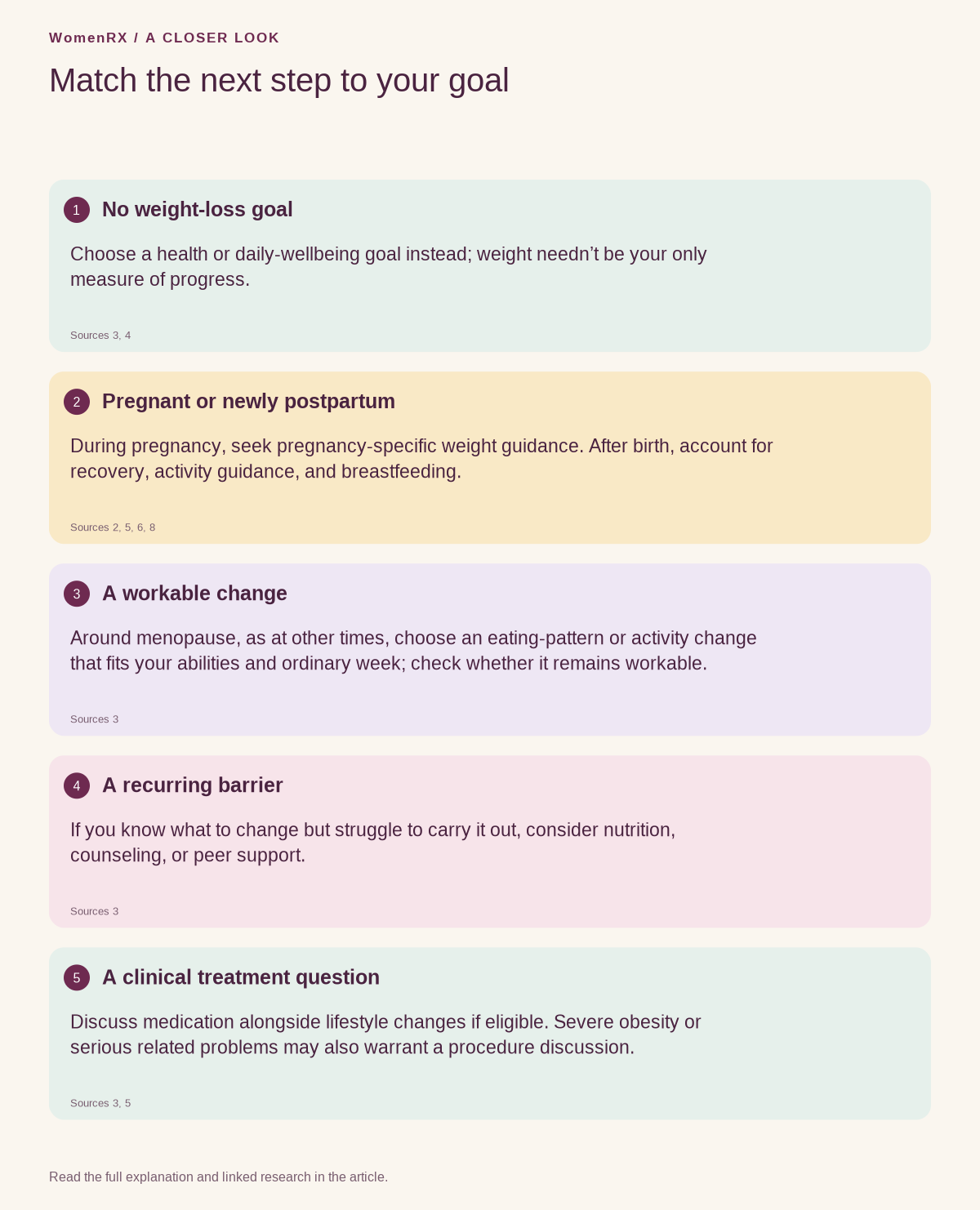
Match the next step to your goal
No weight-loss goal: Choose a health or daily-wellbeing goal instead; weight needn’t be your only measure of progress.34
Pregnant or newly postpartum: During pregnancy, seek pregnancy-specific weight guidance. After birth, account for recovery, activity guidance, and breastfeeding.2568
A workable change: Around menopause, as at other times, choose an eating-pattern or activity change that fits your abilities and ordinary week; check whether it remains workable.3
A recurring barrier: If you know what to change but struggle to carry it out, consider nutrition, counseling, or peer support.3
A clinical treatment question: Discuss medication alongside lifestyle changes if eligible. Severe obesity or serious related problems may also warrant a procedure discussion.35
Read the figure as text
Start with your circumstances and the problem you want an approach to solve. These are choices, not required steps in order.- No weight-loss goal: Choose a health or daily-wellbeing goal instead; weight needn’t be your only measure of progress.34
- Pregnant or newly postpartum: During pregnancy, seek pregnancy-specific weight guidance. After birth, account for recovery, activity guidance, and breastfeeding.2568
- A workable change: Around menopause, as at other times, choose an eating-pattern or activity change that fits your abilities and ordinary week; check whether it remains workable.3
- A recurring barrier: If you know what to change but struggle to carry it out, consider nutrition, counseling, or peer support.3
- A clinical treatment question: Discuss medication alongside lifestyle changes if eligible. Severe obesity or serious related problems may also warrant a procedure discussion.35
More questions, answered
Does a BMI number decide whether I should lose weight?
No single number can decide what goal is right for you. BMI is used in some treatment recommendations, but weight assessment can also include your health history, other conditions, activity, and physical exam. 3 5
Are weight-loss supplements a reliable alternative?
The NIH Office of Dietary Supplements describes the overall evidence for weight-loss supplements as inconclusive and unconvincing. Combination products can also make it difficult to tell which ingredients affect benefits or safety. 1
Sources you can check
- Dietary Supplements for Weight Loss - Health Professional Fact SheetAccessed 2026-09-25Return to first citation
- Postpartum Care: MedlinePlusAccessed 2026-09-25Return to first citation
- Obesity: MedlinePlusAccessed 2026-09-25Return to first citation
- Body Weight: MedlinePlusAccessed 2026-09-25Return to first citation
- Pharmacologic Treatments With Lifestyle Modifications in Nonpregnant Adults With Overweight or Obesity in Outpatient Settings: A Living Clinical Guideline From the American College of Physicians (April 2026).Qaseem A, Cross JT, Harrod CS, Owens DK, Balk EM, Crandall CJ, Clinical Guidelines Committee of the American College of Physicians, Fitterman N, Gibson M, Lewis J, Mackey K, Miller... · Annals of internal medicine · 2026Return to first citation
- Executive summary of evidence and consensus-based clinical practice guideline for management of obesity and overweight in postpartum women: An AIIMS-DST initiative.Kumari A, Ranjan P, Vikram NK, Kaur D, Balsalkar G, Malhotra A, Puri M, Batra A, Madan J, Tyagi S, Guleria K, Dabral A, Sarkar S, Nigam A, Anwar W, Kamath S, Bhatla N, Kumari SS, K... · Diabetes & metabolic syndrome · 2022Return to first citation
- Optimal gestational weight gain in women with pregestational type 2 diabetes: a population-based cohort study in China.Xue Y, Cui Z, Shu X, Juan J, Kang X, Yao M, Chen X, Wei Z, Kong L, Chen H, Cui S, Gao F, Zhu P, Yan J, Xu X, Zhang L, Wang Y, Mi Y, Yang H. · Diabetology & metabolic syndrome · 2025Return to first citation
- Weight management across preconception, pregnancy, and postpartum: A systematic review and quality appraisal of international clinical practice guidelines.Harrison CL, Teede H, Khan N, Lim S, Chauhan A, Drakeley S, Moran L, Boyle J. · Obesity reviews : an official journal of the International Association for the Study of Obesity · 2021Return to first citation