Semaglutide or Liraglutide for Weight Management?
For the injectable products, the biggest day-to-day difference is weekly versus daily injections, while trial results favor semaglutide on average but don’t establish a best choice for every woman.
Injectable semaglutide for weight management is given weekly; liraglutide is injected daily. The cited Wegovy label also includes a semaglutide tablet, which does not follow the weekly injection schedule. In cited weight-management trials, liraglutide was titrated toward 3 mg with weekly dose increases, while several semaglutide trials escalated toward 2.4 mg weekly over 16 weeks, with other study schedules varying. The exact product, current label, side effects, pregnancy plans, and access all matter. 125
The simplest difference: how often you inject
For the injectable products used in weight management, the familiar trade-off is a weekly semaglutide injection versus a daily liraglutide injection. The cited Wegovy label also includes a semaglutide tablet; the weekly injection schedule does not apply to it. Both are GLP-1 receptor agonists. Trials studied each alongside reduced-calorie eating and increased physical activity, so the medicines weren’t tested as stand-alone strategies. A weekly routine may fit more easily into some people’s lives; a daily routine may suit others. The schedule is a practical difference, not proof that one medicine will be easier for you to tolerate or continue. 125
Dose escalation is another practical difference, but trial schedules aren’t personal instructions. In the adult Saxenda trials, dosing was increased weekly to reach 3 mg. Several Wegovy weight-management trials escalated toward 2.4 mg once weekly over 16 weeks; other studies in the prescribing information used escalation periods of 12 to 16 weeks or 20 weeks. These are study regimens, and the exact product’s current US prescribing information should guide a treatment discussion. 12
The exact product matters. Semaglutide is available under different brand names, and the cited Wegovy label includes both injection and tablet forms. The product used for weight management should not be assumed interchangeable with another semaglutide product. Check the current US prescribing information for the specific brand and form being discussed. 25
What the weight-loss evidence can, and can’t, tell you
A 2026 systematic review of randomized trials in adults with overweight or obesity but without diabetes reported placebo-subtracted weight loss of up to 14.8% with subcutaneous semaglutide and up to 5.8% with liraglutide among commercially available therapies. The review included trials with different durations and designs, and these are the largest reductions reported, not guaranteed results or a head-to-head estimate for a particular person. They shouldn’t be read as a direct, like-for-like comparison. 4
The review also reports that head-to-head data found greater weight loss with semaglutide than liraglutide. A separate network meta-analysis ranked liraglutide lower for weight loss, but indirect comparisons combine results across trials and can be affected by differences among those studies. Together, this evidence favors semaglutide on average; it doesn’t prove that every woman will lose more weight with it or that it will be the better fit. 34
Women were well represented in some studies: the Saxenda adult safety trials were 71% female, and a Wegovy trial described in the US prescribing information was 79% female. Those enrollment figures don’t establish a women-specific advantage. The cited prescribing-information passages give enrollment by sex but do not provide sex-stratified efficacy results showing whether either medicine works better for women. 12
Tolerability: compare the experience, not separate trial percentages
Digestive symptoms are a real consideration. In adult liraglutide trials, 9.8% of people taking Saxenda stopped treatment because of adverse reactions, compared with 4.3% taking placebo. Nausea, vomiting, and diarrhea were among the most common reasons for stopping. These figures come from liraglutide trials, not a direct comparison with semaglutide, so they can’t tell you which medicine is easier to tolerate. 1
A network meta-analysis found higher risks of any adverse events and stopping treatment because of adverse events with liraglutide across the treatments it assessed. That’s a comparison across a network of trials, not a personal prediction. Ask what side effects to watch for, how dose increases are handled, and what the plan is if symptoms make it hard to continue. 3
Pregnancy plans change the conversation
A review of GLP-1 medicines advises against using them during pregnancy because human pregnancy information is limited and animal studies have raised concerns. It reports an 8-to-10-week interval before conception for semaglutide; check the current US product information and get individualized guidance before planning pregnancy. The review does not specify a preconception interval for liraglutide, so don’t assume its timing is the same. 25
If pregnancy is possible or planned, bring that up before choosing a medicine. The decision may be different from the one that fits weight management when pregnancy isn’t a near-term consideration. 5
A short checklist for the shared decision
Before deciding, confirm:
- Which product and form? Ask for the brand and whether it’s an injection or tablet, rather than relying on the medicine’s generic name alone. 2
- What is it being prescribed for? Check that the exact product’s US prescribing information covers the intended use. Product names containing the same medicine don’t automatically mean the same indication. 25
- Which schedule and dose-escalation plan? If comparing injections, weigh a weekly schedule against a daily one in your real routine, and ask which product-specific plan applies. The cited trial schedules describe research, not personal instructions. 125
- What is the plan if side effects interfere? Ask about expected symptoms, dose escalation, and when to report a problem. 13
- Could pregnancy timing affect the choice? Discuss plans before starting, and verify product-specific timing rather than applying semaglutide guidance to liraglutide. 5
- Can you obtain the exact product? Confirm coverage and availability with your insurer and pharmacy before treating one option as practical. The evidence on weight loss alone can’t answer that local question.
For many women, semaglutide’s average weight-loss results and the weekly schedule of its injection will make it worth discussing first. Liraglutide’s daily schedule, individual tolerability, pregnancy plans, and product access may still influence the decision. The useful comparison is not simply “which works better?” but “which exact product, schedule, and evidence profile fits my circumstances?”
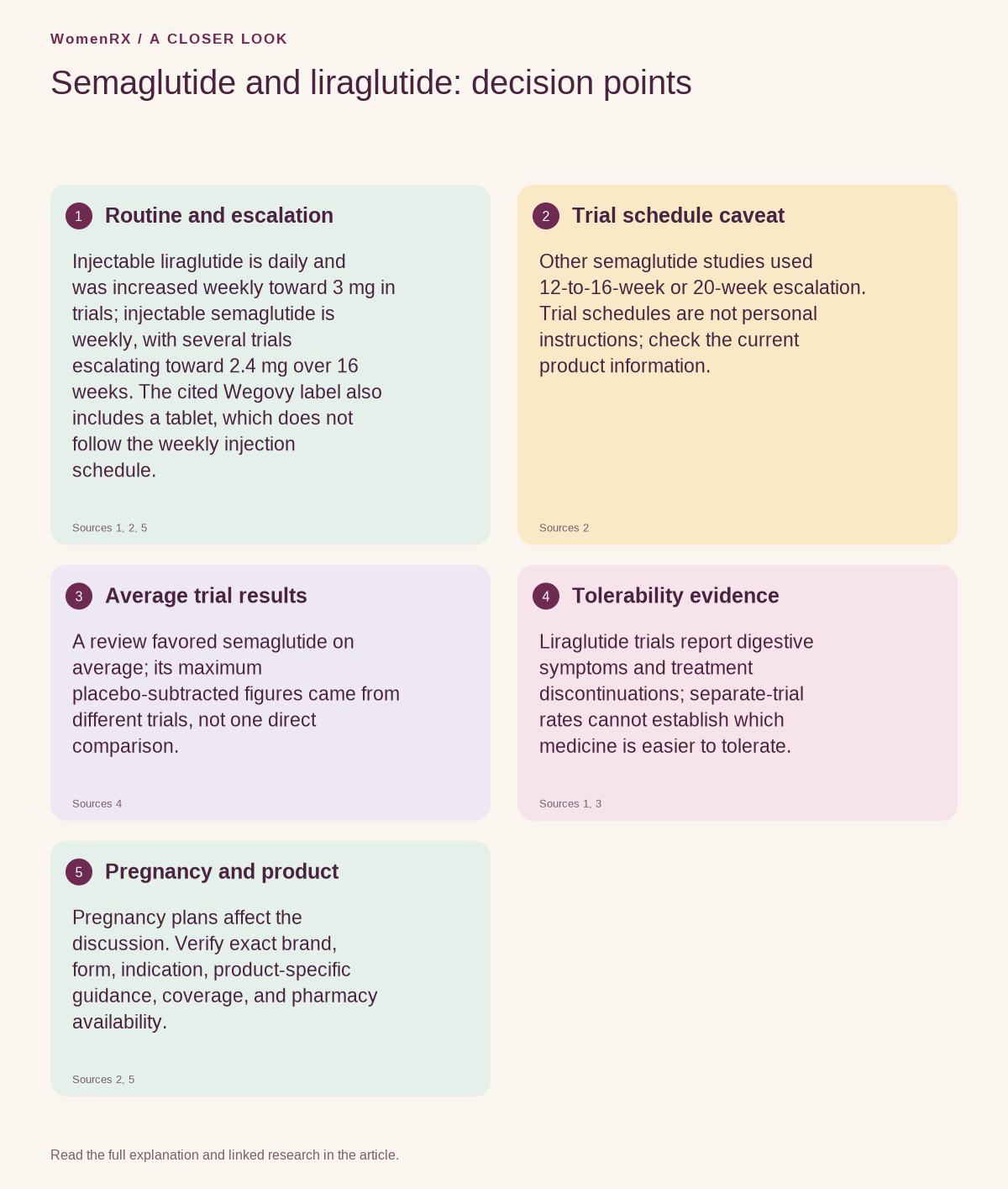
Semaglutide and liraglutide: decision points
Routine and escalation: Injectable liraglutide is daily and was increased weekly toward 3 mg in trials; injectable semaglutide is weekly, with several trials escalating toward 2.4 mg over 16 weeks. The cited Wegovy label also includes a tablet, which does not follow the weekly injection schedule.125
Trial schedule caveat: Other semaglutide studies used 12-to-16-week or 20-week escalation. Trial schedules are not personal instructions; check the current product information.2
Average trial results: A review favored semaglutide on average; its maximum placebo-subtracted figures came from different trials, not one direct comparison.4
Tolerability evidence: Liraglutide trials report digestive symptoms and treatment discontinuations; separate-trial rates cannot establish which medicine is easier to tolerate.13
Pregnancy and product: Pregnancy plans affect the discussion. Verify exact brand, form, indication, product-specific guidance, coverage, and pharmacy availability.25
Read the figure as text
A side-by-side summary of dosing routines and cited trial schedules, what the evidence suggests, and what still needs checking for your situation.- Routine and escalation: Injectable liraglutide is daily and was increased weekly toward 3 mg in trials; injectable semaglutide is weekly, with several trials escalating toward 2.4 mg over 16 weeks. The cited Wegovy label also includes a tablet, which does not follow the weekly injection schedule.125
- Trial schedule caveat: Other semaglutide studies used 12-to-16-week or 20-week escalation. Trial schedules are not personal instructions; check the current product information.2
- Average trial results: A review favored semaglutide on average; its maximum placebo-subtracted figures came from different trials, not one direct comparison.4
- Tolerability evidence: Liraglutide trials report digestive symptoms and treatment discontinuations; separate-trial rates cannot establish which medicine is easier to tolerate.13
- Pregnancy and product: Pregnancy plans affect the discussion. Verify exact brand, form, indication, product-specific guidance, coverage, and pharmacy availability.25
More questions, answered
Does the evidence show that semaglutide works better specifically for women?
These studies included many women, but those enrollment percentages don’t establish a female-specific benefit. The reported comparisons favor semaglutide on average, not specifically in women. 124
Are the weight-loss percentages a direct comparison?
No. The reported figures are the largest placebo-subtracted results in a review of different trials, not a single trial comparing the medicines under identical conditions. The review also reports head-to-head evidence favoring semaglutide, but the figures quoted here are not that head-to-head result. 4
Sources you can check
- SAXENDA (LIRAGLUTIDE) INJECTION, SOLUTION [NOVO NORDISK PHARMACEUTICAL INDUSTRIES, LP] | US prescribing information and patient instructionsAccessed 2026-09-25Return to first citation
- WEGOVY (SEMAGLUTIDE) INJECTION, SOLUTION WEGOVY (SEMAGLUTIDE) TABLET [NOVO NORDISK PHARMACEUTICAL INDUSTRIES, LP] | US prescribing information and patient instructionsAccessed 2026-09-25Return to first citation
- Analysis of the efficacy and safety of liraglutide, semaglutide, and tirzepatide for the treatment of overweight and obesity: a systematic review and network meta-analysis.Pałka W, Moćko P, Śladowska K, Holko P, Kawalec P. · Journal of endocrinological investigation · 2026Return to first citation
- Efficacy and Safety of Glucagon-like Peptide-1 Receptor Agonists and Co-agonists for Weight Loss Among Adults Without Diabetes : An Updated Systematic Review.Moiz A, Filion KB, Samuels AE, Tsoukas MA, Yu OHY, Peters TM, Eisenberg MJ. · Annals of internal medicine · 2026Return to first citation
- GLP-1 Receptor Agonists and Fertility: What Is Known So Far?Becker AS, Castilhos JP, Shugair SAS, Colombo T, Hentschke M-. · JBRA assisted reproduction · 2026Return to first citation