How to Compare GLP-1 Medicines for Weight Management
The right comparison is less about finding one “best” medicine and more about matching evidence, routine, health history, and reproductive plans.
For nonpregnant adults with obesity, the American College of Physicians places semaglutide and tirzepatide among its first-line medication options with lifestyle changes; liraglutide is a later-line option. That’s a population-level recommendation, not an individual prescription. Compare eligibility, how each is taken, possible side effects, your medical history, access, and pregnancy plans, then agree on how you’ll assess whether treatment is helping. 4
There isn’t one GLP-1 medicine that’s best for every woman. In a 2026 guideline for nonpregnant adults with obesity, the American College of Physicians (ACP) suggests semaglutide or tirzepatide as first-line medication options alongside lifestyle changes, and liraglutide as a third-line option. The recommendations are conditional, and the guideline asks clinicians and patients to weigh benefits, harms, costs, access, other health conditions, goals, and preferences together. 4
That’s a useful starting point, not a verdict about which medicine is right for you. The medicines differ in how they work and how they’re taken, and results from separate trials aren’t a direct head-to-head comparison of all three for weight management.
First, compare the actual options
Semaglutide and liraglutide act on the GLP-1 receptor. Tirzepatide acts on both the GLP-1 and GIP receptors, so it’s related but not precisely the same type of medicine. The weight-management products discussed here are Wegovy (semaglutide), Zepbound (tirzepatide), and Saxenda (liraglutide). The same ingredient may also appear in a product intended for a different use, so ask about the specific product and formulation being considered. 235
Eligibility is a first filter. The ACP guideline addresses nonpregnant adults with obesity, defined there as a body mass index (BMI) of at least 30. It also addresses adults with a BMI of at least 27 but below 30 who have type 2 diabetes, dyslipidemia, hypertension, obstructive sleep apnea, or cardiovascular disease. Its recommendations don’t mean that everyone who meets those descriptions should take a medicine. 4
A practical difference is the routine. The comparative review describes semaglutide as a weekly injection or daily oral tablet, tirzepatide as a weekly injection, and liraglutide as a daily injection. If a daily routine would be hard to maintain, that’s worth saying. If you strongly prefer not to inject, ask whether the Wegovy tablet is suitable for your situation. 25
| Medicine | Routine | Safety distinction | A useful question |
|---|---|---|---|
| Wegovy (semaglutide) | Weekly injection or daily tablet. 25 | Its product information reports severe digestive reactions in weight-reduction trials, advises against use with severe gastroparesis, and lists prior serious hypersensitivity to semaglutide or its ingredients as a contraindication. 2 | Which form is appropriate for me, and does my health history affect that choice? |
| Zepbound (tirzepatide) | Weekly injection; acts on both GIP and GLP-1 receptors. 5 | A comparative review describes digestive effects, and a reproductive review raises a possible reduction in oral contraceptive effectiveness. Check Zepbound’s product-specific contraindications separately. 35 | If I use oral contraception, or have a relevant medical history, what does Zepbound’s current prescribing information say? |
| Saxenda (liraglutide) | Daily injection. 15 | Its product information reports serious hypersensitivity reactions and advises caution after anaphylaxis or angioedema with another GLP-1 medicine. 1 | Would a daily injection fit my routine, and does a history of serious medicine reactions affect the choice? |
The product information for Saxenda and Wegovy advises against combining them with another GLP-1 receptor agonist. 12
Weigh evidence without turning it into a contest
The ACP guideline gives semaglutide and tirzepatide first-line status for nonpregnant adults with obesity, based on moderate-certainty evidence, and liraglutide third-line status, based on low-certainty evidence. Those categories reflect the guideline’s review and recommendations; they don’t predict your personal response or settle every comparison between products. 4
A separate comparative review reports that tirzepatide generally showed greater reductions in weight across clinical trials, but also cautions that comparisons rely on indirect evidence. That means the medicines weren’t necessarily tested against one another in the same study, under the same conditions. It’s more useful to ask how the evidence fits your situation than to treat a cross-trial ranking as a guarantee. 5
What the safety information can and cannot compare
Digestive effects are one concrete tradeoff to discuss. The Wegovy prescribing information reports severe gastrointestinal adverse reactions in 4.1% of adults receiving the injection and 0.9% receiving placebo in trials for weight reduction; for the tablet, the corresponding figures were 2% and 0%. These are product-specific trial results, not a direct comparison with liraglutide or tirzepatide. Wegovy is not recommended for people with severe gastroparesis. 2
Your history can matter more than a side-effect percentage. For example, Wegovy is contraindicated for someone who has had a serious hypersensitivity reaction to semaglutide or its ingredients. Saxenda’s prescribing information reports serious hypersensitivity reactions and advises caution when a person has had anaphylaxis or angioedema with another GLP-1 medicine. These selected warnings don’t establish that one product is safer than another; compare the precautions for each specific product under consideration. 12
A comparative review describes gastrointestinal effects with all three medicines and suggests differences in frequency or severity, but its comparisons are indirect. The Wegovy and Saxenda precautions described here do not establish Zepbound’s product-specific contraindications. Wegovy’s warnings cannot stand in for Zepbound’s. Review the current information for the product being considered against your health conditions, previous serious medicine reactions, and other medicines. 125
Make room for pregnancy plans and PCOS
If pregnancy is possible or part of your plans, raise it before starting or continuing treatment. A review of reproductive evidence describes limited human safety information during pregnancy and recommends avoiding these medicines during lactation. Ask about the current guidance and timing for the specific medicine you’re considering rather than applying one timing rule to all products. 3
For PCOS, don’t assume a possible change in weight automatically means a proven fertility treatment. A narrative review reports promising but emerging findings on menstrual regularity, ovulation, and pregnancy outcomes, especially in some studies combining GLP-1 medicines with metformin. Those findings don’t establish that a particular weight-management medicine is a PCOS or infertility treatment for every woman. Discuss your reproductive goals and contraception with your clinician; the review also raises a possible interaction between tirzepatide and oral contraceptive effectiveness. 3
A useful way to choose
Bring the conversation back to the tradeoffs that affect your life: which option is appropriate for your health history, whether the required routine fits, what side effects would be hardest to manage, and whether cost or availability could interrupt treatment. The ACP specifically recommends discussing these issues along with your goals, values, and contraindications. 4
You might ask: “What makes you consider this option for me?”, “What side effects or health history would change the choice?”, and “How will we decide whether it’s helping enough to continue?” The ACP calls for another discussion of benefits, harms, goals, and practical fit when a response is inadequate and a switch is being considered. That gives follow-up a purpose without assuming the same medication suits every woman. 4
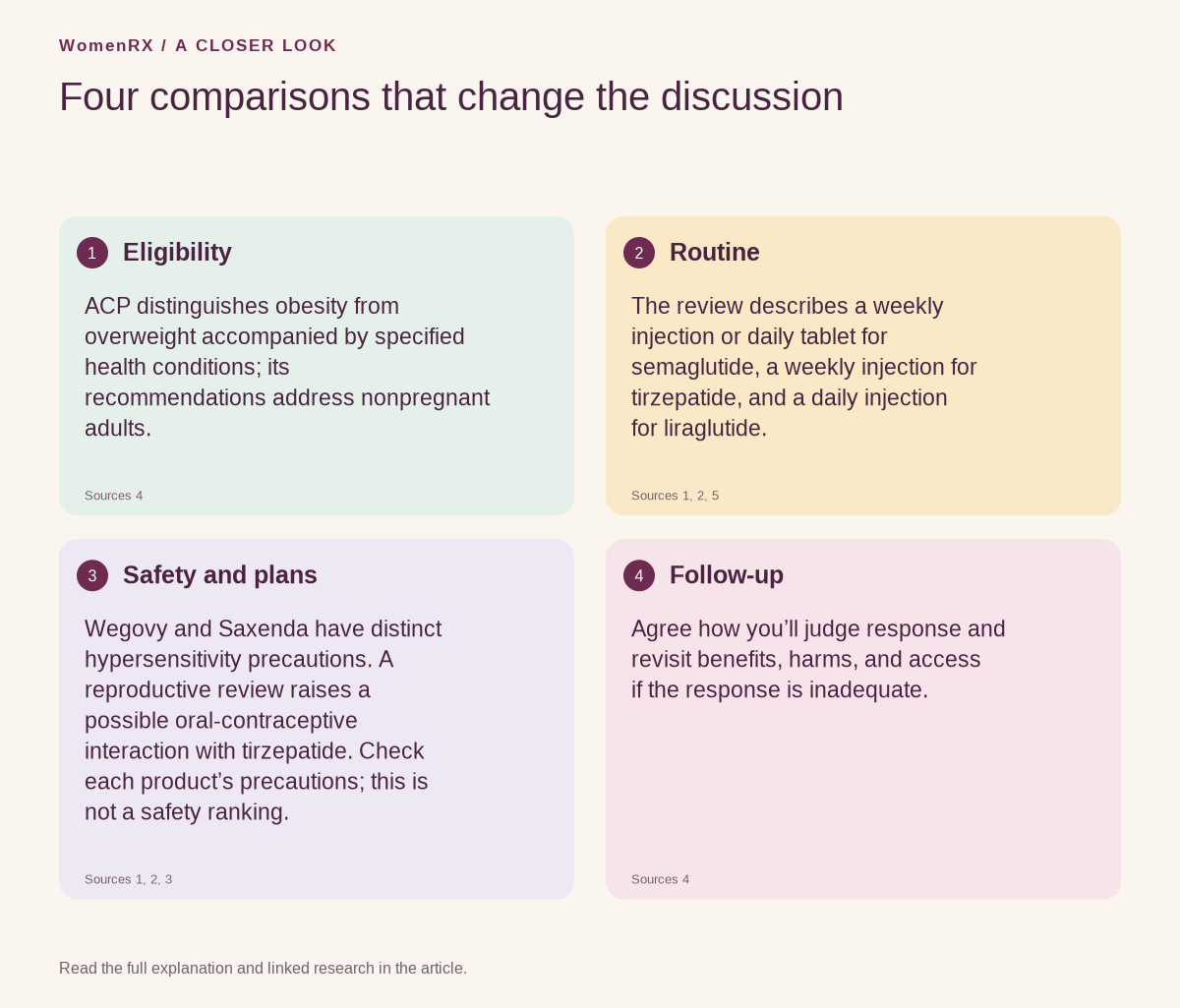
Four comparisons that change the discussion
Eligibility: ACP distinguishes obesity from overweight accompanied by specified health conditions; its recommendations address nonpregnant adults.4
Routine: The review describes a weekly injection or daily tablet for semaglutide, a weekly injection for tirzepatide, and a daily injection for liraglutide.125
Safety and plans: Wegovy and Saxenda have distinct hypersensitivity precautions. A reproductive review raises a possible oral-contraceptive interaction with tirzepatide. Check each product’s precautions; this is not a safety ranking.123
Follow-up: Agree how you’ll judge response and revisit benefits, harms, and access if the response is inadequate.4
Read the figure as text
Use these distinct decision points alongside the medicine-by-medicine routine table.- Eligibility: ACP distinguishes obesity from overweight accompanied by specified health conditions; its recommendations address nonpregnant adults.4
- Routine: The review describes a weekly injection or daily tablet for semaglutide, a weekly injection for tirzepatide, and a daily injection for liraglutide.125
- Safety and plans: Wegovy and Saxenda have distinct hypersensitivity precautions. A reproductive review raises a possible oral-contraceptive interaction with tirzepatide. Check each product’s precautions; this is not a safety ranking.123
- Follow-up: Agree how you’ll judge response and revisit benefits, harms, and access if the response is inadequate.4
More questions, answered
Does PCOS mean one of these medicines is the best choice?
No. A review describes early, promising reproductive findings in women with PCOS, but they don’t establish one medicine as best or prove a fertility benefit for every woman. Bring your reproductive goals into the medication discussion. 3
Can I use one GLP-1 medicine with another?
The Wegovy and Saxenda product information advises against using those medicines with another GLP-1 receptor agonist. Discuss any proposed combination or switch with your prescriber. 12
Sources you can check
- SAXENDA (LIRAGLUTIDE) INJECTION, SOLUTION [NOVO NORDISK PHARMACEUTICAL INDUSTRIES, LP] | US prescribing information and patient instructionsAccessed 2026-09-25Return to first citation
- WEGOVY (SEMAGLUTIDE) INJECTION, SOLUTION WEGOVY (SEMAGLUTIDE) TABLET [NOVO NORDISK PHARMACEUTICAL INDUSTRIES, LP] | US prescribing information and patient instructionsAccessed 2026-09-25Return to first citation
- GLP-1 Receptor Agonists and Fertility: What Is Known So Far?Becker AS, Castilhos JP, Shugair SAS, Colombo T, Hentschke M-. · JBRA assisted reproduction · 2026Return to first citation
- Pharmacologic Treatments With Lifestyle Modifications in Nonpregnant Adults With Overweight or Obesity in Outpatient Settings: A Living Clinical Guideline From the American College of Physicians (April 2026).Qaseem A, Cross JT, Harrod CS, Owens DK, Balk EM, Crandall CJ, Clinical Guidelines Committee of the American College of Physicians, Fitterman N, Gibson M, Lewis J, Mackey K, Miller MC, Obley AJ, Etxeandia-Ikobaltzeta I, Shamliyan T. · Annals of internal medicine · 2026Return to first citation
- Impact of Semaglutide, Liraglutide and Tirzepatide on Cardiometabolic Outcomes: A Comparative Narrative Review.Bawadi H, Abuhijleh H, Nofal M, Zakaria ZZ, Al-Asmakh M. · Endocrinology, diabetes & metabolism · 2026Return to first citation