GLP-1 Medicines or Bariatric Surgery: How to Compare
The choice involves more than expected weight loss: consider what each treatment asks of you now and over time.
GLP-1-based medicines and bariatric surgery are different treatment paths. Semaglutide is used to help eligible adults lose weight and keep it off, but side effects can affect treatment. Many people lose weight quickly after bariatric surgery, though some regain weight later; surgery requires lifelong follow-up. A review comparing cardiovascular outcomes cannot tell you which path would produce more weight loss for you. 236
Start with the outcome you care about
If you’re comparing a medicine with surgery, it’s reasonable to ask which might help you lose more weight. But that question alone may not settle the choice. Perhaps you’re also thinking about a weight-related health condition, how you’d manage side effects, or what treatment would fit your life over the next few years. Obesity care can include weight-loss medicines and, for some people, surgery; your health history is part of deciding which options to discuss. 1
Try naming your priorities before comparing paths. For example: “I want to improve my weight-related health, but I’m planning a pregnancy,” or “I could manage regular treatment, but I’m concerned about an operation.” Those aren’t medical findings. They’re useful starting points for a conversation about what you’re willing and able to take on.
What each path involves
A GLP-1-based medicine is a treatment you take rather than a procedure. Semaglutide is one example used to help adults with obesity, or some adults with overweight and a weight-related medical problem, lose weight and keep it off. Its prescribing information reports gastrointestinal adverse reactions, sometimes severe. In adult weight-reduction trials of semaglutide injection, severe gastrointestinal reactions were reported in 4.1% of people receiving it and 0.9% receiving placebo. That comparison describes one product and its trial groups, not the benefits or risks of every medicine in the class. If semaglutide is the option under discussion, ask how you would weigh its benefits against side effects as treatment continues. 2
Bariatric surgery isn’t one operation. Different procedures limit how much food you can take in; some also change digestion and nutrient absorption. Many people lose weight quickly afterward, but some weight regain can occur. Following diet and exercise recommendations can help keep most of the weight off. Surgery carries risks, including infection, hernias, and blood clots, and requires medical follow-up for the rest of your life. Unlike deciding whether to continue a medicine, choosing a procedure means living with its changes to food intake and, for some procedures, nutrient absorption. Ask which procedure is being proposed and what its particular recovery, eating changes, and follow-up would involve. 6
Neither path comes with a promise that your weight will follow a straight line. MedlinePlus notes that many people lose weight quickly after bariatric surgery but regain some later. In a US study of insured adults with both type 2 diabetes and obesity who started GLP-1 receptor agonists, 53% were still using the treatment they started at one year. That study describes treatment use in that population, not how well a particular medicine will work for you or how long you should take it. 64
Compare the evidence for the outcome you want
The studies behind a medicine’s reported result and a surgery result may involve different people, comparison groups, and follow-up periods. Putting two percentages side by side doesn’t make them a fair personal prediction. A review of cardiovascular outcomes found that bariatric surgery was associated with reductions in major adverse cardiovascular events, heart failure, and heart attack compared with controls. GLP-1 receptor agonists were associated with fewer major adverse cardiovascular events compared with controls, while their findings for heart failure and heart attack were not statistically significant. The review combined direct and indirect evidence and found substantial variation across studies. It examined cardiovascular outcomes, so it does not settle which path is likely to produce more weight loss for you. 3
A useful question is: What outcomes can you estimate for someone with my health history, and what uncertainty remains? Ask separately about weight and the conditions you want to address. Then compare the commitments: for medicine, what taking the specific product and reviewing its benefits and side effects would involve; for surgery, what recovery from the proposed procedure and lifelong follow-up would involve. Find out which options are available to you and what you would pay out of pocket for each. 26
Bring your plans into the same conversation
If pregnancy is possible or planned, say so early, even if you haven’t decided on a timeline. Ask how that plan affects the choice of treatment, when it might make sense to revisit the decision, and who would coordinate your care. The same approach can help if you’re postpartum or your priorities are changing during perimenopause: describe what’s happening in your life rather than assuming one treatment is automatically better for your life stage.
You also don’t have to treat this as a once-and-for-all vote between medicine and surgery. Your response, preferences, and circumstances may change. Researchers are studying tirzepatide after gastric bypass in people with persistent obesity, but a published description of that small trial reports its design and baseline characteristics, not whether the added treatment worked. It shows why a future care plan is a fair topic to raise, not why you should expect to need both treatments. 5
For a productive discussion, leave with answers to three distinct questions: What are we trying to improve? What will this option require from me now and later? What would make us change course? Those answers make the tradeoff more personal than a headline weight-loss figure.
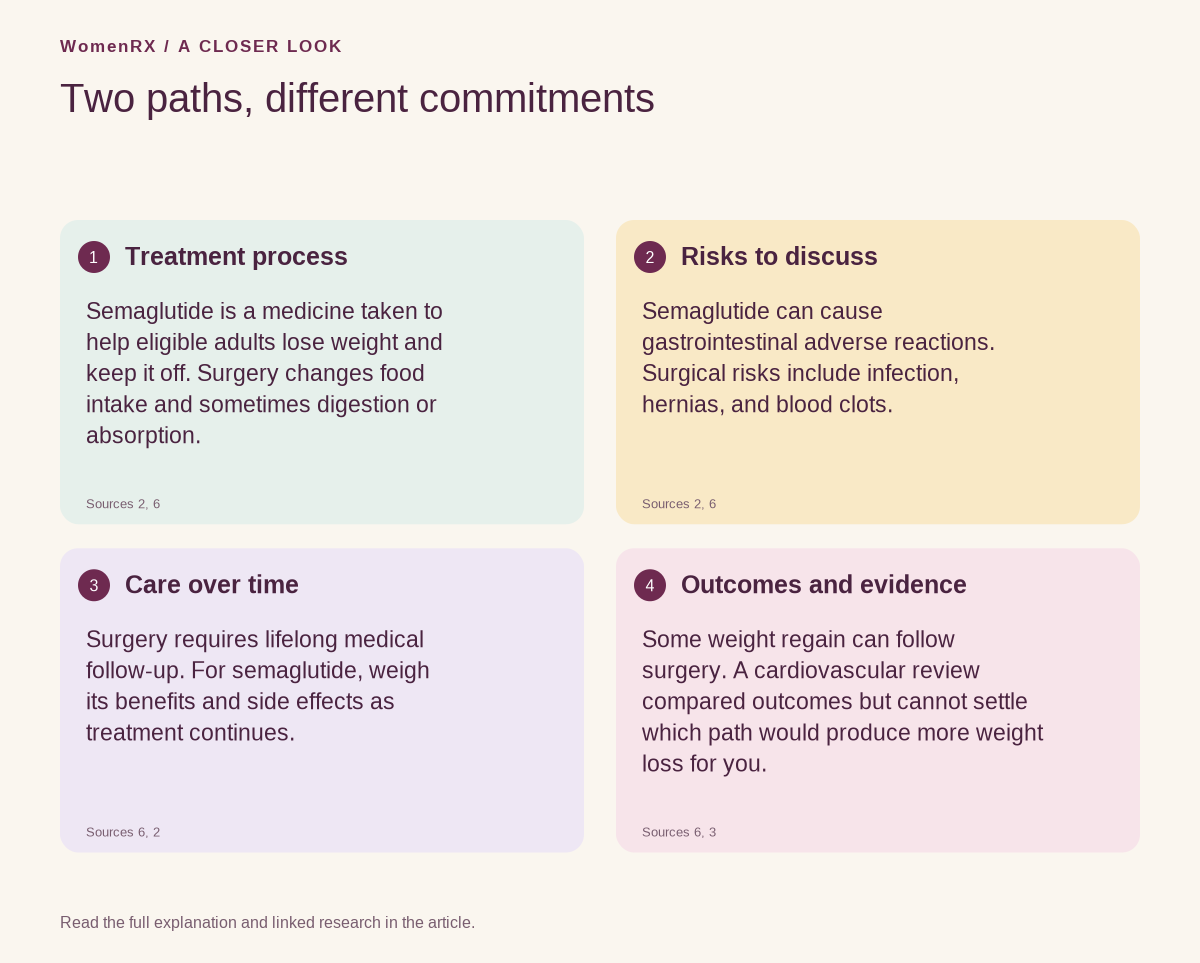
Two paths, different commitments
Treatment process: Semaglutide is a medicine taken to help eligible adults lose weight and keep it off. Surgery changes food intake and sometimes digestion or absorption.26
Risks to discuss: Semaglutide can cause gastrointestinal adverse reactions. Surgical risks include infection, hernias, and blood clots.26
Care over time: Surgery requires lifelong medical follow-up. For semaglutide, weigh its benefits and side effects as treatment continues.62
Outcomes and evidence: Some weight regain can follow surgery. A cardiovascular review compared outcomes but cannot settle which path would produce more weight loss for you.63
Read the figure as text
Use these distinctions to compare what treatment would involve, not to assign either path a score.- Treatment process: Semaglutide is a medicine taken to help eligible adults lose weight and keep it off. Surgery changes food intake and sometimes digestion or absorption.26
- Risks to discuss: Semaglutide can cause gastrointestinal adverse reactions. Surgical risks include infection, hernias, and blood clots.26
- Care over time: Surgery requires lifelong medical follow-up. For semaglutide, weigh its benefits and side effects as treatment continues.62
- Outcomes and evidence: Some weight regain can follow surgery. A cardiovascular review compared outcomes but cannot settle which path would produce more weight loss for you.63
More questions, answered
Does bariatric surgery eliminate the need for follow-up?
No. Weight-loss surgery requires lifelong medical follow-up. Some procedures change nutrient absorption, and following diet and exercise recommendations can help people keep most of the weight off after surgery. Ask what follow-up would look like for the specific procedure being discussed. 6
Can medicine be considered after bariatric surgery?
It can be a topic for discussion if weight or weight-related health concerns persist. A small randomized trial is studying tirzepatide after gastric bypass in people with persistent obesity, but its published design report does not provide treatment results. 5
Sources you can check
- Obesity: MedlinePlusAccessed 2026-09-25Return to first citation
- WEGOVY (SEMAGLUTIDE) INJECTION, SOLUTION WEGOVY (SEMAGLUTIDE) TABLET [NOVO NORDISK PHARMACEUTICAL INDUSTRIES, LP] | US prescribing information and patient instructionsAccessed 2026-09-25Return to first citation
- Comparative Cardiovascular Outcomes of GLP-1 Receptor Agonists Versus Bariatric Surgery: A Systematic Review and Network Meta-Analysis.Shirmohammadi E, Ghasemloo N, Ebrahimi N, Mohammadzadeh N, Ehtemami A, Babaei M, Fardoost S. · Endocrinology, diabetes & metabolism · 2026Return to first citation
- Trends in utilization of glucagon-like peptide‑1 receptor agonists, sodium-glucose cotransporter‑2 inhibitors, and metabolic bariatric surgery in U.S. adults with diabetes and obesity.Wartko PD, Zhang R, Johnson E, Begle C, Bobb JF, Chen C, Singh A, Ross L, O'Connor PJ, Arterburn D, McCoy RG. · Diabetes research and clinical practice · 2026Return to first citation
- GLP-1 Receptor Agonists Post-Bariatric Surgery (GRABS) Trial: Rationale, Design and Baseline Characteristics.Samuels JM, Williams CR, Patel MB, Self WH, Funk LM, Roumie C, Spann MD, Northup CJ, Ye F, Irlmeier R, Sohn I, Zhu Y, Niswender K. · Diabetes, obesity & metabolism · 2026Return to first citation
- Bariatric Surgery | Weight Loss Surgery | Gastric Bypass | MedlinePlusAccessed 2026-09-25Return to first citation